
Season Pass Podcast Interview

We had the pleasure of being interviewed at the Gold Striker media day by the great Doug Barnes of “The Season Pass” podcast. Check out the interview about halfway through at the link below:
Can’t wait to talk up “Lost Parks” some more in the future, Doug!
iTunes:
https://itunes.apple.com/podcast/the-season-pass-the-essential/id268430539
Direct Link:
http://traffic.libsyn.com/seasonpasspodcast/The_Season_Pass_235.mp3

How to use YouTube to Combat Cell Phones on Coasters

Seems counter intuitive, right? How can the very thing that allows dangerous, illegal POV video to be so popular be used to stop it? Well, read on and find out:
Arguably, cell phones are one of the greatest inventions of the past century – the convenience of being on contact whenever, where ever. The freedom to upload photos and videos at any moment – including while guests are on your rides and attractions.
You don’t have to hear me tell you that cell phone filming on rides is an epidemic in our industry. It’s pushing insurance premiums higher and higher. A projectile of that density, loose at 65mph could be several injury lawsuits just waiting to happen, not to mention the bad publicity in the media.
Before the Gold Striker wooden roller coaster even opened to the public at California’s Great America this past month, guests were seen filming on the ride using cell phones. When opening day came, the second train of the day that featured general public passengers had three (3) cell phones out.
“But we already provide guests with storage options while they’re on rides!”
Sadly, that doesn’t matter. The mentality of guests today, specifically Millennials, is to not experience the ride they’re on, but to record and share the experience with all their friends. The more “Likes” on Facebook, the higher “Thumbs Up “ count on YouTube, the better.
“But, it’s free publicity!”
Yes, it is free publicity – telling everyone online that it’s okay to film on your rides – and risk the safety of everyone around them. It’s nothing a good marketing campaign of your own marketing team couldn’t accomplish (see #3).
So how then, does your park stop this major liability and potentially lower your insurance premiums at the same time? It’s actually a simple, three step process:
1.) When it Comes to your Park’s Policies, “Grow a Pair”
Stark as it is, it needs to be said. For so many years, park guests have received warnings about what NOT to do at a park. They’ve received so many that they’ve become complacent to them. A good comparison would be to think about the last time you actually picked up a safety card in an airplane and read it. That’s the same mentality going on with your younger guests.
Also to consider – Millennials expect warnings. They’re willing to go right up to the warning and only back down when confronted. This is a generation where “everybody’s a winner,” and there’s little to no consequences to their actions. If your sign says “anyone caught with a camera on a ride will be removed from the park” then DO IT. (While deleting or confiscating the offending device.) The only way to change guests’ behavior is to show them that you mean business.
For example, Six Flags New England has a single warning sign at every high profile attraction. It reads, “Any cell phone or filming on this ride will result in immediate ejection from the park, no refunds and a 5 year ban from the park.” That gets people’s attention. In addition, all of their ride auto spiels also include a warning: “Anyone using a cell phone or MP3 payer to record while on the ride is subject to immediate dismissal from the park by Six Flags Security.”
The Santa Cruz Beach Boardwalk goes a step further. Ride attendants actively monitor the lift hill of the Giant Dipper roller coaster via security video. If a cell phone or other recording device is seen, the ride is immediately stopped and will not start again until the offending device is put away. If the device re-appears after the lift, security is called to wait at the station, takes away any tickets or passes the guest may have and is escorted immediately off park property.
Now that you’ve taken the first steps to stem the flow of content at the source, it’s time to move onto where the content lives…online.
2.) Actively monitor and police social media, especially YouTube.
This should go without saying, especially if you read my last post – but if you don’t watch your social media channels continuously, you’re in for a shock…
What’s your signature ride at your park? Go ahead and search it on YouTube, I’ll wait…
Okay, you’re back? Great – how many results came up? Each one of those videos are potential lawsuits from injured guests, who will blame you for allowing people to film on rides. The real scary part – these are only the videos that were tagged properly on YouTube – many more could potentially exist without proper tagging or incorrect spellings. (Not to mention Facebook videos as well.)
Remember, this is your property people are filming on. You are well within your rights as a park to have videos on YouTube flagged or taken down for safety, security or other reasons.
Use the ban as an opportunity. In the complaint, be sure to add a link to an authorized POV (point of view) video that came from the park, with a friendly reminder to not film on rides.
Some park-centric websites have gone so far as to monetize videos filmed at parks . Yes, you heard me correctly – they were filming commercially – and they paid none of your fees, had no insurance coverage AND you didn’t even know they were there. You wouldn’t allow a film crew to just wander around the park without your spokesperson, so why would you allow this?
3.) Film (and share liberally) professional, on-ride video that you created or authorized.
Gone are the days of needing a film crew, jibs, cranes and more when it comes to making high quality video. A simple GoPro Hero with accompanying mounts will run your department about $400-$450 after tax. That’s a small price to pay to avoid millions in lawsuits.
Mount the camera on either the handlebars of the front car, or via the suction cup mount to a flat, non-porous surface. Duct tape can be used to stabilize the rig, but it’s not necessary in many cases. Never use any footage that could come across as shaky, or handheld. You’ll run the risk of having it look too much like a cell phone video; guests will be only encouraged to film on their own.
Now that you have authorized POV, post your video everywhere – not just on YouTube. Link to it via your other social media outlets – have it available for download for free (just be sure you include your personal watermark to show it’s really from the park). Have a QR code posted near the ride exit, so guests can scan it and receive a link to the video. It takes the work (and risk) of filming on a ride out of the hands of the guests – it’s already been done for them!
Combine that with active monitoring and better training for ride attendants, and you’ll see a significant decrease in after the ride and receive it on their phone. Take all the work out of guests filming and put it on yourself – you will see results quickly and hopefully, watch your insurance premiums decrease as well.
Review my prior posts about “Social Media and the Amusement Park” here.
About the Author:
Kris Rowberry has been following the amusement industry for over 15 years. He is the creator and host of both “The Lost Parks of Northern California” and “Great American Thrills®“
KGO Interview

KGO 810 AM here in the Bay Area interviewed me this past Friday on the “Lost Parks” series. Hopefully, it’s the start of people discovering my little series!
For those who missed it – check it out!
Lost Parks, Episode 1 – San Mateo’s “Pacific City”
Ladies and Gentlemen, may I present to you, episode one of, “The Lost Parks of Northern California,” featuring San Mateo’s “Pacific City.”
Be sure to like our video, comment on it, subscribe to our channel and share with your friends! We’re on Facebook, Google+ and Twitter!
You can also follow the American Coaster Enthusiasts (my partner on this journey) at www.ACEonline.org or www.ACEnorcal.org
Enjoy!
Why Buy New – When You Can Buy USED?
Fans of the Santa Cruz Beach Boardwalk should recognize this coaster “under construction.”
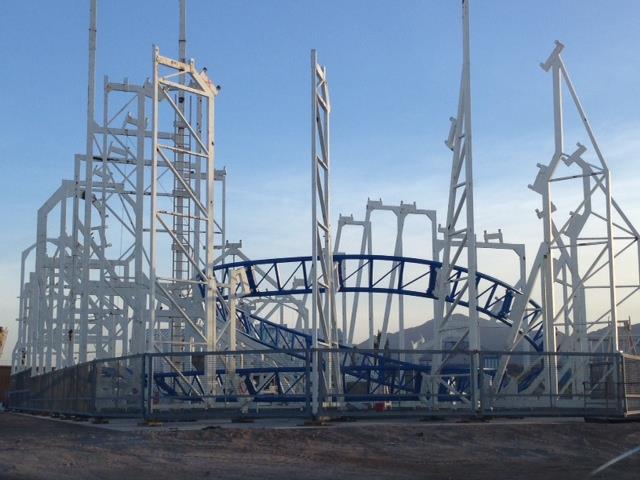
Yep, it’s the former Hurricane, with a new coat of paint and in a MUCH LESS salty environment (Not to mention drier, too!)
When old roller coaster or thrill ride eventually gets retired (Woodies are the lone exception – as they’re constantly being replaced) many of them are actually sold to smaller, “mom and pop” parks where they’re appreciated for many years after their first installation.
There’s even websites, such as this one, which could be considered the “Craiglist” of the Coaster – where all sorts of new and used rides are bought, sold and traded between parks.
So unless your favorite ride was completely torn down…
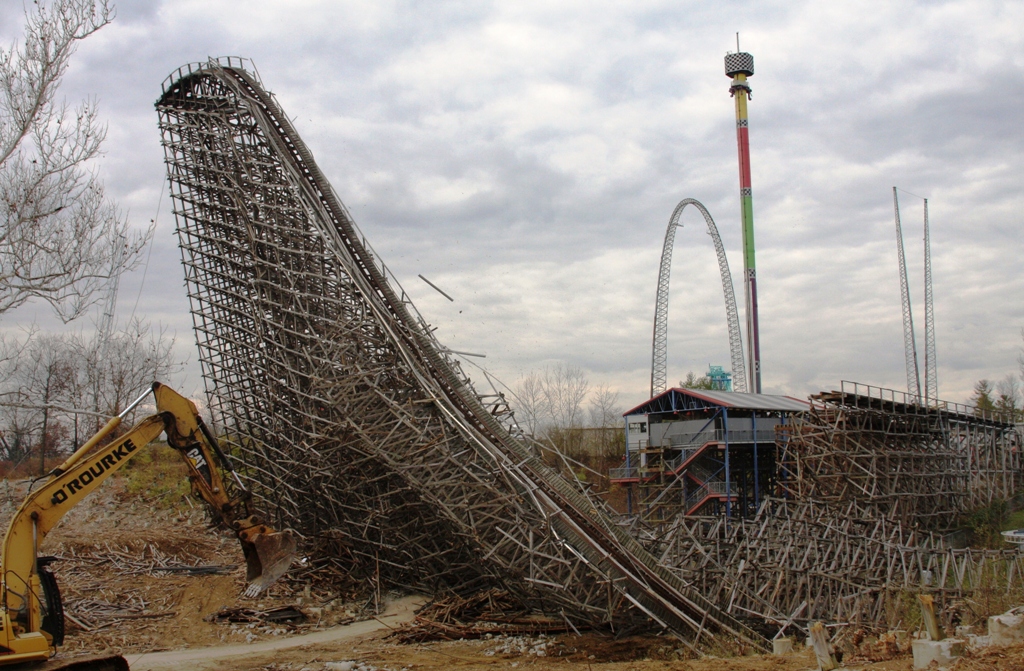
…there’s a good possibility that it was just “re-located.”
Now, the thrill of the chase is on!
The art of the on-ride photo
In a way, they’ve become more than just part of the amusement park experience – they have become attractions in their own right…
The on-ride photo – a way for parks to make more money off you – and a way to prove to Grandma and your friends that you really did ride “The Comet” after all…
The magnum opus of these cameras is surely mounted upon Disney’s Splash Mountain. Just about everyone has heard of “Flash Mountain” a place where fans (and even Disney employees) would post photos of ladies showing off their “Zip a Dee Doo Dahs” during the climactic final plunge on the flume.
Sadly, showing your “Briar Patches,” – while hilarious – can get you kicked out of the park. And the photo it took? Deleted forever before anyone could see or print it.
Unfortunately, some of these stunts (as funny as they can be) are also quite dangerous. Loose objects in the past decade have contributed to significant injuries or even malfunctions of rides. Plus, parks’ aren’t huge fans of saddling more liability insurance because you and your dumb little buddies decided to sneak a RAZOR aboard the ride…
So, here now are some of the best (SAFE) on-ride photos from around the web:

Why not get the whole family involved?
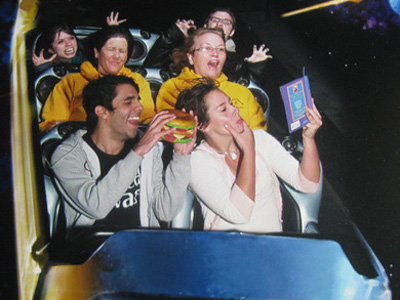
Space Mountain never looked so…interesting?

Ah yes – the singular “group” pose – always a classic!

The eyes tell the story!

Now if only they were on Ghostrider – this would be totally in theme with the ride!

I really don’t know where to start with this one – it’s perfect in every way! DeNiro battles the Russians on his namesake, with press and fans behind them! (Even the ref has GLOVES on!)

Don’t you wish your girlfriend was as awesome as her?

No, this is NOT photoshopped – talk about timing!

Well, the Beast IS the longest roller coaster in the US – over 30 years after it opened. Is it really that boring, though?
(I certainly don’t think so!)
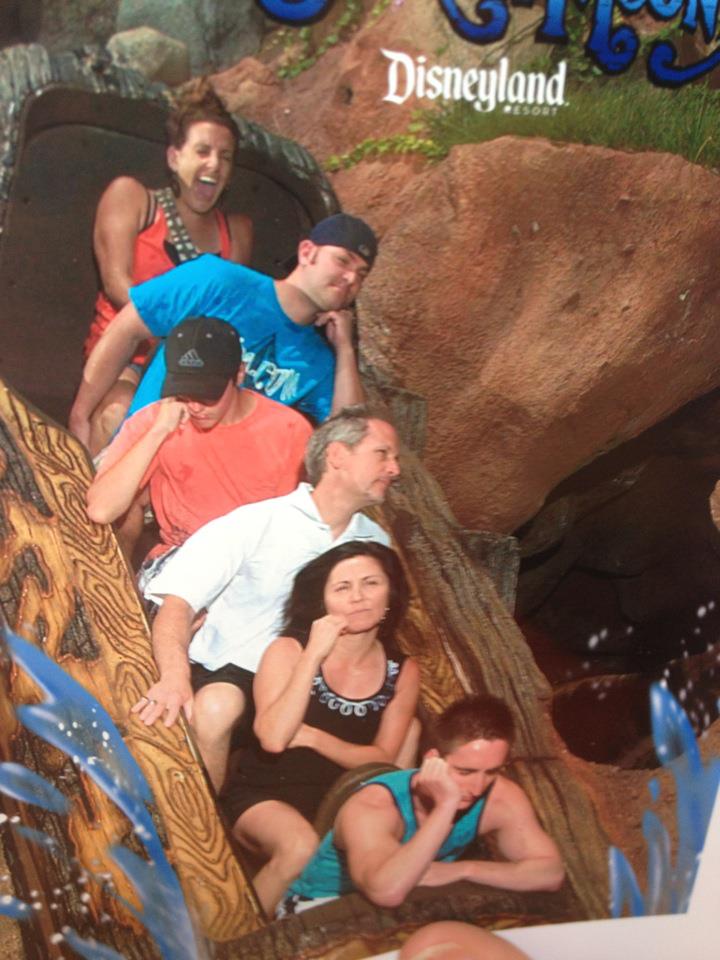
Continuing with the “boring” theme – here’s my good pals the LaPutka’s doing their best on-ride pose via Splash Mountain!

“Dad, whatever you do – please don’t embarrass me in front of my friends!”

“Just catching up on the news while we plummet down to the Briar patch…”

And finally – what better way to finish this post than with a Tebow Tower of Terror!
Official Trailer – “The Lost Parks of Northern California”
The wait is over – no more screen captures – this is the OFFICIAL trailer to the “Lost Parks” series! Look for the debut episode, featuring San Mateo’s “Pacific City Resort” to debut right here on March 29th, 2013!
“Won’t You Come and Play With Us?”
Longtime residents of the South Bay remember this park by a much different theme.
Howdy, partner! Can you name this ‘dem here lost amusement park of San Jose, CA?
We’re hoping to have the video completed for this park by July (fingers crossed!)
Rough Cut is Complete!
It’s been a long time coming, but I’m happy to announce that our first episode has made it to the “rough cut” stage!
Folks, it almost looks like a proper television program!
Stay tuned for announcements on when the episode will debut…for now, here’s a behind-the-scenes screenshot of me describing why this lost park disappeared. (Hint – guests eventually POO-POOED the idea of ever coming back…)

Test Footage from our new Opening!
Anyone up to see some test footage from our latest shoot? Look forward to the final product to debut soon on our YouTube channel as well as here!
Introducing the “Lost Parks” series!
This has been a long time coming – but I’m proud to introduce the first in a series of videos on the lost amusement parks of Northern California.
Special thanks to Nick Laschkewitsch for his excellent camera work on this intro.
Enjoy, everyone!
True Enthusiasts
After observing and working in this industry for over 15 years, I’ve found there to be two types of people that enjoy amusement / theme parks in this country: those who visit to enjoy themselves with their friends and families; and those who visit the park to criticize every facet of the park or people who enjoy attractions that they do not.
I’ve dubbed them, “enthusiasts and enthusi-asses,” respectably.
I bring this up because there is an event occurring over the next few weekends along the Jersey shore that highlights this disparity within the ranks of those who consider themselves as “fans” of amusement parks – and has re-affirmed my belief in humanity.
First, a little background –

Sandy brought devastation to several seaside amusement parks in New Jersey and countless billions in damage elsewhere in the United States. Photo Credit: Master Sgt. Mark C. Olsen/U.S. Air Force/New Jersey National Guard.
Hurricane Sandy devastated the East Coast, with millions affected. Some of the most visible victims were the traditional, seaside amusement parks of New Jersey. When the first photos of the damage came in, the striking photo of a pleasure pier – with rides partially submerged in the surf – became one of the many iconic photos of the disaster. Several other seaside amusement parks, including Keansburg Amusement Park fell victim to the same fate along the East Coast’s shore.
It was a dark time for the owners of these traditional parks, many of which have been in the family for generations. With the storm still wreaking havoc, some people took to the internet to thank the hurricane for destroying certain rides, as if they somehow deserved this fate.
They never seemed to post anything about the families who had invested so much of their personal savings to purchase and install the rides; Let alone the incredible financial burden that was sure to follow.
A person who “enjoys” a specific hobby and who seems to only care about themselves and not others – I’d describe that person as an “enthusi-ass,” wouldn’t you?
So now, we come to the other side of the spectrum, to the “enthusiast.” Once the damage was fully accounted for and insurance issues resolved – the New Jersey region of the American Coaster Enthusiasts (ACE) decided that they were not going to stand for stupidity. They took to the internet, not to flame, troll or degrade an already bad situation…
No – they sprang into action.

The New Jersey chapter of the American Coaster Enthusiasts (ACE) decided to use the internet for good, by giving back to the very park that gave to them, which makes them true “enthusiasts” in every sense of the word.
The region created a repeating event they dubbed, “Dig out the Wildcat.” Its purpose: to assist the family owned Keansburg Amusement Park in removing deposited sand around their Wildcat roller coaster.
People helping people. Via the internet. Not yelling or flaming one another.
What a novel concept.
What will happen in the small, family owned amusement park on the Keansburg shore over the next few weekends is proof-positive that there still are good people in this world. Over 20 people have expressed interest in the event.
Even better, that group of people – who share the common bond of enjoying amusement parks – can unite to help out the very people that allow them to enjoy life to the fullest.
They know that there’s no opportunities for rides, or the coveted “exclusive ride time,” no – they simply want to help out their fellow human beings.
True “enthusiasts” in every sense of the word. True enthusiasts talk with action. In this case, it’s with buckets and shovels.
At least now we can see the true enthusiasts use their hands for good.
I only wish that I could get out there myself and assist them.
 Great American Thrills®