
Gold Striker Re-Opens!
After a slight delay to install an additional 70 foot long tunnel, Gold Striker is back up and running (and presumably under the decibel limit agreed to by both Prudential Real Estate Investors and Cedar Fair (owners of the park).
The park sent out this message on Facebook today:
“Great news regarding Gold Striker. An additional 70 ft. tunnel, similar to the initial descent tunnel, has been added and the ride is better than ever. Feel the rush today.”
So – no long closure (as was initially implied and worried about on some websites – this one included) and a second massive headchopper sure to add to the thrills of the ride – what’s not to love?
It’s been a long road to get here, but all fans of the park and ride can breathe a sign of relief – after seven long years – Gold Striker is finally here to stay and now open PERMANENTLY!
If you haven’t already, get yourself out to California’s Great America and ride the Best Wooden Coaster on the West Coast, GOLD STRIKER!

After a brief hiatus, Gold Striker is back up and thrilling guests after an additional tunnel was added to mitigate sounds coming from the coaster.
Gold Striker Closed Only Temporarily for Modifications
After two weeks of soft testing, a lavish grand opening ceremony and over a month of regular operation, the Gold Striker wooden roller coaster at California’s Great America is closed temporarily to allow for additional sound mitigation to be placed on the ride. But don’t hit your panic buttons – published news reports say the ride is expected to be back up and running by the July 4th holiday – NOT an extended, unknown period.
According to the City of Santa Clara’s “Smart Permit” website, Gold Striker had several criteria to meet in order for it to open permanently, the biggest of which states: “Should the additional testing reveal that the coaster is not in compliance with Condition 23 (amount of sound coming from the ride) or any applicable City ordinances, Cedar Fair shall undertake Remedial Measures, as defined in the Settlement Agt Agreement.” Apparently, the ride was just shy of making all those criteria.
Many industry watchers and local boosters see this addition to the park (and the subsequent work to ensure everyone is satisfied) as a serious commitment from corporate owner Cedar Fair, LP to both the park and the local economy.
“Cedar Fair elected to close the ride to install additional sound mitigation upgrades,” said Santa Clara Mayor, Jamie Matthews. “Those upgrades should bring the ride into full compliance with the previous settlement. I’m hoping to see it open here for the 4th of July.”
He added, “I am very happy with the way this is situation is working out – it shows responsible citizenship – that we can all work together and come to a solution.”
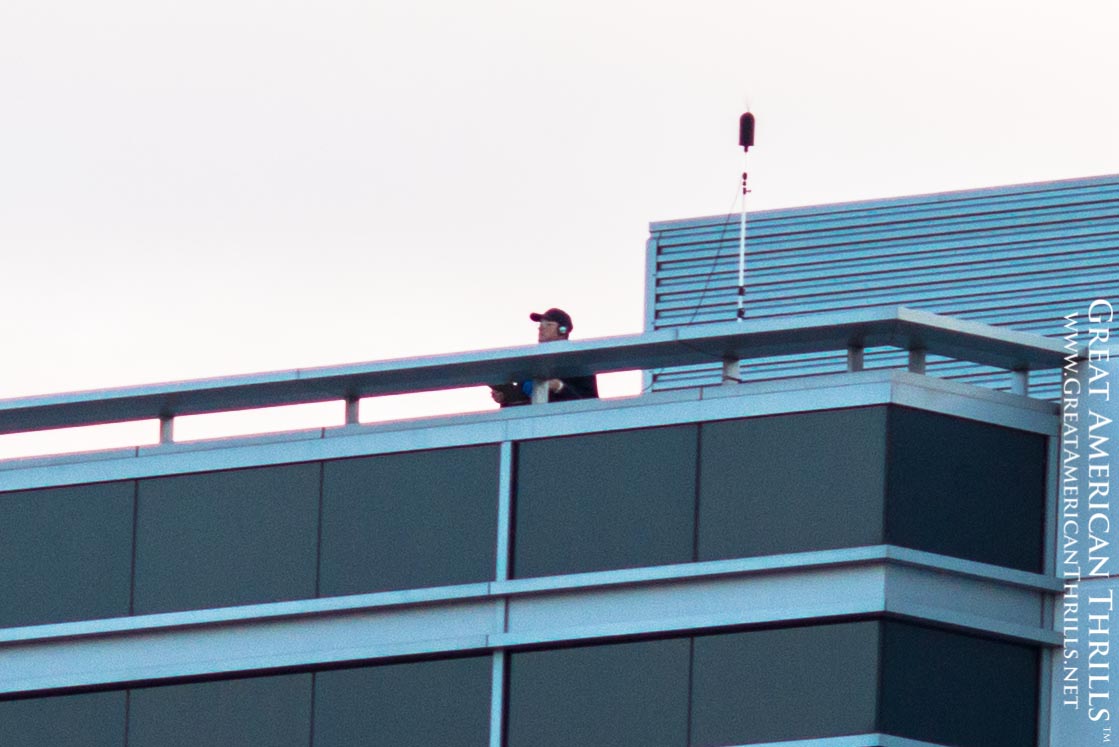
A man with recording equipment and headphones monitors the noise coming from Gold Striker from one of Prudential’s buildings.
Since “soft-opening” in May, Gold Striker has seen major additions, most notably the addition of plywood walls and white foam along the sides and underside of the track. By coincidence, these spots pass closest to or face the buildings located on Great America Parkway. During initial construction, the park added what was dubbed an, “initial descent tunnel” onto the first drop of the ride. This feature was presumably added to mitigate the sound from the first drop of the ride.
Trying to build this ride has been quite the roller coaster ride in and of itself – the plans go back to 2007, when the park first began the permitting process. In addition to the standard permits, three hearings were held on potential noise levels – all of which were initiated by appeals from the owners of the buildings closest to the proposed ride.
Billy D’Anjou, a local roller coaster enthusiast, has logged 80 circuits on the coaster since it opened in May and is hoping to hit his 100th ride in July.
“I personally don’t mind more enhancements (to the ride) but I think the whole noise mitigation issue has gotten out out of control,” he said. “In the end it makes me worry what limitations Great America will have in the future. (Prudential) should expect noise from a theme park. It’s not a library or fine art museum.”
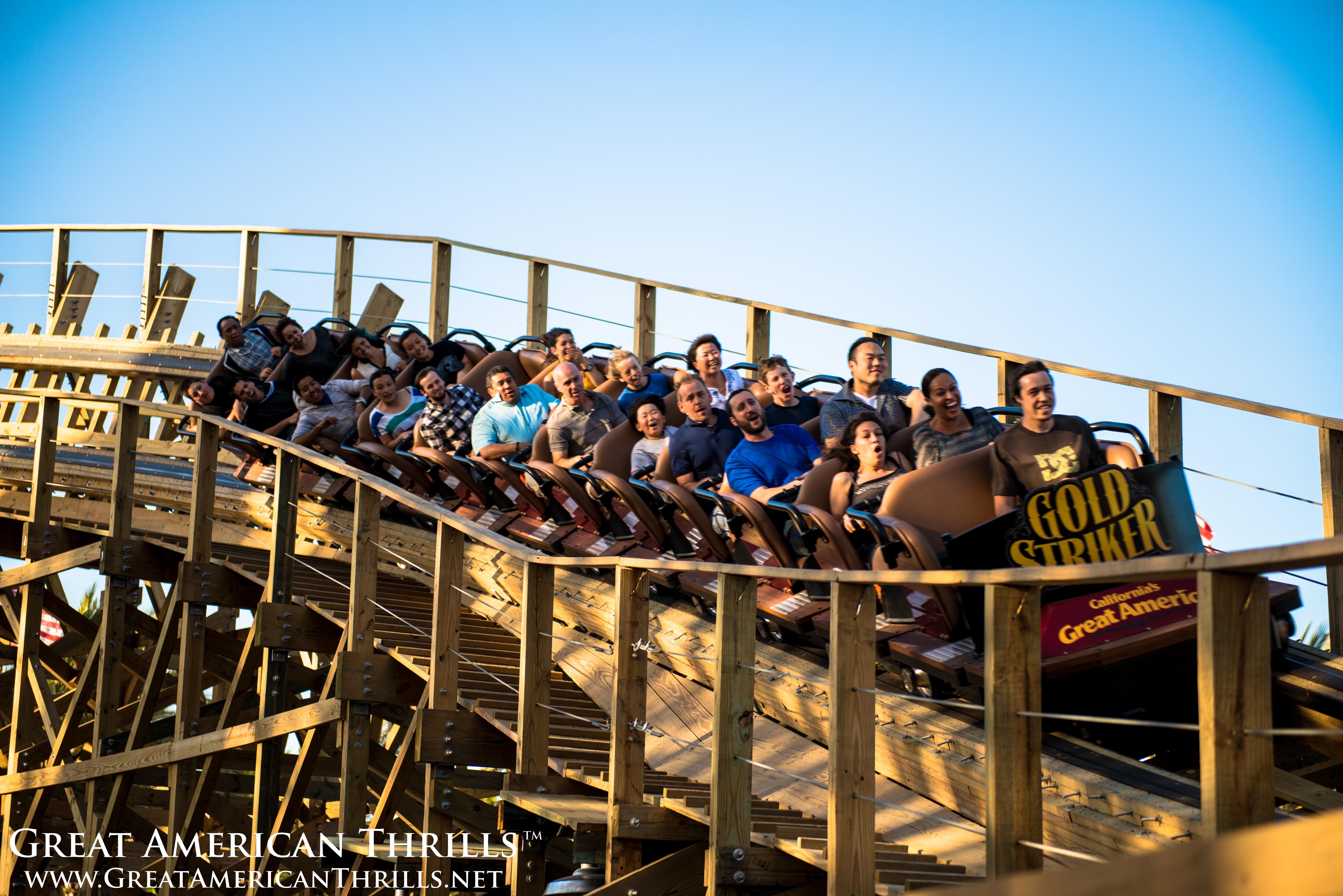
Gold Striker thrills riders on a recent operating day.
Gold Striker is the first wooden roller coaster built in Northern California since 1999. It boasts the tallest and fastest drop in Northern California and is the largest capital investment in the park in over a decade. The ride was built partially on the footprint of another ride, Willard’s Whizzer – a steel coaster that operated from 1976 to 1988.
The land that Prudential’s buildings sit on was originally an auxiliary parking lot for Great America. The land was sold in the late 90’s during the dot com boom. Prudential acquired the buildings in early 2002, according to a press release on their website.
Marriott’s Great America opened in 1976, as a celebration of America’s bi-centennial. The concept was to create a chain of parks to become an answer to Disney’s theme park empire.
Illegal POV Filming – When Will They Learn?

I hate to be a broken record – but if you’ve been reading my writings on illegal, handheld POV filming on rides – then watching this video should come as no surprise to you.
If you think filming on rides is harmless behavior – how would YOU like to be hit with a GoPro Hero3 at 55mph?
Thankfully, no one was apparently injured in this situation.
Here’s the kicker – while the ride starts well after the train has been dispatched and out of the eyesight of ride employees – the lift has not one, but TWO cameras on it. There’s got to be a better way of preventing this – and there is!
Advertising in an Amusement Park – Practice what you Preach!
This large, banner ad is currently up at Six Flags Over Texas, hanging on the outside of the “La Vibora” bobsled coaster station. It’s promoting MetroPCS – but the cute green Android figures aren’t what caught my eye…it’s the fact that the ad is encouraging people to have their phones out on rides:

It’s okay to film and photograph on rides with your phone, according to this ad – but not according to park rules and announcements.
Don’t believe me? Check out the figure with the “M” on their shirt. Yup. They’re snapping a photo while the ride is going. What’s even more troubling – they’re snapping a photo on what appears to be a swing ride – an attraction that had just debuted when I visited this year (2013); in fact, it’s the tallest in the world at 400 feet.
It also happens to be located next to the main roadway entrance to the park. Boy, that be a heck of a way to start your day when you’re driving into the park and your windshield shatters from a loose cell phone, don’t you think?
If you’ve read my previous post on this topic, this epidemic of cell phone filming is only going to become worse as the Millennial generation becomes of the age to own a cell phone. Showing ads like this, then telling them to not have loose articles aboard the ride? It just wreaks of, “What were they thinking?!?” and it’s just plain DUMB in my opinion.
Seriously – how did this ad proof get by both the corporate offices AND the local marketing officials?!?
“But loose cell phones never hit people or fall out of hands! They’re not as big of a threat as you make them out to be!”
I probably would have confided to you that I’ve never seen an injury as a result of a phone getting loose and hitting someone…though I do have proof that phones are coming loose:
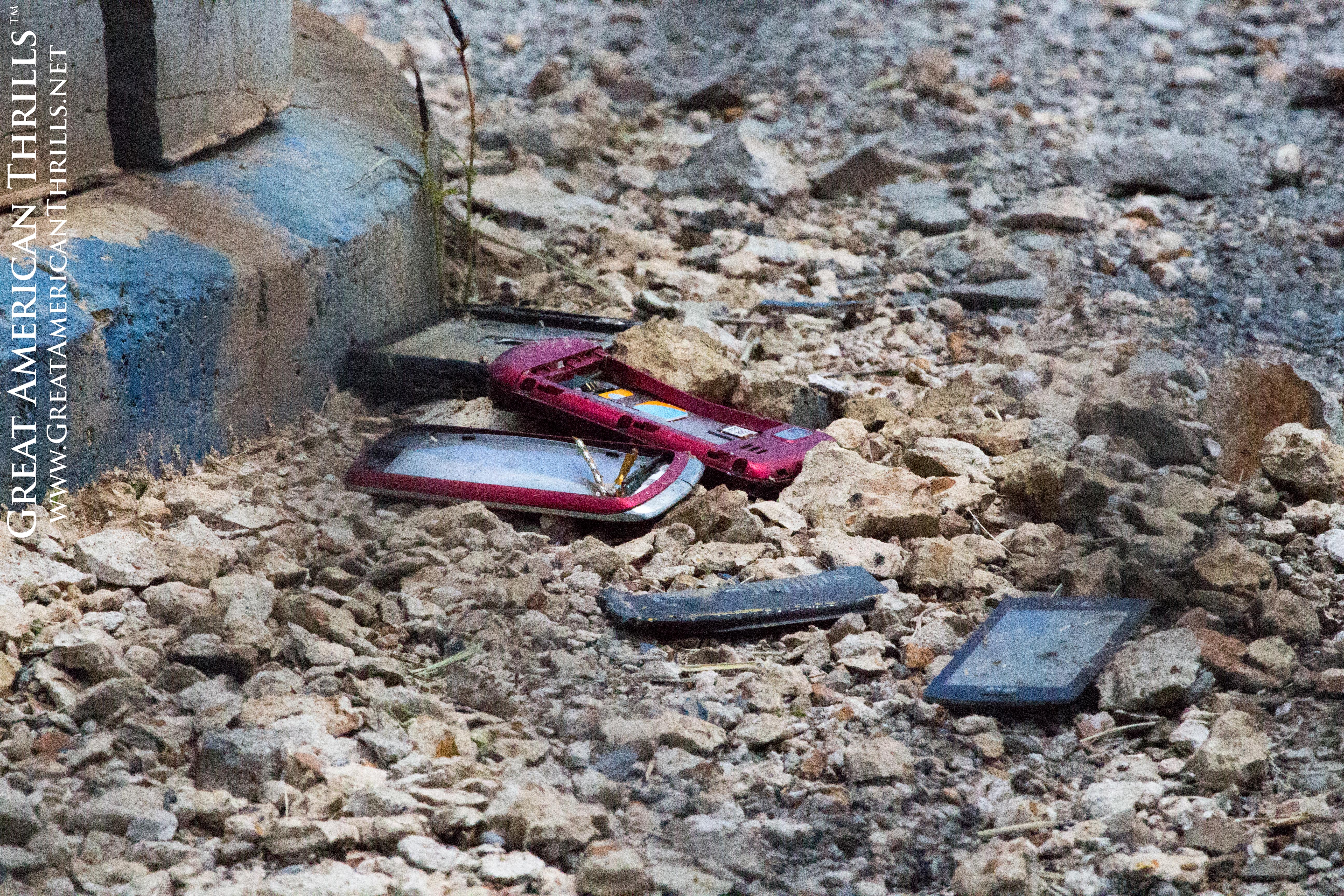
Cell phone carnage under Mr. Freeze: Reverse Blast at Six Flags St. Louis.
That was before this past weekend, however. That’s when I DID witness several people get injured by a loose cell phone at the Santa Cruz Beach Boardwalk. The guest whipped out their cell phone after concealing it on the “Double Shot” freefall tower attraction just as it launched – and wouldn’t you know it – the phone got loose, fell 125 feet and promptly smashed into guests waiting in line.
This madness simply has to stop – before someone else is either injured or outright KILLED by a flying, loose article. Ads like this aren’t doing the parks any favors. They’re literally shooting themselves in the proverbial foot.
“I think you’re reading into this ad a little too much – people don’t get encouraged by ads or do what they say…”
You sure about that? Because I’m lovin’ it.
You thought of McDonald’s just now, didn’t you? Feeling a bit hungry all of a sudden? As much as we don’ t like to think it, advertising is a very powerful tool to control behavior – so to encourage the very behavior you’re trying to eliminate in your safety spiels and park map rules is well – not the smartest move in my book.
My point is this – advertise all you want to your guests, but at the very least, practice what you preach!
Review my prior posts about “Social Media and the Amusement Park” here.
About the Author:
Kris Rowberry has been following the amusement industry for over 15 years. He is the creator and host of both “The Lost Parks of Northern California” and “Great American Thrills®“
Connecting with our Past

I’m always fascinated and shocked when we go out into the field how many people have such fond amusement park memories.
I shouldn’t be so surprised – yet are built for fun after all – but I think we all sometimes forget that we need a little fun in our lives.
Sometimes, it just takes a guy with a camera, microphone and bright light to remind us of all the good times.
How Much Posting is TOO Much on Social Media?
Continuing my series on how social media can be used more effectively at amusement parks / FEC’s – just how many times should you be posting to your social media accounts on a daily basis?
Some experts feel that the higher quality the post, the less often you have to post it, while others feel that with all the filtering being done online, the more often you post, the better chances you have of actually being seen and / or heard.
The New York Times – arguably the most respected news source in the country – posts on average, seven to eight times per day. As much as you’d like to think your attraction has that much to tell the world – it simply doesn’t.*
Posting even HALF that often is enough to turn off your potential viewers. Yes, you are being filtered by Facebook and the new algorithm – but it’s not worth over-posting if most of your “likes” are going to mute your posts or worse, mark them all as spam.
If RollerCoasterTycoon had a social media option, I’d be posting a maximum of three times a day while open, once a day when closed.
Post #1: Morning, Before Opening
Post #2: Midday
Post #3: End of Operating Day
Rotate the timing of each of these posts (i.e. Don’t post a funny / cool photo each day at 3:00pm, spice it up a little).
It should go without saying, but you simply MUST be scheduling posts – to try and keep up with each post each day will ultimately drive you nuts. To assist in keeping your sanity, a scheduling software solution, such as TweetDeck or HootSuite is an absolute must! (I’ll be going into more detail on how to use HootSuite with my #Hashtag post soon)

Also to help with keeping up with your quota – consider “banking” photos over your operating season, as well – if you can’t find anything interesting to post about one day, use one of those banked photos.
Remember that while rides are fun, most people visit parks to enjoy the fun WITH OTHERS. Highlighting unique groups in your attraction, big game winners and specific attractions is sure to bring in more views (plus more turnstiles rotating).
Fan submitted photos are also a great (and often overlooked) way to have your social media content create itself. But, as I said in my first posting on this series – never forget that the entire purpose of social media is NOT to sell to your followers directly – it’s to start a conversation and interact with them.
Once you throw up an update, be prepared to interact with people. “Like Bait,” as it’s known, has a place on Facebook, but it will never convert those eyeballs to your turnstiles unless they can feel a connection to your attraction. For instance, posting a cool photo of your roller coaster may get 1,000 likes, but people will also ask questions, too. Each one of those questions is an opportunity to connect (and THEN sell your product to them AND all their friends).
If you’re a seasonal park, take advantage of the off-season to show all the transformative work going on behind-the-scenes. Just be aware that trying to sell a season pass in the middle of the winter with a photo of a dry waterslide probably isn’t going to go very viral. However, a video of employees sliding down said slide in a bathing suit – in the snow, now THAT’S different!)
If you’re shooting your own photos to post on Facebook, Twitter and / or Google+ (and you should be) and you’re using a DSLR (i.e. NOT a cell phone camera) adding a watermark with your website or hashtag is absolutely necessary. People will inevitably share quality or memorable photos – and with watermarked information on them, your logo and website will be sitting right there in front of all those shares for consumption.


Which one of these social media update photos would YOU want to be saved as a follower’s new computer background? (Airship Ventures, 2007 – 2012)
So, don’t fill guests (or potential guests) feeds, walls or updates with tons of info, photos and sales pitches – just nurture them. There’s no reason to go crazy and post 15 Instagram shots of your newest ride. You’ll see your following grow and ultimately see more butts through the turnstiles.
In my next article, I’ll be talking about #hashtags – what are they? How can you use them to promote your attraction / FEC?
*The only exception to this rule is when your attraction is facing a crisis situation or dangerous weather conditions.
Review my prior posts about “Social Media and the Amusement Park” here.
About the Author:
Kris Rowberry has been following the amusement industry for over 15 years. He is the creator and host of both “The Lost Parks of Northern California” and “Great American Thrills®“
Season Pass Podcast Interview

We had the pleasure of being interviewed at the Gold Striker media day by the great Doug Barnes of “The Season Pass” podcast. Check out the interview about halfway through at the link below:
Can’t wait to talk up “Lost Parks” some more in the future, Doug!
iTunes:
https://itunes.apple.com/podcast/the-season-pass-the-essential/id268430539
Direct Link:
http://traffic.libsyn.com/seasonpasspodcast/The_Season_Pass_235.mp3
How to use YouTube to Combat Cell Phones on Coasters
Seems counter intuitive, right? How can the very thing that allows dangerous, illegal POV video to be so popular be used to stop it? Well, read on and find out:
Arguably, cell phones are one of the greatest inventions of the past century – the convenience of being on contact whenever, where ever. The freedom to upload photos and videos at any moment – including while guests are on your rides and attractions.
You don’t have to hear me tell you that cell phone filming on rides is an epidemic in our industry. It’s pushing insurance premiums higher and higher. A projectile of that density, loose at 65mph could be several injury lawsuits just waiting to happen, not to mention the bad publicity in the media.
Before the Gold Striker wooden roller coaster even opened to the public at California’s Great America this past month, guests were seen filming on the ride using cell phones. When opening day came, the second train of the day that featured general public passengers had three (3) cell phones out.
“But we already provide guests with storage options while they’re on rides!”
Sadly, that doesn’t matter. The mentality of guests today, specifically Millennials, is to not experience the ride they’re on, but to record and share the experience with all their friends. The more “Likes” on Facebook, the higher “Thumbs Up “ count on YouTube, the better.
“But, it’s free publicity!”
Yes, it is free publicity – telling everyone online that it’s okay to film on your rides – and risk the safety of everyone around them. It’s nothing a good marketing campaign of your own marketing team couldn’t accomplish (see #3).
So how then, does your park stop this major liability and potentially lower your insurance premiums at the same time? It’s actually a simple, three step process:
1.) When it Comes to your Park’s Policies, “Grow a Pair”
Stark as it is, it needs to be said. For so many years, park guests have received warnings about what NOT to do at a park. They’ve received so many that they’ve become complacent to them. A good comparison would be to think about the last time you actually picked up a safety card in an airplane and read it. That’s the same mentality going on with your younger guests.
Also to consider – Millennials expect warnings. They’re willing to go right up to the warning and only back down when confronted. This is a generation where “everybody’s a winner,” and there’s little to no consequences to their actions. If your sign says “anyone caught with a camera on a ride will be removed from the park” then DO IT. (While deleting or confiscating the offending device.) The only way to change guests’ behavior is to show them that you mean business.
For example, Six Flags New England has a single warning sign at every high profile attraction. It reads, “Any cell phone or filming on this ride will result in immediate ejection from the park, no refunds and a 5 year ban from the park.” That gets people’s attention. In addition, all of their ride auto spiels also include a warning: “Anyone using a cell phone or MP3 payer to record while on the ride is subject to immediate dismissal from the park by Six Flags Security.”
The Santa Cruz Beach Boardwalk goes a step further. Ride attendants actively monitor the lift hill of the Giant Dipper roller coaster via security video. If a cell phone or other recording device is seen, the ride is immediately stopped and will not start again until the offending device is put away. If the device re-appears after the lift, security is called to wait at the station, takes away any tickets or passes the guest may have and is escorted immediately off park property.
Now that you’ve taken the first steps to stem the flow of content at the source, it’s time to move onto where the content lives…online.
2.) Actively monitor and police social media, especially YouTube.
This should go without saying, especially if you read my last post – but if you don’t watch your social media channels continuously, you’re in for a shock…
What’s your signature ride at your park? Go ahead and search it on YouTube, I’ll wait…
Okay, you’re back? Great – how many results came up? Each one of those videos are potential lawsuits from injured guests, who will blame you for allowing people to film on rides. The real scary part – these are only the videos that were tagged properly on YouTube – many more could potentially exist without proper tagging or incorrect spellings. (Not to mention Facebook videos as well.)
Remember, this is your property people are filming on. You are well within your rights as a park to have videos on YouTube flagged or taken down for safety, security or other reasons.
Use the ban as an opportunity. In the complaint, be sure to add a link to an authorized POV (point of view) video that came from the park, with a friendly reminder to not film on rides.
Some park-centric websites have gone so far as to monetize videos filmed at parks . Yes, you heard me correctly – they were filming commercially – and they paid none of your fees, had no insurance coverage AND you didn’t even know they were there. You wouldn’t allow a film crew to just wander around the park without your spokesperson, so why would you allow this?
3.) Film (and share liberally) professional, on-ride video that you created or authorized.
Gone are the days of needing a film crew, jibs, cranes and more when it comes to making high quality video. A simple GoPro Hero with accompanying mounts will run your department about $400-$450 after tax. That’s a small price to pay to avoid millions in lawsuits.
Mount the camera on either the handlebars of the front car, or via the suction cup mount to a flat, non-porous surface. Duct tape can be used to stabilize the rig, but it’s not necessary in many cases. Never use any footage that could come across as shaky, or handheld. You’ll run the risk of having it look too much like a cell phone video; guests will be only encouraged to film on their own.
Now that you have authorized POV, post your video everywhere – not just on YouTube. Link to it via your other social media outlets – have it available for download for free (just be sure you include your personal watermark to show it’s really from the park). Have a QR code posted near the ride exit, so guests can scan it and receive a link to the video. It takes the work (and risk) of filming on a ride out of the hands of the guests – it’s already been done for them!
Combine that with active monitoring and better training for ride attendants, and you’ll see a significant decrease in after the ride and receive it on their phone. Take all the work out of guests filming and put it on yourself – you will see results quickly and hopefully, watch your insurance premiums decrease as well.
Review my prior posts about “Social Media and the Amusement Park” here.
About the Author:
Kris Rowberry has been following the amusement industry for over 15 years. He is the creator and host of both “The Lost Parks of Northern California” and “Great American Thrills®“
Photo of the Day: Boomerang at Six Flags St. Louis
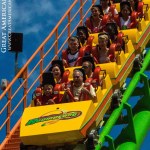
Yesterday, Six Flags St. Louis unveiled their latest coaster in their collection and Great American Thrills was there on OPENING DAY to see what the venerable Vekoma design had in store for guests.
Amazingly, the ride is SMOOTH for a Vekoma – and the park is working diligently to improve the catch on the second hill to eliminate that traditional “thud” that’s so common on this model. The ride sits between the Tidal Wave flume, Sky Screamer and venerable Screamin’ Eagle wooden coaster at the top of the park.

Big thanks goes out to my friends at BorrowLenses for allowing me to capture such beautiful photos with their gear.
Interested in purchasing / using some of my photos? Check out my 500px: http://500px.com/GreatAmericanThrills
View my videos on YouTube: http://www.youtube.com/user/GreatAmericanThrills
Follow me on Facebook: http://www.facebook.com/GreatAmericanThrills
Tweet me on Twitter: http://www.twitter.com/krowberry
+1 me on Google+: https://plus.google.com/u/1/115502587437263155125/posts
Follow me on Instagram: http://instagram.com/krowberry
Photo of the Day: Loose Articles under Mr. Freeze

This is the reason that parks don’t want you to have loose articles onboard roller coasters – because this is almost ALWAYS their fate!
Big thanks goes out to my friends at BorrowLenses for allowing me to capture such beautiful photos with their gear.
Interested in purchasing / using some of my photos? Check out my 500px: http://500px.com/GreatAmericanThrills
View my videos on YouTube: http://www.youtube.com/user/GreatAmericanThrills
Follow me on Facebook: http://www.facebook.com/GreatAmericanThrills
Tweet me on Twitter: http://www.twitter.com/krowberry
+1 me on Google+: https://plus.google.com/u/1/115502587437263155125/posts
Follow me on Instagram: http://instagram.com/krowberry
Photo of the Day: Roar! at Six Flags Discovery Kingdom
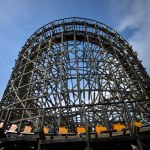
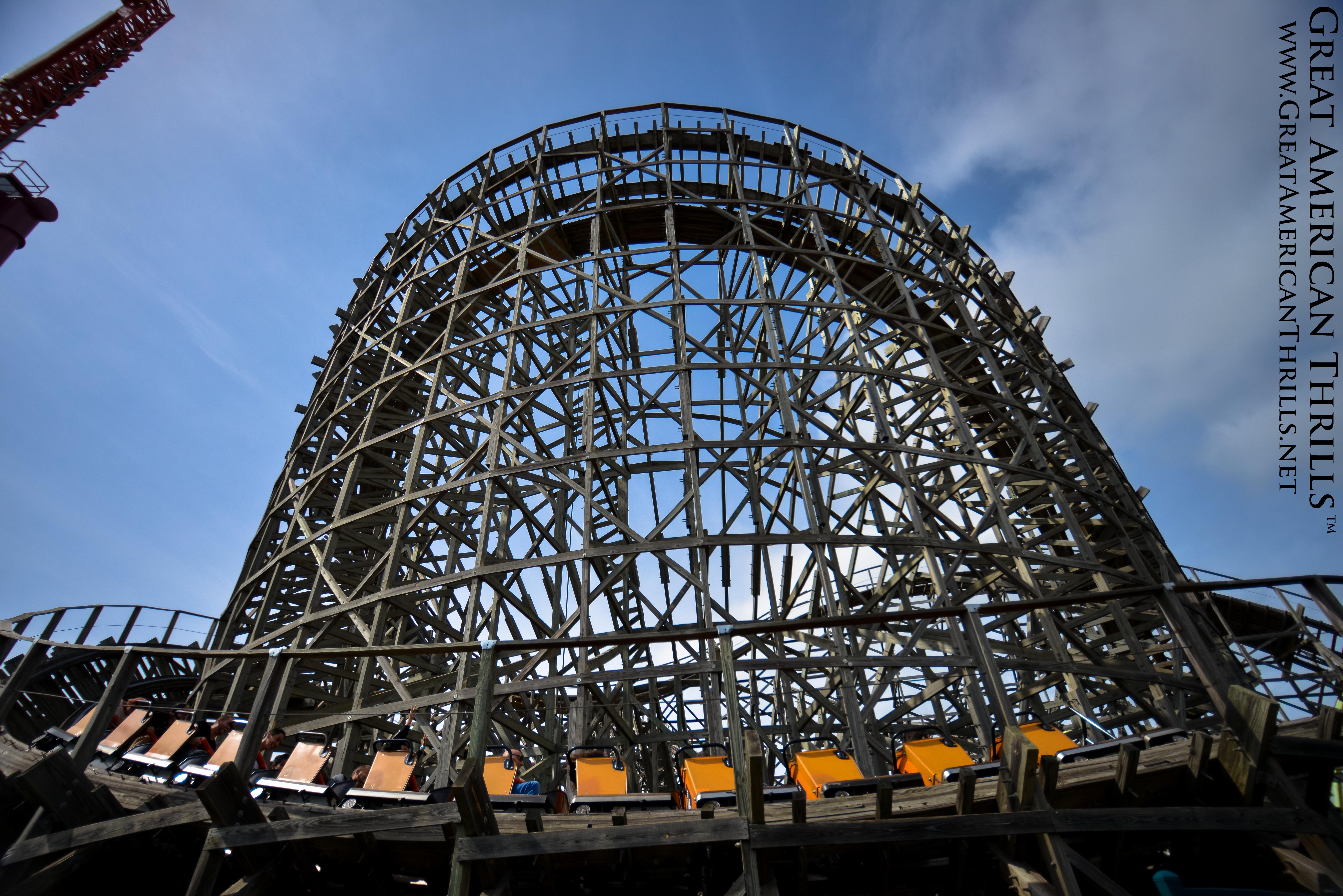
When it opened in 1998, Roar! was the first modern wooden coaster to feature “Millennium Flyer” trains. Using patents and designs from the 1920’s, Great Coasters, International were able to make this version of Roar! with tighter curves and sharper transitions, simply because the trains’ were able to negotiate them better. All GCI installations since now feature these “throwback” trains.
Sadly, this coaster has deteriorated rapidly in the past few years – and is so rough, that I’d have to recommend a PASS on riding it – which is hard to do, considering it’s amazing layout and speed.
Big thanks goes out to my friends at BorrowLenses for allowing me to capture such beautiful photos with their gear.
Interested in purchasing / using some of my photos? Check out my 500px: http://500px.com/GreatAmericanThrills
View my videos on YouTube: http://www.youtube.com/user/GreatAmericanThrills
Follow me on Facebook: http://www.facebook.com/GreatAmericanThrills
Tweet me on Twitter: http://www.twitter.com/krowberry
+1 me on Google+: https://plus.google.com/u/1/115502587437263155125/posts
Follow me on Instagram: http://instagram.com/krowberry
Star Tower POV (Point of View) Video
Need a break at work today? Then come along for quite possibly the SLOWEST point of view (POV) video that you will ever see of any amusement park ride on Earth – here’s the complete ride cycle for the 200 foot tall Star Tower at California’s Great America. That being said, you’ll see all of the major attractions of the park in action – a rare feat to capture in just one ride!
Gold Striker Video – Rider Reactions
With Gold Striker now officially open to the public at California’s Great America – enjoy this on-ride video of myself and “Lost Parks” Producer, Nicholas Laschkewitsch (who is also the ACE NorCal Asst. Regional Rep) taking in a ride.
Gold Striker NOW OPEN at California’s Great America
Yes, it’s official. As of this afternoon, the Gold Rush has officially met your adrenaline rush – GOLD STRIKER at California’s Great America is now offically OPEN TO THE PUBLIC!
Look for a full media review in the next few days – but for now, get out and enjoy Gold Striker at California’s Great America!
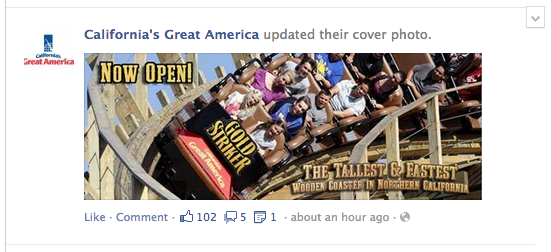
Gold Striker is officially open to the public!
Social Media and Your Amusement Park

Arguably, the biggest change in terms of marketing in the past decade has to be the meteoric rise of social media.
In the past (referred to as web 1.0), parks and attractions had fan pages or message boards that covered daily events or changes. In some cases, these outlets also promoted the park in a positive light, but that wasn’t always guaranteed.
Today (in web 2.0), parks now have the ability to schedule and control messages to potential and repeat customers on an ongoing, daily basis. Even the best television campaign could not reach such a targeted audience.
But, being relatively new to the game, many parks don’t quite understand how to use social media properly to benefit them. Sadly, in many cases, parks are shooting themselves in the digital foot.
So how then can your park or attraction avoid the most common pitfalls of social media?
1.) Social media means just that – BE SOCIAL!
The point of social media is to start (or maintain) a conversation. Whether it’s between you and your customers, or your customers and potential customers – once a story or idea starts online it can quickly lead to revenue, if it gains enough traction and virality.
However, simply throwing up a daily update on something cool about the park is not going to reach most of your audience. Just because you have 50,000 likes on Facebook, does not mean all 50,000 are seeing your post.
Not everyone enjoys pretty pictures – some are more engaged with a “What’s this Part” or “Flashback Friday” post. Create a weekly checklist of specific post types so that you can reach a greater majority of your online audience.
2.) Always promoting an item or product is social media poison.
Yes, we’re all looking for a quick return on investment, but consider this: If you throw away junk mail whenever it comes in your mailbox at home, why wouldn’t you do the same if presented with the same situation on your social media channels?
While a thinly veiled call to action is okay every now and then, it’s not good to fill your feed up with “BUY THIS!” in each and every post you put out. Simply put, lose the 1960’s “Mad Men” advertising jargon that we all have had been beaten into our heads over our lives, and be more, “real.”
That being said, don’t forget that your social media posts are a major (and instant) public-facing outlet that has the potential to reach millions if something goes awry.
Simply put, social media is not something you assign your seasonal marketing intern as a fun project. It should be a full-time position, as it can actually keep your audience engaged (and spending money) even in the off-seasons.
3.) While your park or attraction may close for the night, your social media feeds don’t.
Remember that the internet is on 24/7/365. While a majority of posts are made between 8:00am and 8:00pm, that can change depending on your audience and operating hours. Responding to posts, both good and bad, in a timely manner can mean the difference between closing a sale and losing a customer for life.
In addition, the larger your social media audience becomes, the more susceptible you become to nefarious postings, such as links to pornography on your public facing wall or feed. The faster you can pull them down, the less people will have seen it.
4.) Negative feedback on your social media feed is an opportunity, not blight.
The absolute, worst behavior a park could do when managing negative feedback on social media is to simply ignore it. There are very limited circumstances where a deleted comment or all-out ban from the page could be necessary, but if managed properly, these situations are rare.
Nothing will make an angry guest feel better than to know that someone is listening or trying to rectify the situation. Even if it’s simply re-iterating a policy that the guest does not agree with, it’s still better to show the effort to others on the feed than to delete it or worse, ignore it altogether.
5.) Stir (and track) conversation with park centric hash tags, but don’t make it too complicated
Remember the old “Kodak Photo Spot” in your park? Hash tags are the new photo spot. Create a simple one to see what people are doing and saying in your park, along with mentions of things that people may talk about, such as new attractions.
Because you’ll be tracking mentions and hash tags, you’ll quickly discover that a good majority of your social media content literally writes or creates itself. You can share guest photos, positive experiences and interact directly with them. I guarantee they’ll want to share with all their friends and family that, “…’So and So Park’ re-tweeted my pic!” That’s social media at work.
6.) Use cell phone photos only when absolutely necessary – have a DSLR with you.
Cell phone cameras are convenient, yes – but they have limitations in terms of quality. While it’s easy to post an update from inside your park via phone, try to resist. A higher quality photo – from a SLR style camera – will allow you to add logo watermarks back in the office. A higher quality photo will also encourage people to save it on their desktop or share it with others – where it will always be in front of them at work, home or their mobile device. And your logo is right there next to it.
Shares and re-tweets, however can be cell phone shots – as these are directly from guests. A higher quality photo automatically sets the parks’ content above the guests, so it becomes more recognizable.
7.) Use the outlets that work the best for your skill and for your park.
While it’s not a bad idea to get your feet in the water on as many of the popular social networks as possible – beware that they all have different audiences and content requirements. Google+ tends to be a more educated, affluent crowd. Instagram requires only photos, while Pinterest is weighted heavily towards women.
Don’t try to overreach when you first start off – go with the outlets that make most sense to you and your audience. Once you’re comfortable, slowly begin to expand. Sometimes too much of a good thing is well, too much!
Review my prior posts about “Social Media and the Amusement Park” here.
About the Author:
Kris Rowberry has been following the amusement industry for over 15 years. He is the creator and host of both “The Lost Parks of Northern California” and “Great American Thrills®“
Photo of the Day: Giant Dipper Flash-Lapse
In honor of the Coaster Guy visiting Santa Cruz, I dug through the archives to find an awesome boardwalk shot…
They say going to visit the Santa Cruz Beach Boardwalk is like stepping back in time. With the effect that I captured with this photo, it almost looks like the Morgan trains ARE going back in time, a la “Back to the Future.”
Now, if only the idiot didn’t have his cell phone out, it would have been perfect. I’ll definitely be going back this summer again – but with a tripod!
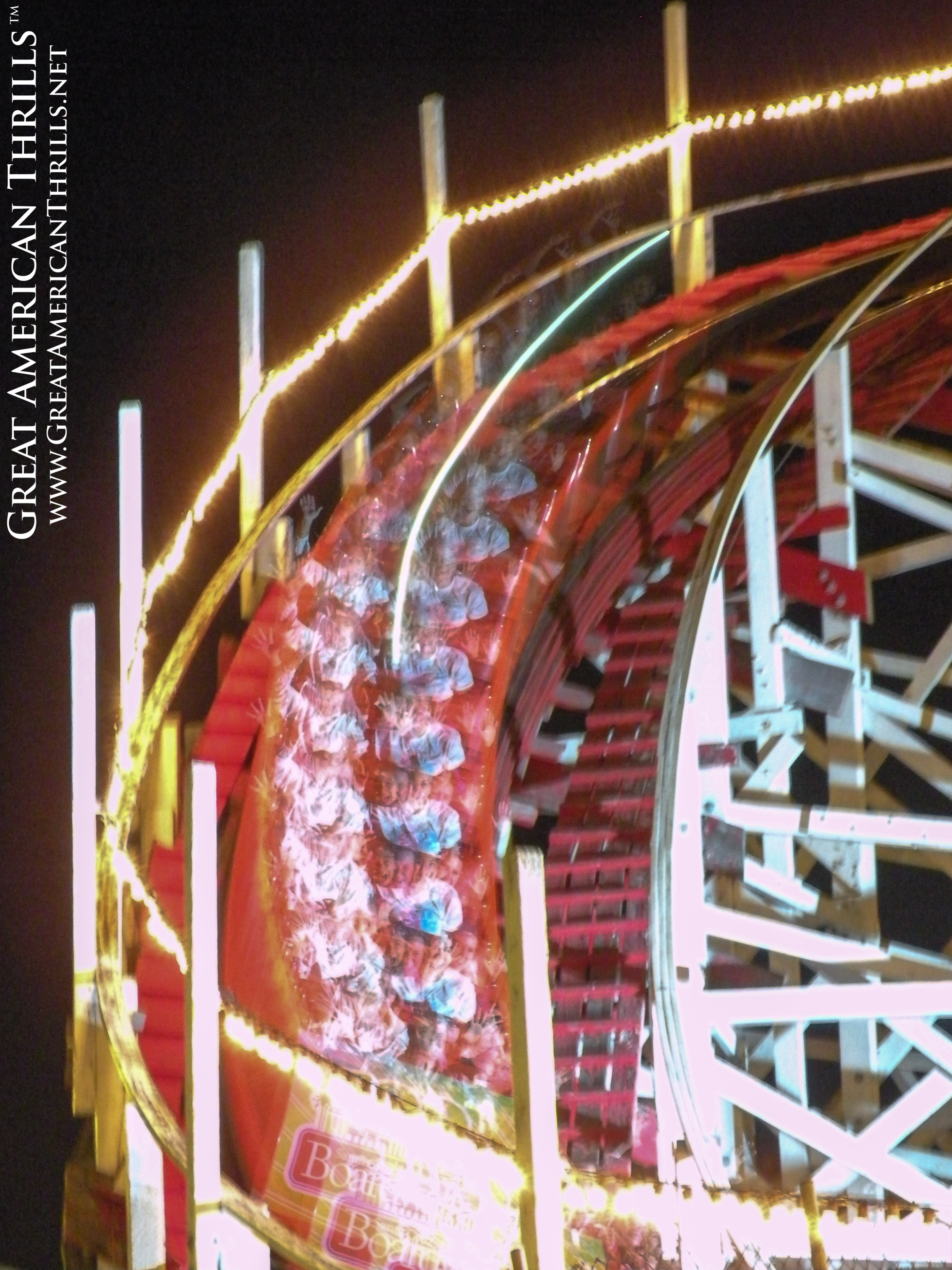
As always, a big thanks to my friends at BorrowLenses for allowing me to capture such beautiful photos with their gear.
Interested in purchasing / using some of my photos? Check out my 500px: http://500px.com/GreatAmericanThrills
View my videos on YouTube: http://www.youtube.com/user/GreatAmericanThrills
Follow me on Facebook: http://www.facebook.com/GreatAmericanThrills
Tweet me on Twitter: http://www.twitter.com/krowberry
+1 me on Google+: https://plus.google.com/u/1/115502587437263155125/posts
Follow me on Instagram: http://instagram.com/krowberry
Photo of the Day: Looff Carousel Ring Machine
As the last of the great seaside amusement parks, visiting the Santa Cruz Beach Boardwalk is like literally stepping back in time. It is home to not one, but TWO national historic landmarks (The 1911 Looff Carousel and 1924 Giant Dipper roller coaster.) Both of these federal landmarks are unique, in that people can actually ride them, rather than admire them from a distance.
This shot was one of my first forays with the stunning Canon 5D Mark III – and the results were simply spectacular. Look for the cut on the finger from the previous pass at the ring machine…now THAT’S dedication!

The 1911 Looff Carousel at the Santa Cruz Beach Boardwalk is one of only 5 left in the world with an operating ring machine.
As always, a big thanks to my friends at BorrowLenses for allowing me to capture such beautiful photos with their gear.
Interested in purchasing / using some of my photos? Check out my 500px: http://500px.com/GreatAmericanThrills
View my videos on YouTube: http://www.youtube.com/user/GreatAmericanThrills
Follow me on Facebook: http://www.facebook.com/GreatAmericanThrills
Tweet me on Twitter: http://www.twitter.com/krowberry
+1 me on Google+: https://plus.google.com/u/1/115502587437263155125/posts
Follow me on Instagram: http://instagram.com/krowberry
Photo of the Day: Carousel Columbia at “Blue Hour”

Quite simply, this is one of the best long exposures I’ve ever taken. Done with a Nikon D7100, 24-70mm lens and NO tripod – just stayed as still as possible. Columbia is still the World’s Tallest Carousel as recognized by Guinness World Records at just over 101 feet tall.

Still the tallest carousel in the world, Carousel Columbia makes for a stunning subject at night. Now, if only all the accent lighting were working…
As always, a big thanks to my friends at BorrowLenses for allowing me to capture such beautiful photos with their gear.
Interested in purchasing / using some of my photos? Check out my 500px: http://500px.com/GreatAmericanThrills
View my videos on YouTube: http://www.youtube.com/user/GreatAmericanThrills
Follow me on Facebook: http://www.facebook.com/GreatAmericanThrills
Tweet me on Twitter: http://www.twitter.com/krowberry
+1 me on Google+: https://plus.google.com/u/1/115502587437263155125/posts
Follow me on Instagram: http://instagram.com/krowberry
Cirque Dreams Splashtastic at Six Flags Discovery Kingdom (Show Review)
Yesterday evening, Six Flags Discovery Kingdom was kind enough to invite Great American Thrills™ out to the park for an exclusive preview of their latest entertainment offering – “Cirque Dreams – Splashtastic.”

The colors of the performance – just like the performers – are vibrant & stand out.
This program is unlike anything we’ve experienced here at a Northern California park – it’s very glitzy and the production value is VERY high. If you were a fan of the “Marriott Era” of entertainment offerings at, say Great America, or the quality of shows that Disney parks offer – then this show will bring back good memories for you.
It also sets a very high precedent for entertainment offerings in the coming years at all the Bay Area amusement / theme parks. (I.E. You’re on notice!) Unlike many other shows at parks which are produced in-house, Cirque Dreams – Splashtastic is a partnership between Six Flags Discovery Kingdom and Cirque Productions.
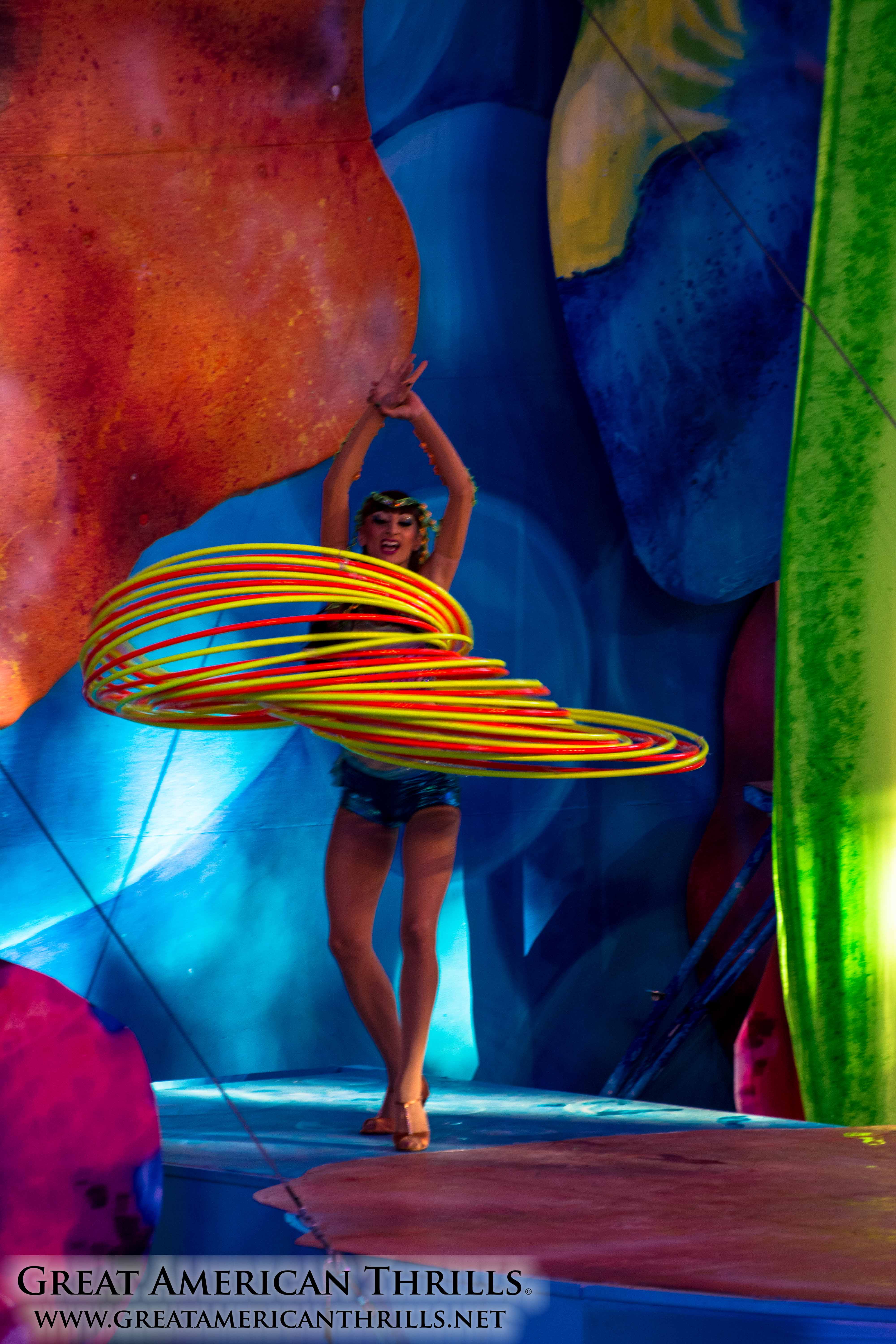
There are seven individual performances in all, this one featuring a hula loop artist.
If you’ve ever been to a “cirque” style show before, you’ll see many of those elements in the program (we can’t really call this a show – it’s much more than that). The program features a showcase of talents, that as the park says, “…combines the grace, power and agility of our bottlenose dolphins and the amazing spectacle of of true performance artists…”

If you don’t feel out of shape after looking at this, you must be one of these two performers!
As you would expect, the entire program is themed with an aquatic flair to it. Costumes mimic sea life, actors are adorned with prosthetics to give them a more “fishy” quality and the entire amphitheater (formerly Dolphin Harbor Stadium) is adorned with colorful graphics strewn about the facility.
There are seven parts to the show in all, each with their own featured characters and skills on display. During pre-production of the show, nearly 300 acts auditioned to be one of those seven featured performances.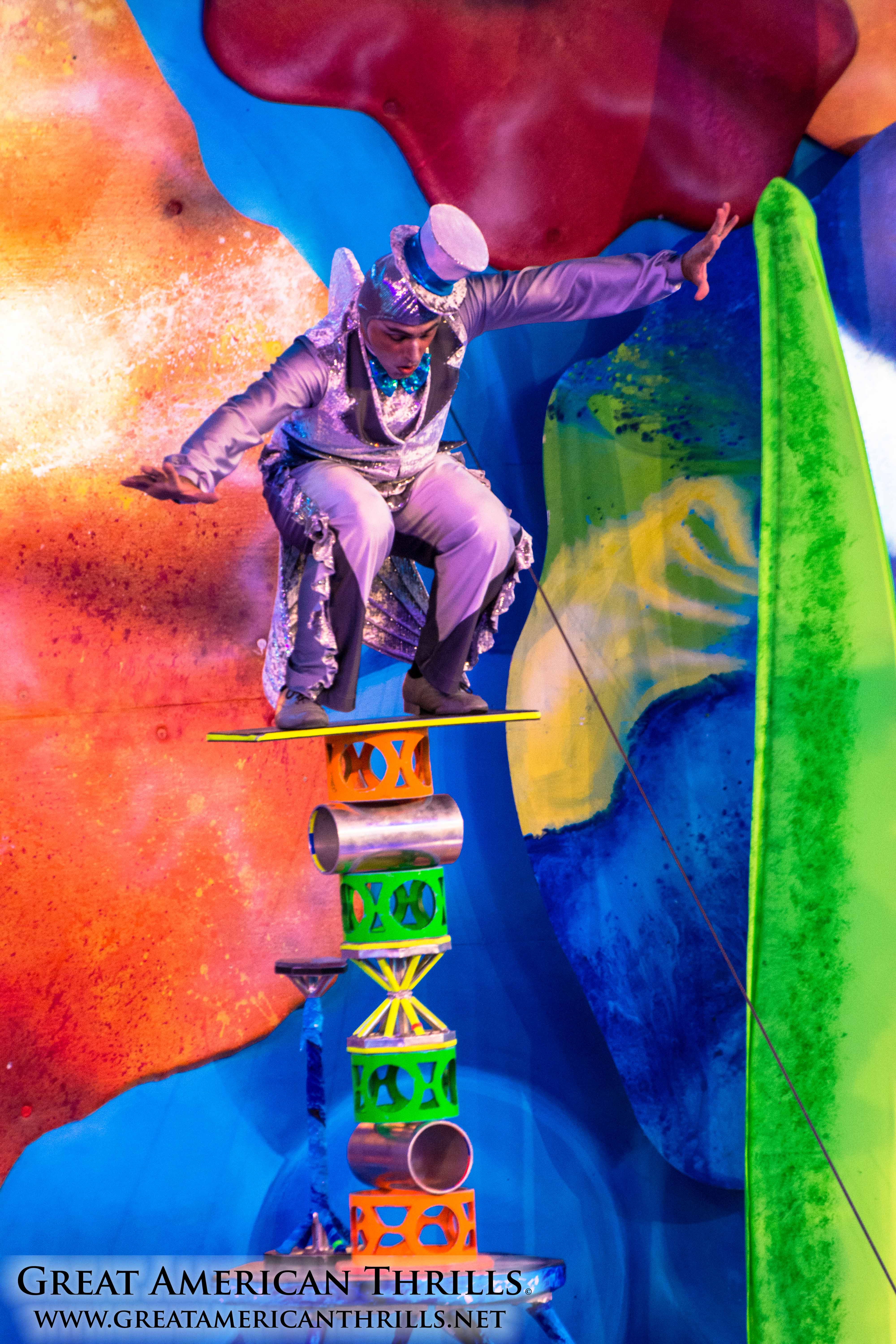
The pace is good and the program keeps moving for the most part with no real lag time. During the human performances, the dolphins show off their stuff as well, including a particularly entertaining dolphin hula hoop behavior that you’ll simply have to see for yourself.
The show was created, produced and directed by Neil Goldberg, an acclaimed Broadway director who also founded the Cirque Dreams troupe over 20 years ago. In other words, this guy knows what he’s doing.
“Our goal was to complement the personalities of the dolphins and performers through playfulness…and unparalleled showmanship,” said Goldberg. “It will be one of those unique, memorable entertainment attractions rarely experienced.”
I’ll be posting a full, exclusive interview with Goldberg later this week.
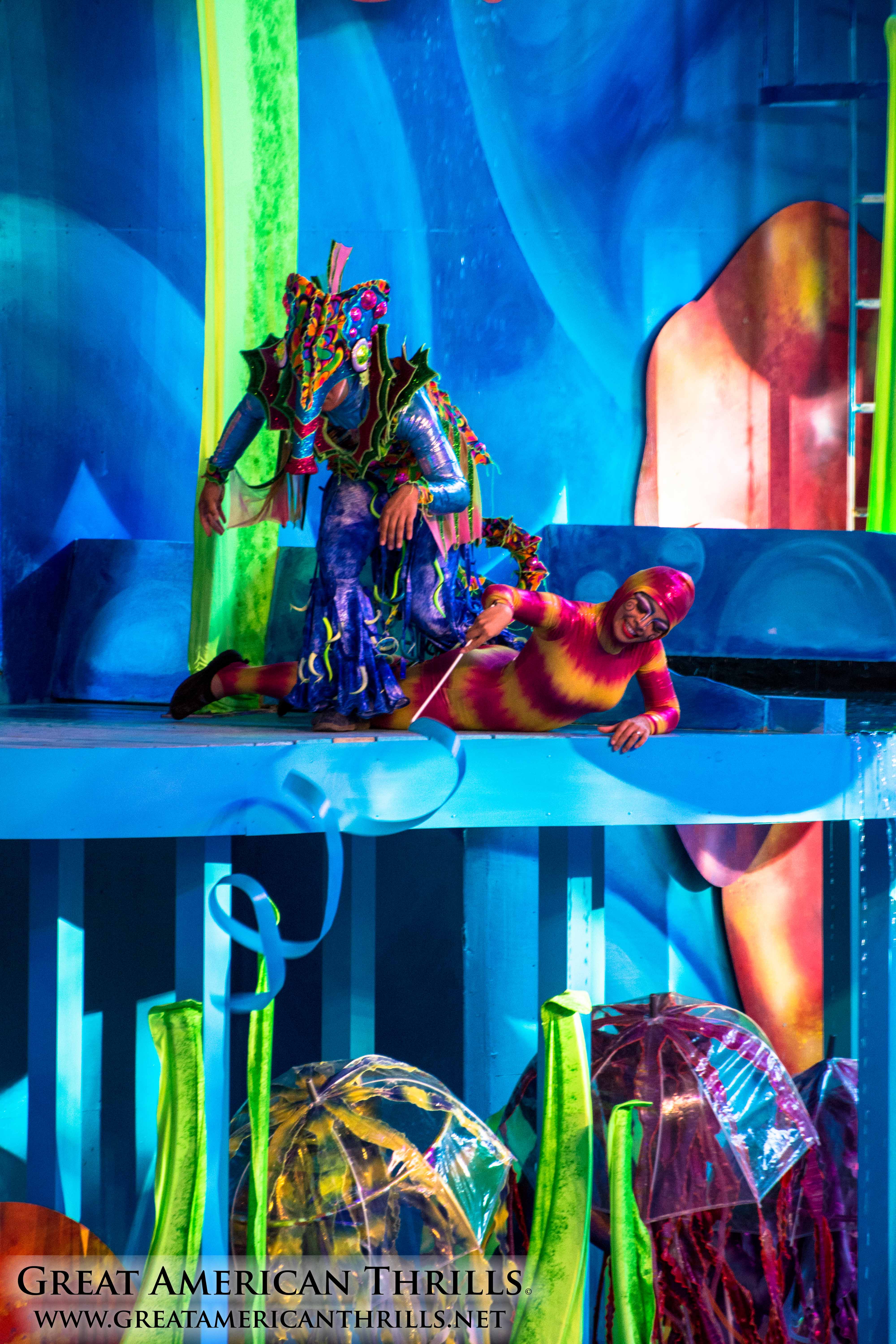
Colorful characters abound in this production – the first for a Northern California amusement park.
The only thing that I can find wrong with the show, is that it has a limited run – just from Memorial Day Weekend though August 11th. But in a way, that works – it makes it a limited engagement, so the performances are better and more special to those who witness them as spectators. It’s quality over quantity, and something that most parks would not think twice about.
I’ll be posting a full interview with the Creator and Director of Cirque Dreams Splashtastic, Neil Goldberg, later this week.

The dolphins are not always at center stage, unlike how most aquatic shows tend to be – rather, they work in tandem with the performers to create a sort of serendipity on stage.
For now – get your plans in now and get out to Six Flags Discovery Kingdom to experience this one of a kind piece of amusement park entertainment – it’s certainly worth the trip.
As always, Great American Thrills™ would like to thank those who made this post possible: Neil Goldberg, Nancy Chan, Lee Munro as well as the entire staff and crew of Six Flags Discovery Kingdom and Cirque Dreams – Splashtastic!

The entire cast takes a bow at the end of the program – to a standing ovation no less – during the first public performance.
Interested in purchasing / using some of my photos? Check out my 500px: http://500px.com/GreatAmericanThrills
View my videos on YouTube: http://www.youtube.com/user/GreatAmericanThrills
Follow me on Facebook: http://www.facebook.com/GreatAmericanThrills
Tweet me on Twitter: http://www.twitter.com/krowberry
+1 Me on Google+: https://plus.google.com/u/1/115502587437263155125/posts
Follow me on Instagram: http://instagram.com/krowberry
I rent all my camera gear through my friends at: BorrowLenses
Gold Striker *ACTUAL REVIEW* at California’s Great America

“Wow.”
That’s the word most people were saying after they got off Gold Striker this evening. While not open to the public yet, California’s Great America invited people, including yours truly, to come out and participate in a promo shoot for commercials and still advertising.

Gold Striker looms large over Carousel Plaza and the front entrance to the park.
Folks, this ride is the REAL DEAL and is setting up to be a real “sleeper hit” across the country. Most people know Great America as a park that seems to enjoy removing rides rather than building them. Gold Striker might just make you forgive them (maybe).
The fun starts before you get to the lift hill (that’s right, BEFORE you get to the lift hill!) Folks in the rear seats will appreciate the incredible whip of the turnaround out of the station, which could be the tightest I’ve ever seen taken at speed before on a woodie) and those in the front seat will appreciate the airtime (yes, I said AIRTIME) on the bunny hill before the lift.
After ascending the lift, riders enter the “initial descent tunnel” and that’s where all hell breaks loose. The ride is fast, noisy and the effect of blasting out fo the tunnel is impossible to describe.
From there the ride does a VERY close flyby of the station stairs, giving wonderful photo / video opportunities. A floater hill and a few head choppers later, the ride finds it’s speed…and keeps it until the brake run.
I don’t want to completely ruin the ride for you, but know that there are many “pops” of air on this ride, usually to set you up for another element. Call it a “tag team coaster” because they work perfectly together.
Coming into the final turn, you hit the magnetic (it’s Silicon Valley, gotta have some technology) and then back to the station. Pictorium fans will be saddened to learn that two of the entrances have been demolished, but the building itself still stands.
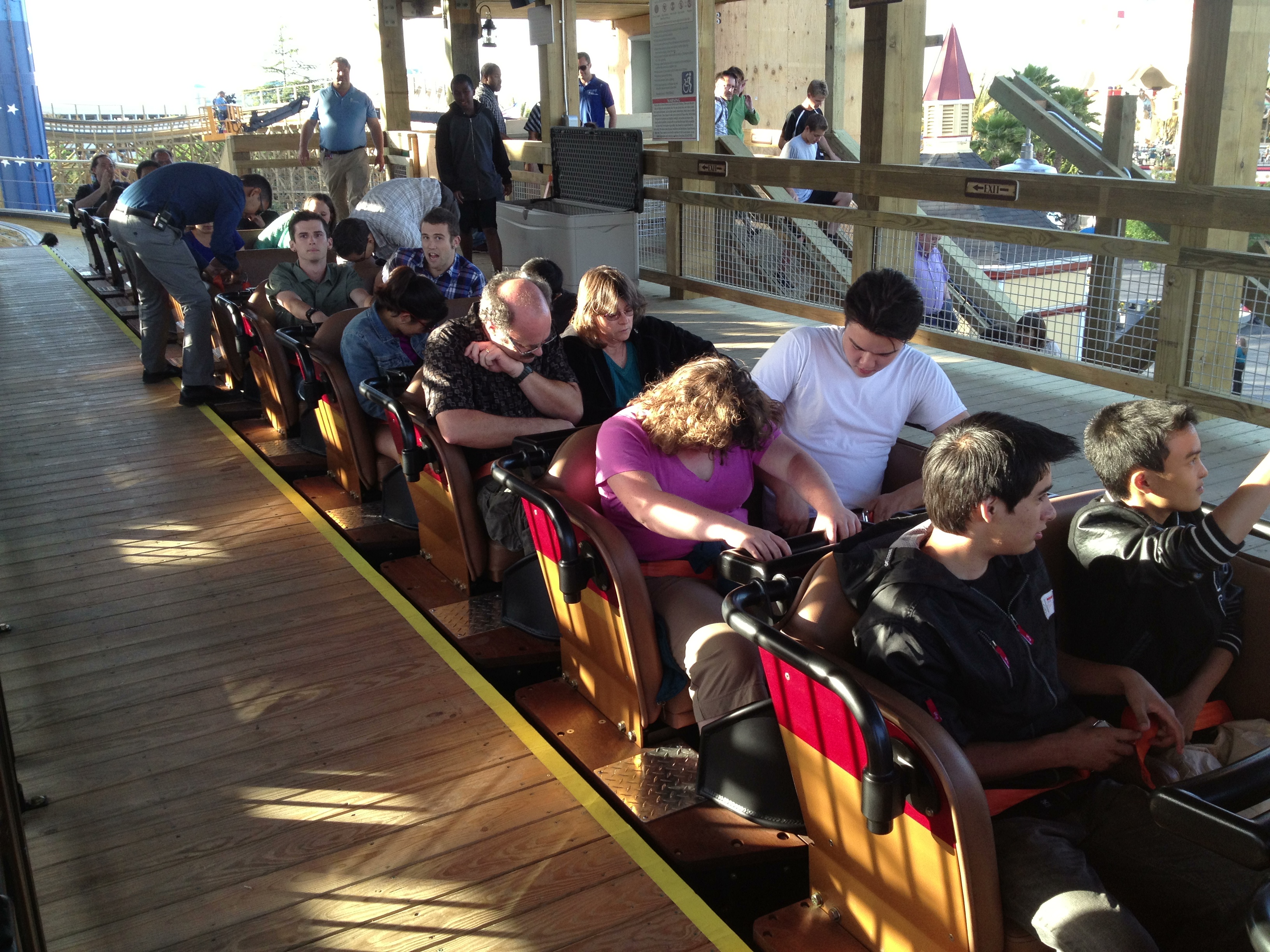
“Millennium Flyer” trains harken back to the “Golden Age” of coaster design. The trains are Gold / Red, Red Gold – in 49ers shades.
To quote my ride mate for this marathon session, “Airtime is back with GCI.”
We squeezed in nine (9) rides before the park shut down the line. Average wait times were 15 minutes, shrinking as more and more of the general public left. This ride is NOT EASY to marathon, but for all the RIGHT reasons. It is INTENSE, BREAKNECK PACED and to be quite honest, many of us in attendance were pinching ourselves, wondering how we got this ride to come here in the first place.
So, in conclusion…
This is a winner all-around for a park more recently known for REMOVING rides than ADDING them. Be prepared for sharp transitions, “set up” surprises and well-timed elements. The ride is smooth with little attitude. This is not an, “airtime machine” but it has well over 8-10 (I kept losing count) pop airtimes. There are moments when you’re riding only on up-stops.
Now, you can take your kids on Grizzly as a warm up and test their (and your) mettle on Gold Striker.
In my opinion, this coaster could EASILY take on El Toro in national polls and in many cases it should WIN.
The ONLY thing missing from this ride…is YOU!
To learn more about Gold Striker or to purchase tickets to the park, visit www.cagreatamerica.com

The Arkham Haunted Mansion
Gotta love this take on the famous “Stretching Room” in Disney’s Haunted Mansion. THis one is themed after the Batman saga and features Harley Quinn, The Joker, Poison Ivy and Batgirl.
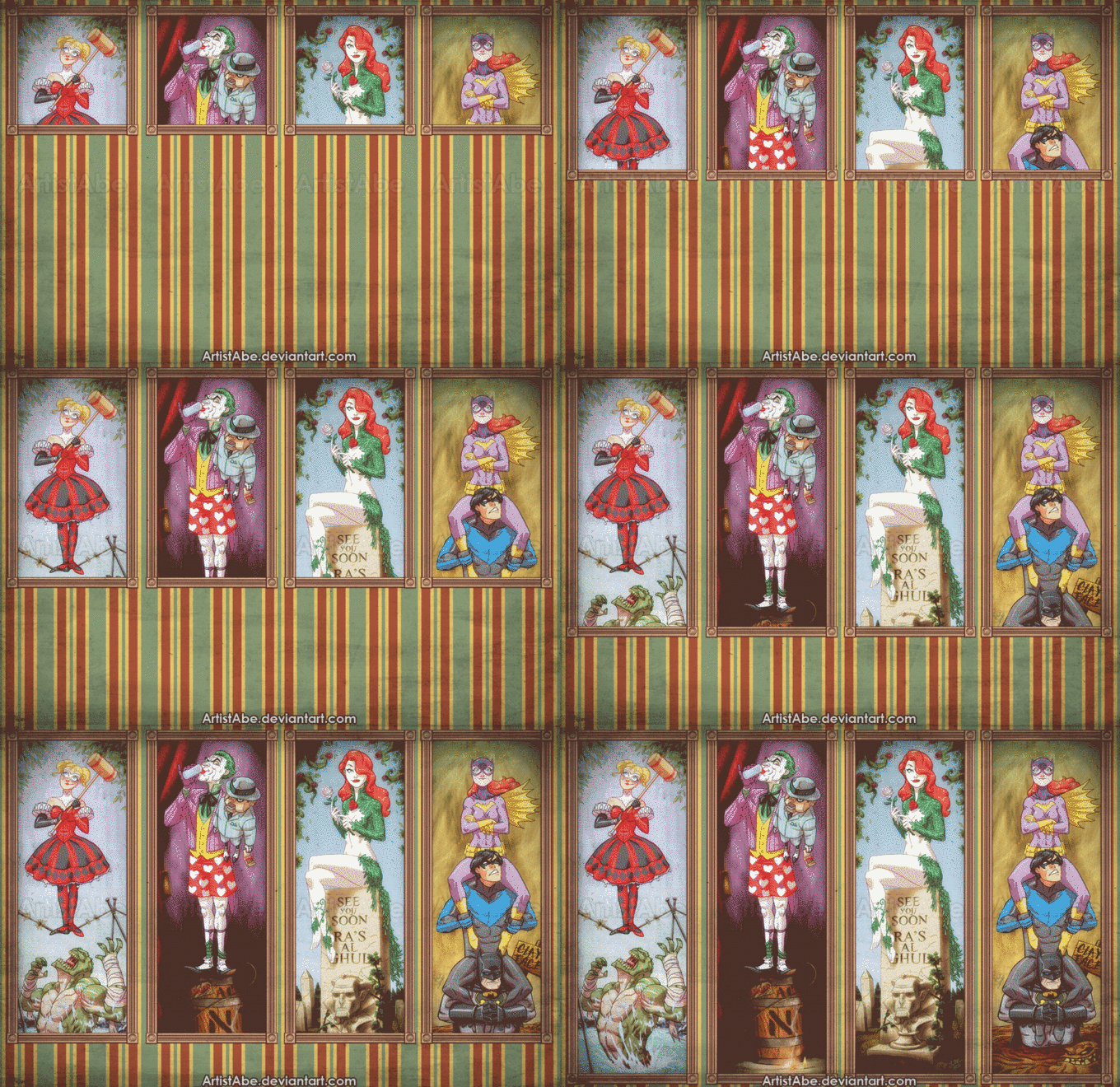
Gif art and artwork by Abe Lopez.
Fun fact: The stretching effect is achieved two different ways at Disneyland and Disney World. One has the ceiling rise, the other has the floor descend. Can you identify which one is which? Leave your guess in the comments section below!
Danke Shen, Deutchland! (Thank you, Germany!)

A big thanks to the folks over in Germany for watching the Lost Parks series in such high numbers! Check out the latest demographics on the YouTube channel!
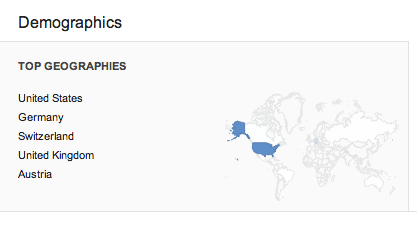
I knew working for a Zeppelin company would pay off at some point!
Sie sind ser schon!
Shameless Plugs
As I continue to upgrade the brand and it’s overall presence, I’ve made a major move in terms of my photography.
In addition to now working with www.BorrowLenses.com as my sole provider of camera equipment (I also work FOR them, hence the partnership) I’ve moved most of my photo collection over to 500px.
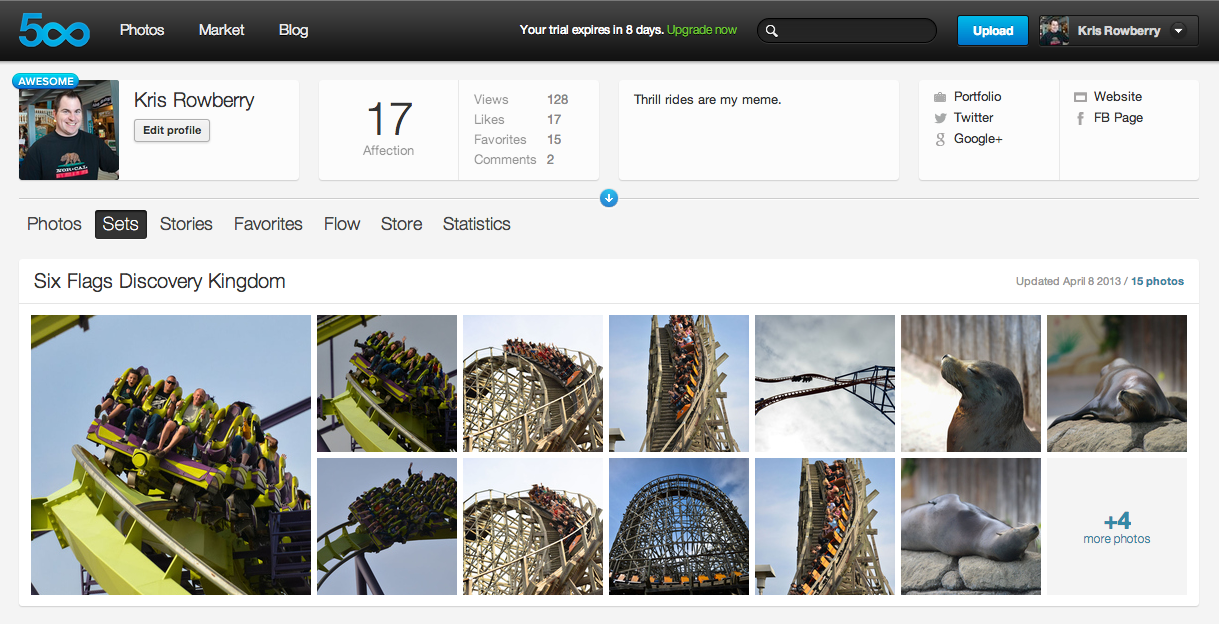
You can view my latest photos, download and even purchase them at: www.500px.com/GreatAmericanThrills
KGO Interview

KGO 810 AM here in the Bay Area interviewed me this past Friday on the “Lost Parks” series. Hopefully, it’s the start of people discovering my little series!
For those who missed it – check it out!
 Great American Thrills®