Six Flags Announces New 2014 Additions

Today’s the big day – the coordinated announcements from all of the Six Flags parks on their new for 2014 attractions!
Looks like our local park, Six Flags Discovery Kingdom, actually made out quite well, with THREE major announcements today.
For a new attraction, the park will receive, “Tsunami Soaker” a teacup ride – with a watery twist. The park was sorely lacking water rides (there’s only two) and those hot Vallejo summers will mean long lines for this fun (and interactive) attraction.
Personally, I love when family attractions get put in – it shows the park has a balance to it, rather than adding extreme thrill rides each and every year, which tend to attract the, “wrong crowds.”
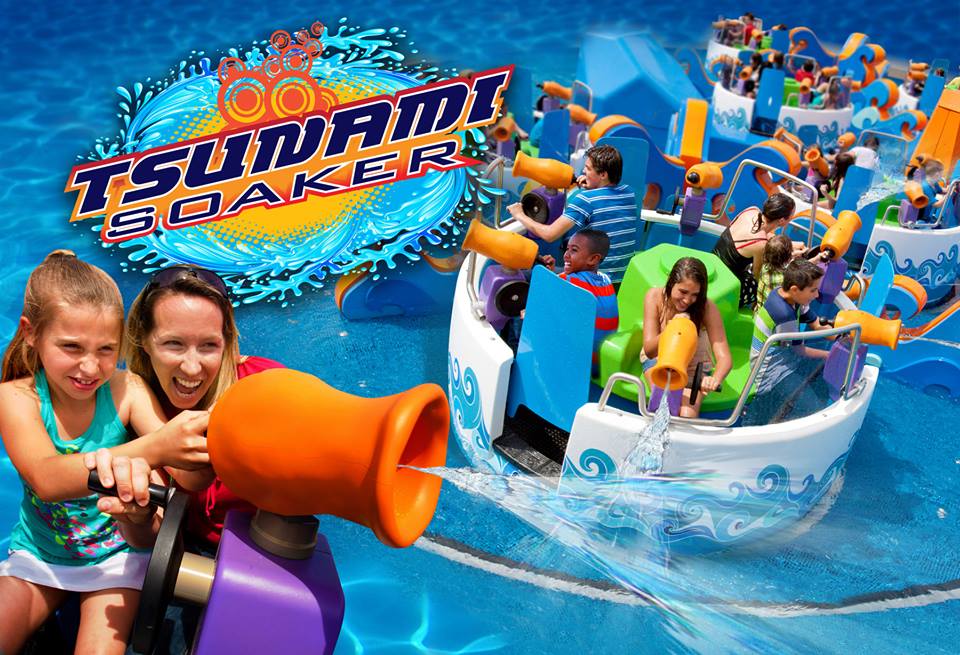
Soaking water + spinning means I’ll sadly have to pass on this one… (Photo credit: Six Flags, Inc.)
Our question – is where exactly will it go? The park isn’t exactly flush with space, so this means either a creative “shoe-in” somewhere in the park, or the removal of an older attraction.
We shall see, because we’re going to leave the speculation to those “other” sites…
In addition, the park has also announced that the popular “Cirque Dreams Splashtastic” WILL RETURN for a limited run again next season. (Which is being overlooked by most other sites) This, combined with the addition of “Tsunami Soaker” gives families a great way to spend their day at Discovery Kingdom.

Cirque Dreams Splashtastic will return for 2014.
And in addition to all of that – a little bit of nostalgia for fans of the park when it was Marine World Africa USA…
The park is going back to being open YEAR ROUND!
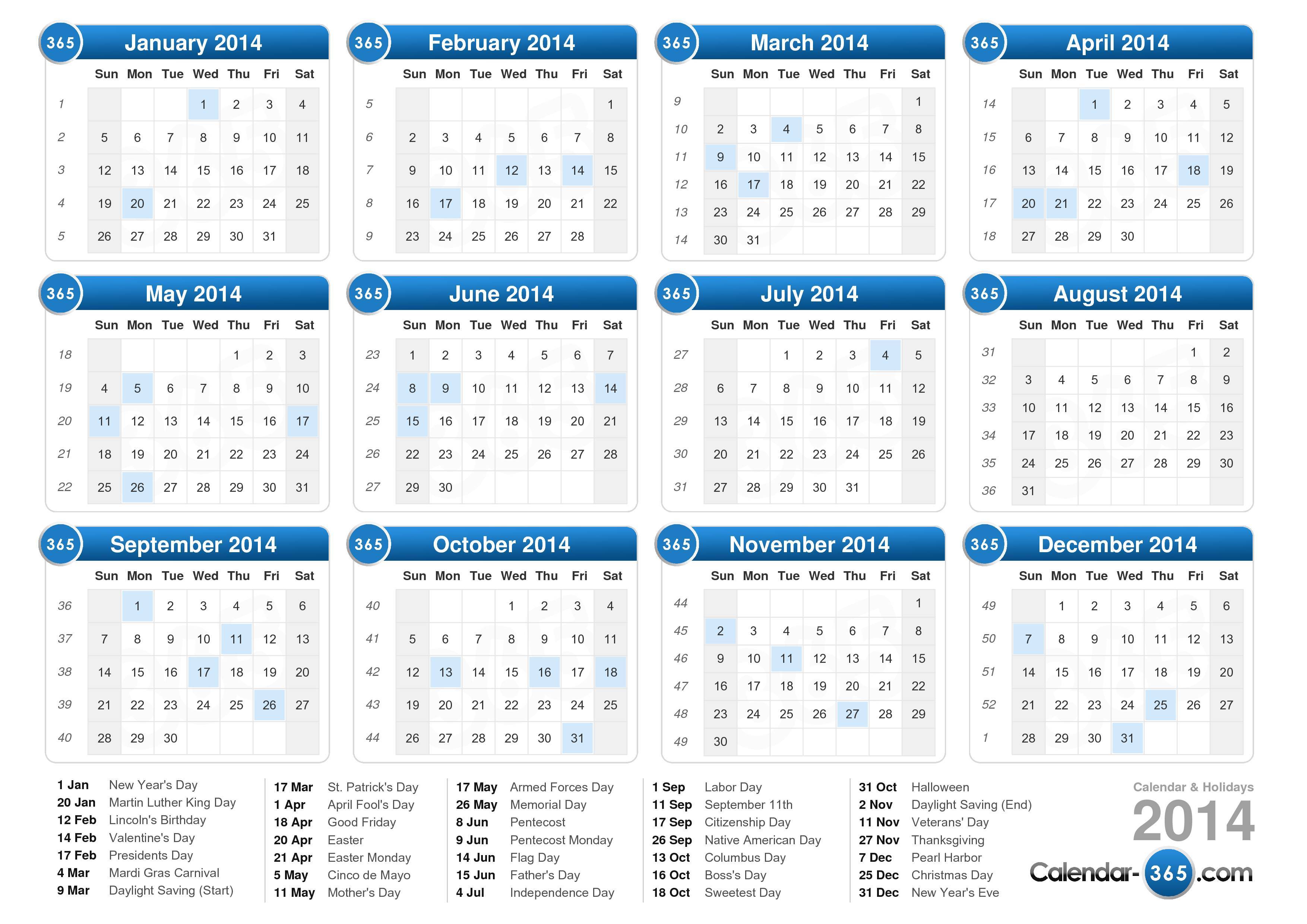
Plan your trip to Six Flags Discovery Kingdom for anytime in 2014 – it’s now open year-round!
“With the region’s mild temperatures, being open all year means guests have even more opportunity to enjoy Discovery Kingdom’s wildlife and wilder rides,” said Don McCoy, park president. “In addition to our summer daily operating schedule, we will now be open on weekends year-round ― further cementing Six Flags Discovery Kingdom as the premier destination for affordable, thrilling entertainment.“
Now of course, this means seeing rides go down during that time, just like Disney does at their parks – it will be interesting to see how this new year-round operation affects, well OPERATIONS! Seasonal parks tend to struggle to keep staffing up for some reason in California, so we’ll see how this year-round push goes this time around.
Considering the move to an annual “membership” plans for season pass sales earlier this year, it’s not surprising – but still great to hear officially.
For a complete list of the new for 2014 attractions at Six Flags parks, including some truly insane record-breakers across the country – visit this link HERE.
#Hashtag Etiquette – Social Media and Your Amusement Park
#Hashtags – arguably one of the more confusing elements of social media.
For many, they’re seen as useless – for others, they’re invaluable tools for social media. So which one are they for social media and the amusement industry?
They’re actually both.
In laments terms – a hashtag is like a folder on your computer – it’s a depository for anything that uses that phrase of tag. So, if you’ve just opened up a new coaster called, let’s say Iron Rattler for example, the logical hashtag you’d want to promote is: #ironrattler. Got a halloween event coming up? Why not use #HauntCGA (If it’s Great America for instance) or #KnottsHaunt for the Knott’s Berry Farm’s event.
The whole idea behind hashtags is to get people’s attention, quickly – as well as help people discover content they’re interested in. That’s what keeps the user engaged and ultimately through your turnstiles. Because so many social networks are adopting this #hashtag feature, it behooves you to understand what they are and how to use them properly for you amusement park:
1.) Keep it simple!
The longer a hashtag, the more often it will be misspelled. In addition, the harder it will be for people to remember. Say you want to promote a specific ride one day. Your park can post “Have you ridden #theplunge today? One lucky rider will receive a backdoor pass after their ride! #YOURPARKNAMEHERE
Then, you can watch the #theplunge tags, even if you don’t have social media management software (which you SHOULD be using, if you’ve read my previous posts HERE).
2.) Make it unique, but relevant!
Say you’ve just opened up a new coaster called, let’s say Iron Rattler. The logical hashtag you’d want to promote is: #ironrattler. Got a halloween event coming up? Why not use #HauntCGA (If it’s Great America for instance) or #KnottsHaunt for the Knott’s Berry Farm’s event. You wouldn’t want someone else to be getting web traffic because of your event / advertising campaign, would you?
Not to be a shameless plug here, but whenever we shoot our “Lost Parks of Northern California” series – we always send out social media updates using the hashtag: #lostparks. Not only is it easy to remember, but it’s also unique in that it wasn’t being used before – therefore all the content using that hashtag is ours.
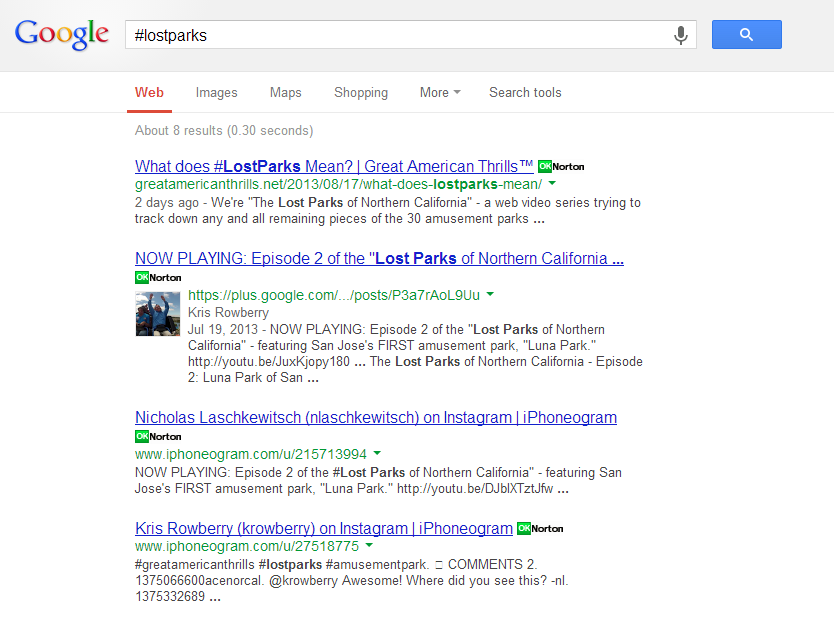
A logical, simple and relevant hashtag makes search engines (and users) easier to capture.
3.) Do NOT make it long!
Remember that some social networks, such as Twitter – give the user only 140 characters to get your message out. A hashtag like #welcomebackspaceexplorers probably isn’t the best bet. But, breaking them up into two smaller hashtags is a better alternative, say #spacemountain #disneyland for instance.
Stick to these guidelines, and you’ll find your SEO increase as well as your interaction via your social media pages. Just be prepared to actually interact with your users – it is SOCIAL media, after all!
In my next post, I’ll discuss the top ten post ideas you SHOULD be doing at your amusement park, regardless of size.
– – –
Kris Rowberry has been following the amusement industry for over 15 years. He has curated social media accounts for several companies, totaling over 450,000 followers across multiple social channels. In addition, he is working on his latest video project: “The Lost Parks of Northern California”
Check out my other postings about Social Media and the Amusement Park HERE.
Happy National Roller Coaster Day!
While it seems everyday is now a holiday – this is one I can get behind!

So after work today, be sure to get out to your local amusement park and celebrate National Roller Coaster Day!
Social Media and the Amusement Park: Don’t Take Yelp Lightly

Despite your personal opinion of the site, Yelp.com has become the de facto review source for many users on the internet. The site says that it’s “Real People, Real Reviews,” and with your amusement park being a major business in the area, chances are someone has already reviewed you and / or created a page for your park. So, how do you monitor and work Yelp to your needs? Read on:
1.) Create an officially moderated Yelp business page, then have it verified:

Multiple pages created by guests only add to confusion in search results and SEO. Plus, misinformation will spread faster.
When searching “Six Flags” in the Bay Area, these are the top four results. Note how there’s seemingly multiple accounts for the park, with reviews about the park in each one. This only makes people confused when they’re trying to find you online. True, the more of you out there, the better for SEO – but not in this case.
By creating an official, park moderated page, Yelp will be more inclined to remove errant listings, making it easier for people to find and review you. Plus, it makes it far easier to respond to guests when there’s only one place to go.
2.) Monitor, monitor, MONITOR!
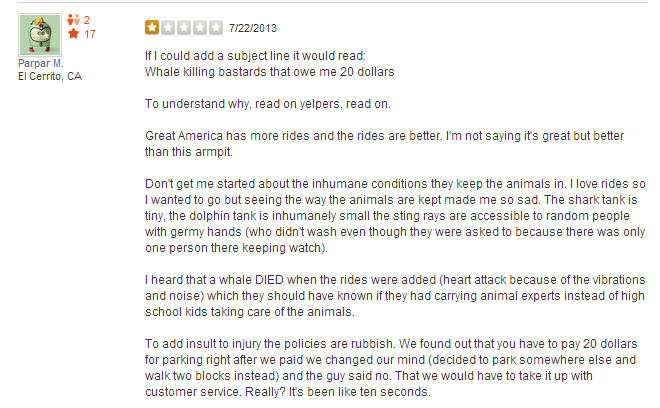
Is this really an accurate review? Hardly – so why allow it to sit for others to view?
It should go without saying, but Yelp is yet another place that you need to be monitoring your image online. Just like your Facebook, Twitter and other social media accounts, Yelp should be monitored closely to make sure that any reviews placed on it are fair, accurate and not derogatory towards your business.
For example, the posting above – is it really an accurate portrayal of the park? Absolutely NOT! So why then would you allow it to stay up, for others to view 24/7? Yelp also gives you the ability to flag reviews for abuse – which is what this one should have done to it.
At the very least – a post like this should be responded to from the park’s official account with accurate information. 95% of angry guests will be quelled once they see the park responding directly to them. Don’t think of it as damage control – think of it more as an opportunity to make a new sale by bringing a guest back. Who knows – they just might upgrade to a season pass…
3.) When you’re wrong – admit it.

Would you eat at a “C” graded restaurant? How people portray you on Yelp has a major impact on decisions to visit.
Look, we’re all human, so we’re not perfect. Mistakes sometimes happen, so it’s up to you to recognize these and make them right wherever possible. But completely ignoring your internet footprint (especially on Yelp) isn’t going to make bad reviews go away.
If a bad review comes in, try to contact the guest first, off of Yelp. Get more information, and then proceed to see what can be done to correct it in the future. Remember that the sooner you contact an angry guest, the better the park looks in their eyes for wanting to assist.
4.) When all else fails, pay Yelp.
Ever wonder why some companies NEVER have a bad review on Yelp? Is it because of the service or business? Maybe. Mot likely, it’s because they pay for those reviews.
You heard right. What most people don’t know, is that companies can actually PAY to look better on Yelp. Yes, call it a shakedown, call it what you will. But the good news – you don’t have to give money to Yelp.
Just by monitoring and responding to reviews through your own company, much as you would with a customer service agent over the phone, or guest service manager would in the park – you’ll see your numbers trend upwards. At the very least, you’ll start getting a better pulse about what your guests are having issues with, and can adapt your business model around it.
Review my prior posts about “Social Media and the Amusement Park” here.
About the Author:
Kris Rowberry has been following the amusement industry for over 15 years. He is the creator and host of both “The Lost Parks of Northern California” and “Great American Thrills®“
Photo of the Day: Gold Striker at California’s Great America

After many years of becoming a park known for REMOVING rides rather than ADDING them, California’s Great America in Santa Clara, CA made a major statement this year with the addition of Gold Striker. Billed as the tallest, fastest (and certainly most intense) coaster in Northern California, Gold Striker is easily one of the top five wooden coasters I’ve ever had the privilege of riding – and should be under consideration for the Top Ten in the United States.
Despite some minor setbacks and delays in opening, mostly due to ongoing noise abatement issues – the ride is now roaring every operating day, to delighted and packed crowds.
A winner all around, this coaster is seen by many as the catalyst for revival at California’s Great America – and fans are loving every moment of it. But don’t take my word for it – check out Westcoaster’s recent review.
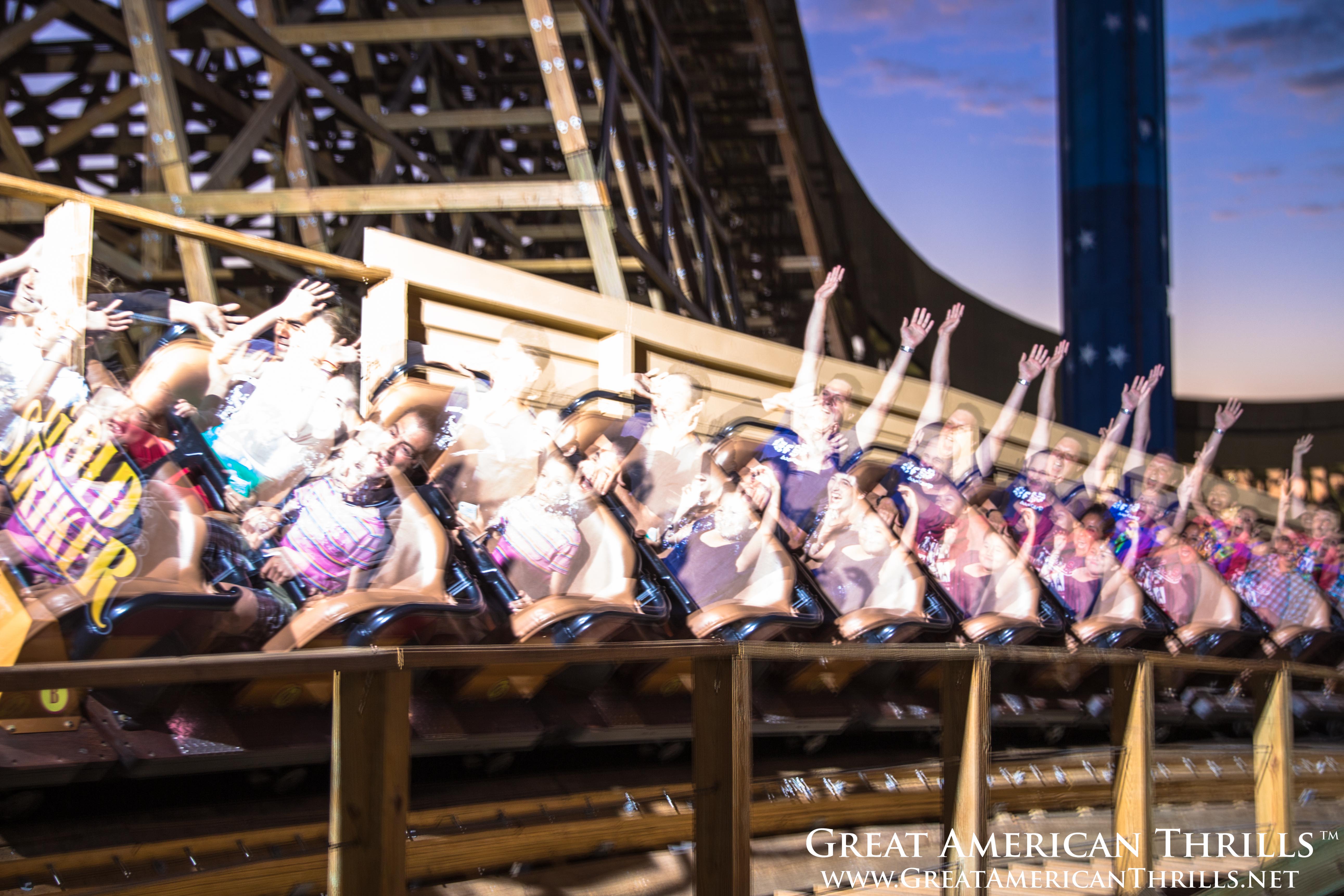
Big thanks goes out to my friends at BorrowLenses for allowing me to capture such beautiful photos with their gear.
Interested in purchasing / using some of my photos? Check out my 500px: http://500px.com/greatamericanthrills/sets
View my videos on YouTube: http://www.youtube.com/user/GreatAmericanThrills
Follow me on Facebook: http://www.facebook.com/GreatAmericanThrills
Tweet me on Twitter: http://www.twitter.com/krowberry
+1 me on Google+: https://plus.google.com/u/1/115502587437263155125/posts
Follow me on Instagram: http://instagram.com/krowberry
Featured on “This Week in Photo” Podcast!
If you haven’t already, check me out on the “This Week in Photo” podcast! We’ll discuss photo composition, the impetus for me getting into photography…and of course, nausea.
Enjoy, everyone!
Learn more about Frederick’s work at: www.thisweekinphoto.com
A Difficult Day for the Amusement Industry, But Don’t Rush To Judgment

An unprecedented two major news-making events took place at two separate amusement parks in the U.S. within minutes of each other on Friday, bringing up the inevitable media hype over ride safety.
At Six Flags Over Texas and Cedar Point, two major incidents occurred that have splashed across the media.
In the wake of yesterday’s tragic event and subsequent investigation at Six Flags Over Texas, Iron Rattler at Six Flags Fiesta Texas has been closed as a precautionary measure, according to a park representative. The ride features the same style of “Iron Horse” track as the Texas Giant and same train manufacturer, Gerstlauer of Germany.
Our thoughts and prayers go out to everyone involved in today’s tragic events.
When reporting news, there’s always the possibility of reporting inaccurate information. When the story is breaking, that risk is even bigger. These stories are no different.
One of the more glaring items that stands out to me is from the The Dallas Morning News. They reported that eyewitness, Carmen Brown, who was in the loading station of the Texas Giant, “…said the woman had expressed concern to a park employee that she was not secured correctly in her seat.”
“He (the ride attendant) was basically nonchalant,” Brown said. “He was, like, ‘As long as you heard it click, you’re fine.’ Hers was the only one that went down once, and she didn’t feel safe. But they let her still get on the ride.”
Here’s the problem – the Texas Giant doesn’t use “clicking” restraints. In fact, according to Gerstlauer, the manufacturer of the trains for the Texas Giant, “The cars feature four self-restraining seats with T-shaped lapbars.” It continues, “The use of redundant hydraulic cylinders ensures that each lap bar can be infinitely adjusted and offers maximum security.” in other words, these restraints come down in silence.
As I was just out at Six Flags Over Texas about five weeks ago, I can attest to this fact. The Texas Giant also features an electronic indicator light on each train, (one for each restraint) which alerts operators if a restraint is too high for safety. The light turns from red to green.
It should not be lost on anyone, but you should know – your odds are far greater of being injured DRIVING to your local amusement park then they are INSIDE your local amusement park. In addition, if you do not feel confident in a ride – you always, ALWAYS have the choice of simply asking to be let out.
Gold Striker Closed Only Temporarily for Modifications
After two weeks of soft testing, a lavish grand opening ceremony and over a month of regular operation, the Gold Striker wooden roller coaster at California’s Great America is closed temporarily to allow for additional sound mitigation to be placed on the ride. But don’t hit your panic buttons – published news reports say the ride is expected to be back up and running by the July 4th holiday – NOT an extended, unknown period.
According to the City of Santa Clara’s “Smart Permit” website, Gold Striker had several criteria to meet in order for it to open permanently, the biggest of which states: “Should the additional testing reveal that the coaster is not in compliance with Condition 23 (amount of sound coming from the ride) or any applicable City ordinances, Cedar Fair shall undertake Remedial Measures, as defined in the Settlement Agt Agreement.” Apparently, the ride was just shy of making all those criteria.
Many industry watchers and local boosters see this addition to the park (and the subsequent work to ensure everyone is satisfied) as a serious commitment from corporate owner Cedar Fair, LP to both the park and the local economy.
“Cedar Fair elected to close the ride to install additional sound mitigation upgrades,” said Santa Clara Mayor, Jamie Matthews. “Those upgrades should bring the ride into full compliance with the previous settlement. I’m hoping to see it open here for the 4th of July.”
He added, “I am very happy with the way this is situation is working out – it shows responsible citizenship – that we can all work together and come to a solution.”
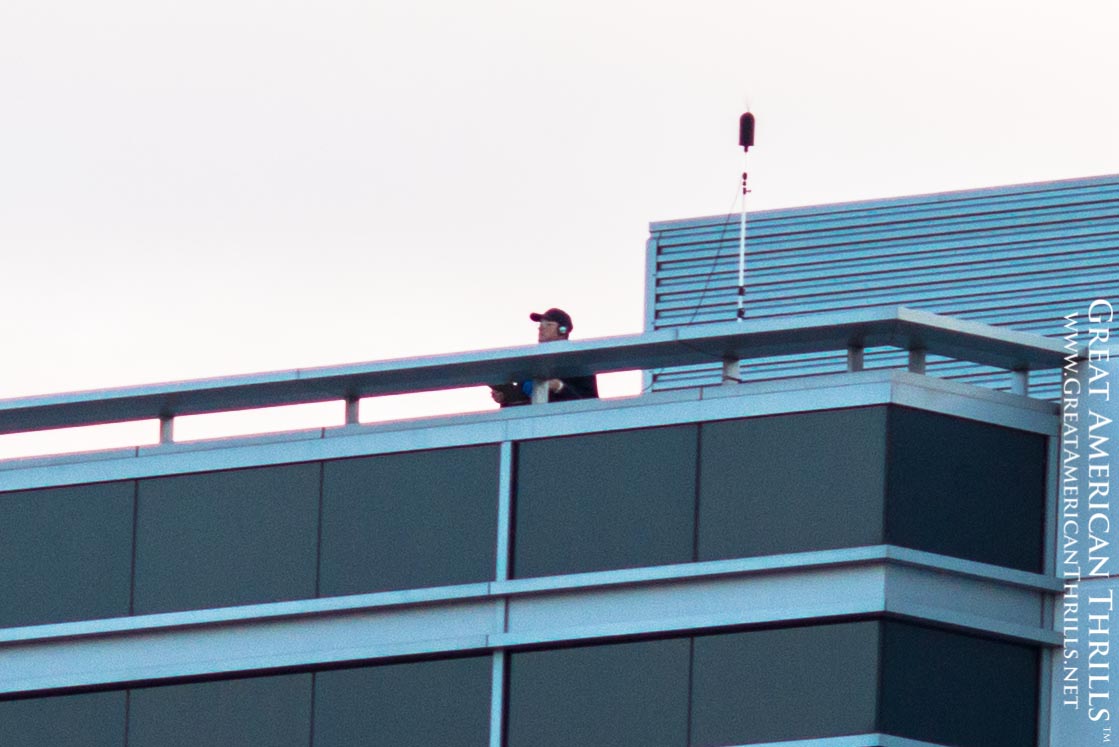
A man with recording equipment and headphones monitors the noise coming from Gold Striker from one of Prudential’s buildings.
Since “soft-opening” in May, Gold Striker has seen major additions, most notably the addition of plywood walls and white foam along the sides and underside of the track. By coincidence, these spots pass closest to or face the buildings located on Great America Parkway. During initial construction, the park added what was dubbed an, “initial descent tunnel” onto the first drop of the ride. This feature was presumably added to mitigate the sound from the first drop of the ride.
Trying to build this ride has been quite the roller coaster ride in and of itself – the plans go back to 2007, when the park first began the permitting process. In addition to the standard permits, three hearings were held on potential noise levels – all of which were initiated by appeals from the owners of the buildings closest to the proposed ride.
Billy D’Anjou, a local roller coaster enthusiast, has logged 80 circuits on the coaster since it opened in May and is hoping to hit his 100th ride in July.
“I personally don’t mind more enhancements (to the ride) but I think the whole noise mitigation issue has gotten out out of control,” he said. “In the end it makes me worry what limitations Great America will have in the future. (Prudential) should expect noise from a theme park. It’s not a library or fine art museum.”
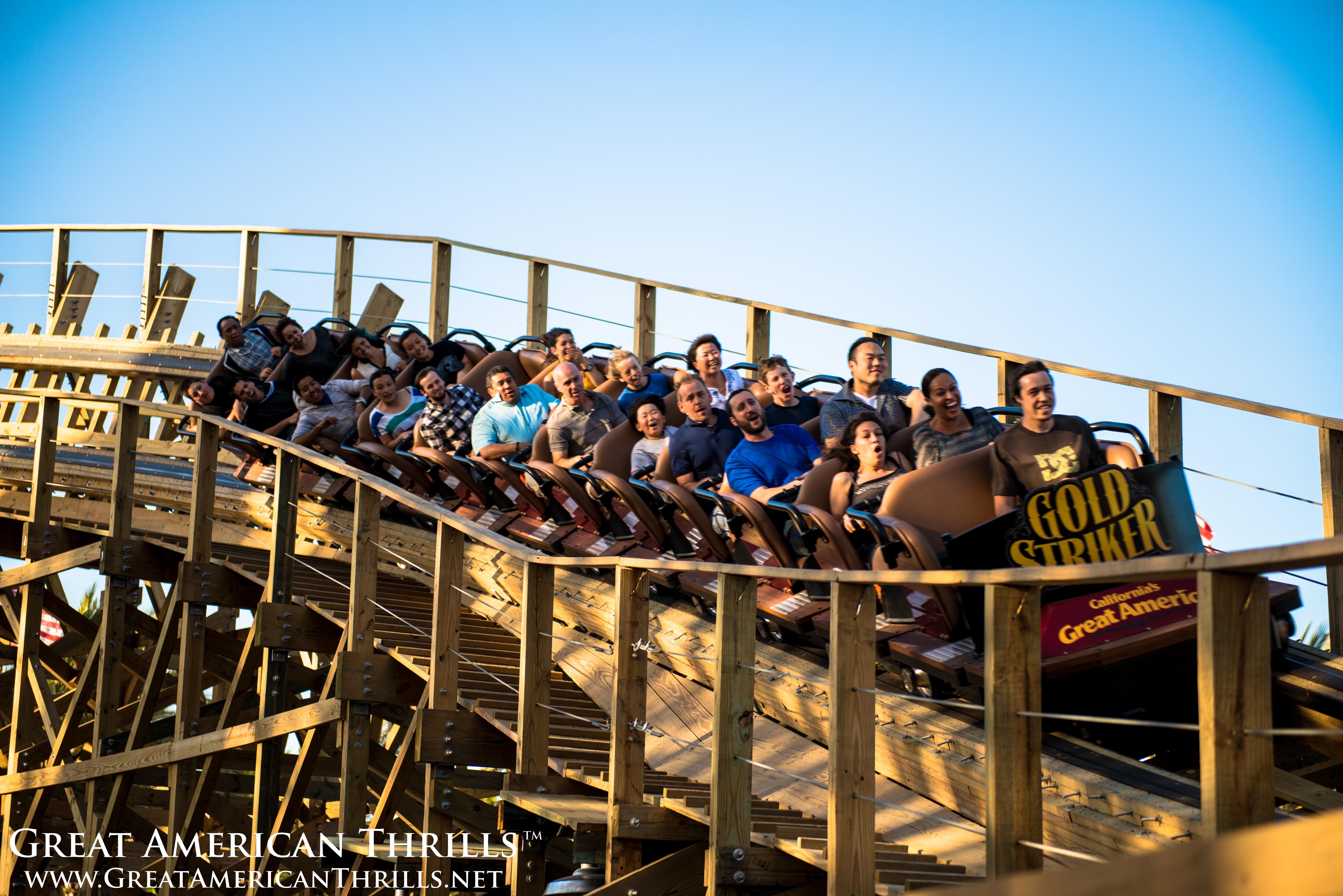
Gold Striker thrills riders on a recent operating day.
Gold Striker is the first wooden roller coaster built in Northern California since 1999. It boasts the tallest and fastest drop in Northern California and is the largest capital investment in the park in over a decade. The ride was built partially on the footprint of another ride, Willard’s Whizzer – a steel coaster that operated from 1976 to 1988.
The land that Prudential’s buildings sit on was originally an auxiliary parking lot for Great America. The land was sold in the late 90’s during the dot com boom. Prudential acquired the buildings in early 2002, according to a press release on their website.
Marriott’s Great America opened in 1976, as a celebration of America’s bi-centennial. The concept was to create a chain of parks to become an answer to Disney’s theme park empire.
How Much Posting is TOO Much on Social Media?
Continuing my series on how social media can be used more effectively at amusement parks / FEC’s – just how many times should you be posting to your social media accounts on a daily basis?
Some experts feel that the higher quality the post, the less often you have to post it, while others feel that with all the filtering being done online, the more often you post, the better chances you have of actually being seen and / or heard.
The New York Times – arguably the most respected news source in the country – posts on average, seven to eight times per day. As much as you’d like to think your attraction has that much to tell the world – it simply doesn’t.*
Posting even HALF that often is enough to turn off your potential viewers. Yes, you are being filtered by Facebook and the new algorithm – but it’s not worth over-posting if most of your “likes” are going to mute your posts or worse, mark them all as spam.
If RollerCoasterTycoon had a social media option, I’d be posting a maximum of three times a day while open, once a day when closed.
Post #1: Morning, Before Opening
Post #2: Midday
Post #3: End of Operating Day
Rotate the timing of each of these posts (i.e. Don’t post a funny / cool photo each day at 3:00pm, spice it up a little).
It should go without saying, but you simply MUST be scheduling posts – to try and keep up with each post each day will ultimately drive you nuts. To assist in keeping your sanity, a scheduling software solution, such as TweetDeck or HootSuite is an absolute must! (I’ll be going into more detail on how to use HootSuite with my #Hashtag post soon)

Also to help with keeping up with your quota – consider “banking” photos over your operating season, as well – if you can’t find anything interesting to post about one day, use one of those banked photos.
Remember that while rides are fun, most people visit parks to enjoy the fun WITH OTHERS. Highlighting unique groups in your attraction, big game winners and specific attractions is sure to bring in more views (plus more turnstiles rotating).
Fan submitted photos are also a great (and often overlooked) way to have your social media content create itself. But, as I said in my first posting on this series – never forget that the entire purpose of social media is NOT to sell to your followers directly – it’s to start a conversation and interact with them.
Once you throw up an update, be prepared to interact with people. “Like Bait,” as it’s known, has a place on Facebook, but it will never convert those eyeballs to your turnstiles unless they can feel a connection to your attraction. For instance, posting a cool photo of your roller coaster may get 1,000 likes, but people will also ask questions, too. Each one of those questions is an opportunity to connect (and THEN sell your product to them AND all their friends).
If you’re a seasonal park, take advantage of the off-season to show all the transformative work going on behind-the-scenes. Just be aware that trying to sell a season pass in the middle of the winter with a photo of a dry waterslide probably isn’t going to go very viral. However, a video of employees sliding down said slide in a bathing suit – in the snow, now THAT’S different!)
If you’re shooting your own photos to post on Facebook, Twitter and / or Google+ (and you should be) and you’re using a DSLR (i.e. NOT a cell phone camera) adding a watermark with your website or hashtag is absolutely necessary. People will inevitably share quality or memorable photos – and with watermarked information on them, your logo and website will be sitting right there in front of all those shares for consumption.


Which one of these social media update photos would YOU want to be saved as a follower’s new computer background? (Airship Ventures, 2007 – 2012)
So, don’t fill guests (or potential guests) feeds, walls or updates with tons of info, photos and sales pitches – just nurture them. There’s no reason to go crazy and post 15 Instagram shots of your newest ride. You’ll see your following grow and ultimately see more butts through the turnstiles.
In my next article, I’ll be talking about #hashtags – what are they? How can you use them to promote your attraction / FEC?
*The only exception to this rule is when your attraction is facing a crisis situation or dangerous weather conditions.
Review my prior posts about “Social Media and the Amusement Park” here.
About the Author:
Kris Rowberry has been following the amusement industry for over 15 years. He is the creator and host of both “The Lost Parks of Northern California” and “Great American Thrills®“
Photo of the Day: Iron Rattler at Six Flags Fiesta Texas

There are roller coasters – and then they’re EPIC roller coasters. Iron Rattler at Six Flags Fiesta Texas is one of those attractions that takes your breath away.
Once the tallest wooden coaster on Earth, the Rattler was transformed this past off season to include Rocky Mountain Construction’s Iron Horse Track (similar to the track on Texas Giant just a few hours north). The ride is now smooth, powerful and FORCEFUL – definitely a steel coaster that should rank in your top three in the world after you ride it.
Did we mention there’s a clever inversion on it, too?

A HUGE thanks goes out to my friends at BorrowLenses for allowing me to capture such beautiful photos with their gear.
Interested in purchasing / using some of my photos? Check out my 500px: http://500px.com/GreatAmericanThrills
View my videos on YouTube: http://www.youtube.com/user/GreatAmericanThrills
Follow me on Facebook: http://www.facebook.com/GreatAmericanThrills
Tweet me on Twitter: http://www.twitter.com/krowberry
+1 me on Google+: https://plus.google.com/u/1/115502587437263155125/posts
Follow me on Instagram: http://instagram.com/krowberry
Caption Contest: Facebook Face Recognition FAIL

While working on editing photos from my recent marathon trip across the country these past two weeks, I couldn’t help but laugh at what Facebook thought was a face…it’s actually a wheel bogey from the “epic” Iron Rattler at Six Flags Fiesta Texas.
What’s your best caption for this shot?
Season Pass Podcast Interview

We had the pleasure of being interviewed at the Gold Striker media day by the great Doug Barnes of “The Season Pass” podcast. Check out the interview about halfway through at the link below:
Can’t wait to talk up “Lost Parks” some more in the future, Doug!
iTunes:
https://itunes.apple.com/podcast/the-season-pass-the-essential/id268430539
Direct Link:
http://traffic.libsyn.com/seasonpasspodcast/The_Season_Pass_235.mp3
How to use YouTube to Combat Cell Phones on Coasters

Seems counter intuitive, right? How can the very thing that allows dangerous, illegal POV video to be so popular be used to stop it? Well, read on and find out:
Arguably, cell phones are one of the greatest inventions of the past century – the convenience of being on contact whenever, where ever. The freedom to upload photos and videos at any moment – including while guests are on your rides and attractions.
You don’t have to hear me tell you that cell phone filming on rides is an epidemic in our industry. It’s pushing insurance premiums higher and higher. A projectile of that density, loose at 65mph could be several injury lawsuits just waiting to happen, not to mention the bad publicity in the media.
Before the Gold Striker wooden roller coaster even opened to the public at California’s Great America this past month, guests were seen filming on the ride using cell phones. When opening day came, the second train of the day that featured general public passengers had three (3) cell phones out.
“But we already provide guests with storage options while they’re on rides!”
Sadly, that doesn’t matter. The mentality of guests today, specifically Millennials, is to not experience the ride they’re on, but to record and share the experience with all their friends. The more “Likes” on Facebook, the higher “Thumbs Up “ count on YouTube, the better.
“But, it’s free publicity!”
Yes, it is free publicity – telling everyone online that it’s okay to film on your rides – and risk the safety of everyone around them. It’s nothing a good marketing campaign of your own marketing team couldn’t accomplish (see #3).
So how then, does your park stop this major liability and potentially lower your insurance premiums at the same time? It’s actually a simple, three step process:
1.) When it Comes to your Park’s Policies, “Grow a Pair”
Stark as it is, it needs to be said. For so many years, park guests have received warnings about what NOT to do at a park. They’ve received so many that they’ve become complacent to them. A good comparison would be to think about the last time you actually picked up a safety card in an airplane and read it. That’s the same mentality going on with your younger guests.
Also to consider – Millennials expect warnings. They’re willing to go right up to the warning and only back down when confronted. This is a generation where “everybody’s a winner,” and there’s little to no consequences to their actions. If your sign says “anyone caught with a camera on a ride will be removed from the park” then DO IT. (While deleting or confiscating the offending device.) The only way to change guests’ behavior is to show them that you mean business.
For example, Six Flags New England has a single warning sign at every high profile attraction. It reads, “Any cell phone or filming on this ride will result in immediate ejection from the park, no refunds and a 5 year ban from the park.” That gets people’s attention. In addition, all of their ride auto spiels also include a warning: “Anyone using a cell phone or MP3 payer to record while on the ride is subject to immediate dismissal from the park by Six Flags Security.”
The Santa Cruz Beach Boardwalk goes a step further. Ride attendants actively monitor the lift hill of the Giant Dipper roller coaster via security video. If a cell phone or other recording device is seen, the ride is immediately stopped and will not start again until the offending device is put away. If the device re-appears after the lift, security is called to wait at the station, takes away any tickets or passes the guest may have and is escorted immediately off park property.
Now that you’ve taken the first steps to stem the flow of content at the source, it’s time to move onto where the content lives…online.
2.) Actively monitor and police social media, especially YouTube.
This should go without saying, especially if you read my last post – but if you don’t watch your social media channels continuously, you’re in for a shock…
What’s your signature ride at your park? Go ahead and search it on YouTube, I’ll wait…
Okay, you’re back? Great – how many results came up? Each one of those videos are potential lawsuits from injured guests, who will blame you for allowing people to film on rides. The real scary part – these are only the videos that were tagged properly on YouTube – many more could potentially exist without proper tagging or incorrect spellings. (Not to mention Facebook videos as well.)
Remember, this is your property people are filming on. You are well within your rights as a park to have videos on YouTube flagged or taken down for safety, security or other reasons.
Use the ban as an opportunity. In the complaint, be sure to add a link to an authorized POV (point of view) video that came from the park, with a friendly reminder to not film on rides.
Some park-centric websites have gone so far as to monetize videos filmed at parks . Yes, you heard me correctly – they were filming commercially – and they paid none of your fees, had no insurance coverage AND you didn’t even know they were there. You wouldn’t allow a film crew to just wander around the park without your spokesperson, so why would you allow this?
3.) Film (and share liberally) professional, on-ride video that you created or authorized.
Gone are the days of needing a film crew, jibs, cranes and more when it comes to making high quality video. A simple GoPro Hero with accompanying mounts will run your department about $400-$450 after tax. That’s a small price to pay to avoid millions in lawsuits.
Mount the camera on either the handlebars of the front car, or via the suction cup mount to a flat, non-porous surface. Duct tape can be used to stabilize the rig, but it’s not necessary in many cases. Never use any footage that could come across as shaky, or handheld. You’ll run the risk of having it look too much like a cell phone video; guests will be only encouraged to film on their own.
Now that you have authorized POV, post your video everywhere – not just on YouTube. Link to it via your other social media outlets – have it available for download for free (just be sure you include your personal watermark to show it’s really from the park). Have a QR code posted near the ride exit, so guests can scan it and receive a link to the video. It takes the work (and risk) of filming on a ride out of the hands of the guests – it’s already been done for them!
Combine that with active monitoring and better training for ride attendants, and you’ll see a significant decrease in after the ride and receive it on their phone. Take all the work out of guests filming and put it on yourself – you will see results quickly and hopefully, watch your insurance premiums decrease as well.
Review my prior posts about “Social Media and the Amusement Park” here.
About the Author:
Kris Rowberry has been following the amusement industry for over 15 years. He is the creator and host of both “The Lost Parks of Northern California” and “Great American Thrills®“
Photo of the Day: Boomerang at Six Flags St. Louis
Yesterday, Six Flags St. Louis unveiled their latest coaster in their collection and Great American Thrills was there on OPENING DAY to see what the venerable Vekoma design had in store for guests.
Amazingly, the ride is SMOOTH for a Vekoma – and the park is working diligently to improve the catch on the second hill to eliminate that traditional “thud” that’s so common on this model. The ride sits between the Tidal Wave flume, Sky Screamer and venerable Screamin’ Eagle wooden coaster at the top of the park.

Big thanks goes out to my friends at BorrowLenses for allowing me to capture such beautiful photos with their gear.
Interested in purchasing / using some of my photos? Check out my 500px: http://500px.com/GreatAmericanThrills
View my videos on YouTube: http://www.youtube.com/user/GreatAmericanThrills
Follow me on Facebook: http://www.facebook.com/GreatAmericanThrills
Tweet me on Twitter: http://www.twitter.com/krowberry
+1 me on Google+: https://plus.google.com/u/1/115502587437263155125/posts
Follow me on Instagram: http://instagram.com/krowberry
Photo of the Day: Loose Articles under Mr. Freeze

This is the reason that parks don’t want you to have loose articles onboard roller coasters – because this is almost ALWAYS their fate!
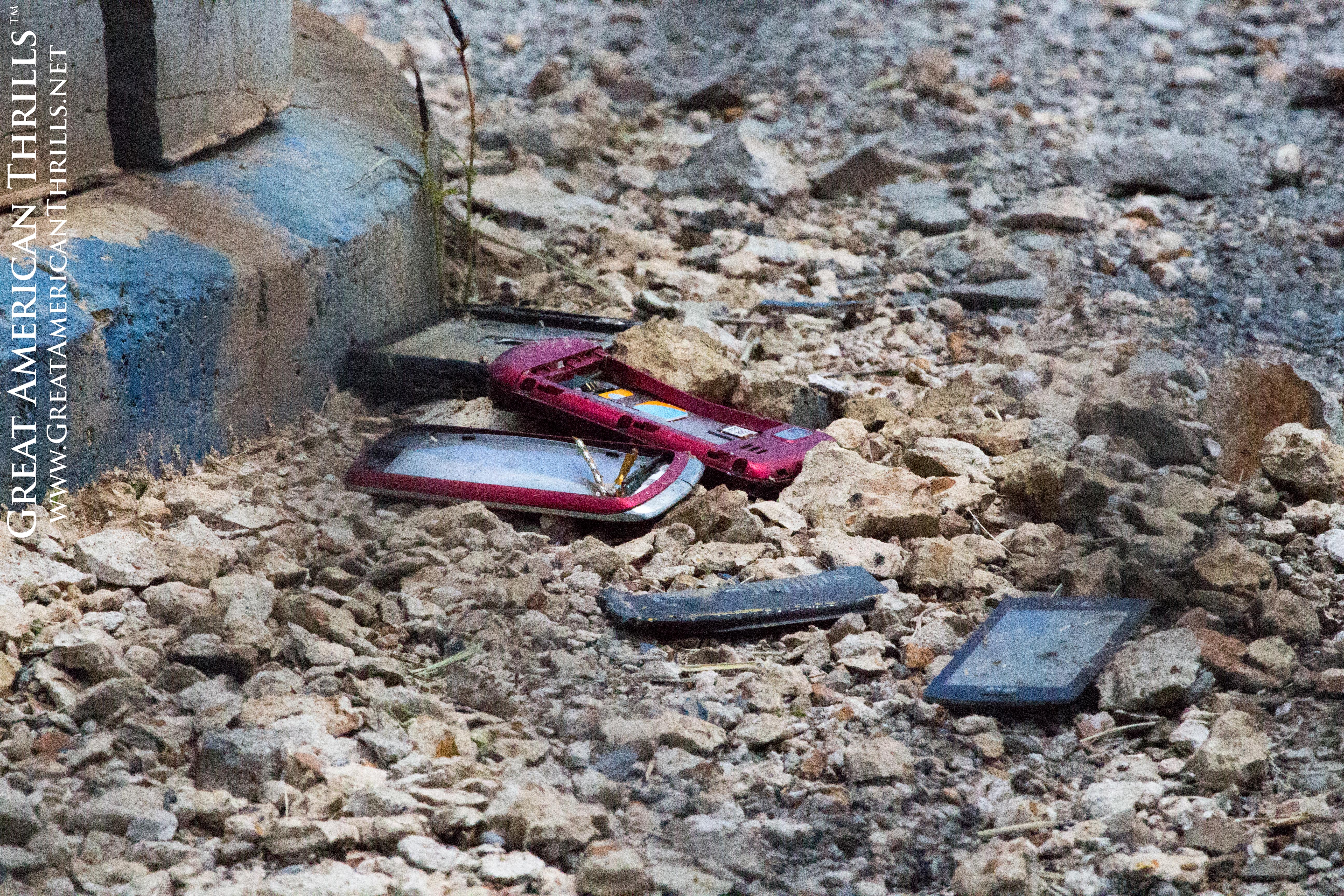
Big thanks goes out to my friends at BorrowLenses for allowing me to capture such beautiful photos with their gear.
Interested in purchasing / using some of my photos? Check out my 500px: http://500px.com/GreatAmericanThrills
View my videos on YouTube: http://www.youtube.com/user/GreatAmericanThrills
Follow me on Facebook: http://www.facebook.com/GreatAmericanThrills
Tweet me on Twitter: http://www.twitter.com/krowberry
+1 me on Google+: https://plus.google.com/u/1/115502587437263155125/posts
Follow me on Instagram: http://instagram.com/krowberry
Photo of the Day: World of Color at Disney California Adventure Park
There are theme park shows – and then there are Disney theme park shows.
Then there’s “World of Color.”
In my lifetime, the best show that I ever saw at any park was EPCOT’s Illuminations – the sight of the night sky turning to daylight for that brief moment still resides with me. I thought that memory would never be supplanted – until I saw “World of Color.” Years in the making and millions of dollars in R&D, and it’s safe to say that those Imagineers got it right…again. To think this photo was shot AFTER the show ends.
Just be sure to bring a rain jacket – a slight change in wind direction will leave you soaked.

In terms of event entertainment, “World of Color” takes the cake. People will begin lining up for showings two (2) hours prior.
Thanks to my friends at BorrowLenses for allowing me to capture such beautiful photos with their gear.
Interested in purchasing / using some of my photos? Check out my 500px: http://500px.com/GreatAmericanThrills
View my videos on YouTube: http://www.youtube.com/user/GreatAmericanThrills
Follow me on Facebook: http://www.facebook.com/GreatAmericanThrills
Tweet me on Twitter: http://www.twitter.com/krowberry
+1 me on Google+: https://plus.google.com/u/1/115502587437263155125/posts
Follow me on Instagram: http://instagram.com/krowberry
Gold Striker Video – Rider Reactions
With Gold Striker now officially open to the public at California’s Great America – enjoy this on-ride video of myself and “Lost Parks” Producer, Nicholas Laschkewitsch (who is also the ACE NorCal Asst. Regional Rep) taking in a ride.
Gold Striker NOW OPEN at California’s Great America
Yes, it’s official. As of this afternoon, the Gold Rush has officially met your adrenaline rush – GOLD STRIKER at California’s Great America is now offically OPEN TO THE PUBLIC!
Look for a full media review in the next few days – but for now, get out and enjoy Gold Striker at California’s Great America!
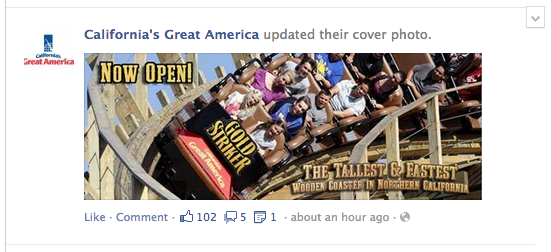
Gold Striker is officially open to the public!
Social Media and Your Amusement Park

Arguably, the biggest change in terms of marketing in the past decade has to be the meteoric rise of social media.
In the past (referred to as web 1.0), parks and attractions had fan pages or message boards that covered daily events or changes. In some cases, these outlets also promoted the park in a positive light, but that wasn’t always guaranteed.
Today (in web 2.0), parks now have the ability to schedule and control messages to potential and repeat customers on an ongoing, daily basis. Even the best television campaign could not reach such a targeted audience.
But, being relatively new to the game, many parks don’t quite understand how to use social media properly to benefit them. Sadly, in many cases, parks are shooting themselves in the digital foot.
So how then can your park or attraction avoid the most common pitfalls of social media?
1.) Social media means just that – BE SOCIAL!
The point of social media is to start (or maintain) a conversation. Whether it’s between you and your customers, or your customers and potential customers – once a story or idea starts online it can quickly lead to revenue, if it gains enough traction and virality.
However, simply throwing up a daily update on something cool about the park is not going to reach most of your audience. Just because you have 50,000 likes on Facebook, does not mean all 50,000 are seeing your post.
Not everyone enjoys pretty pictures – some are more engaged with a “What’s this Part” or “Flashback Friday” post. Create a weekly checklist of specific post types so that you can reach a greater majority of your online audience.
2.) Always promoting an item or product is social media poison.
Yes, we’re all looking for a quick return on investment, but consider this: If you throw away junk mail whenever it comes in your mailbox at home, why wouldn’t you do the same if presented with the same situation on your social media channels?
While a thinly veiled call to action is okay every now and then, it’s not good to fill your feed up with “BUY THIS!” in each and every post you put out. Simply put, lose the 1960’s “Mad Men” advertising jargon that we all have had been beaten into our heads over our lives, and be more, “real.”
That being said, don’t forget that your social media posts are a major (and instant) public-facing outlet that has the potential to reach millions if something goes awry.
Simply put, social media is not something you assign your seasonal marketing intern as a fun project. It should be a full-time position, as it can actually keep your audience engaged (and spending money) even in the off-seasons.
3.) While your park or attraction may close for the night, your social media feeds don’t.
Remember that the internet is on 24/7/365. While a majority of posts are made between 8:00am and 8:00pm, that can change depending on your audience and operating hours. Responding to posts, both good and bad, in a timely manner can mean the difference between closing a sale and losing a customer for life.
In addition, the larger your social media audience becomes, the more susceptible you become to nefarious postings, such as links to pornography on your public facing wall or feed. The faster you can pull them down, the less people will have seen it.
4.) Negative feedback on your social media feed is an opportunity, not blight.
The absolute, worst behavior a park could do when managing negative feedback on social media is to simply ignore it. There are very limited circumstances where a deleted comment or all-out ban from the page could be necessary, but if managed properly, these situations are rare.
Nothing will make an angry guest feel better than to know that someone is listening or trying to rectify the situation. Even if it’s simply re-iterating a policy that the guest does not agree with, it’s still better to show the effort to others on the feed than to delete it or worse, ignore it altogether.
5.) Stir (and track) conversation with park centric hash tags, but don’t make it too complicated
Remember the old “Kodak Photo Spot” in your park? Hash tags are the new photo spot. Create a simple one to see what people are doing and saying in your park, along with mentions of things that people may talk about, such as new attractions.
Because you’ll be tracking mentions and hash tags, you’ll quickly discover that a good majority of your social media content literally writes or creates itself. You can share guest photos, positive experiences and interact directly with them. I guarantee they’ll want to share with all their friends and family that, “…’So and So Park’ re-tweeted my pic!” That’s social media at work.
6.) Use cell phone photos only when absolutely necessary – have a DSLR with you.
Cell phone cameras are convenient, yes – but they have limitations in terms of quality. While it’s easy to post an update from inside your park via phone, try to resist. A higher quality photo – from a SLR style camera – will allow you to add logo watermarks back in the office. A higher quality photo will also encourage people to save it on their desktop or share it with others – where it will always be in front of them at work, home or their mobile device. And your logo is right there next to it.
Shares and re-tweets, however can be cell phone shots – as these are directly from guests. A higher quality photo automatically sets the parks’ content above the guests, so it becomes more recognizable.
7.) Use the outlets that work the best for your skill and for your park.
While it’s not a bad idea to get your feet in the water on as many of the popular social networks as possible – beware that they all have different audiences and content requirements. Google+ tends to be a more educated, affluent crowd. Instagram requires only photos, while Pinterest is weighted heavily towards women.
Don’t try to overreach when you first start off – go with the outlets that make most sense to you and your audience. Once you’re comfortable, slowly begin to expand. Sometimes too much of a good thing is well, too much!
Review my prior posts about “Social Media and the Amusement Park” here.
About the Author:
Kris Rowberry has been following the amusement industry for over 15 years. He is the creator and host of both “The Lost Parks of Northern California” and “Great American Thrills®“
Photo of the Day: Tatsu at Six Flags Magic Mountain
When you build a ride at Six Flags Magic Mountain, there’s an expectation that it has to be bigger and badder than the rest. Tatsu is definitely one of those coasters.
Built on the top of the large hill that defines the park, Tatsu is easily the most intense flying coaster built by Bolliger and Mabillard. I dare you to find a better lift on a ride – as you climb, the terrain falls below you, giving the illusion of rising much faster than you actually are!

When it opened, Tatsu featured the largest inversion on a flying coaster – the VERY intense “pretzel loop” element.
As always, a big thanks to my friends at BorrowLenses for allowing me to capture such beautiful photos with their gear.
Interested in purchasing / using some of my photos? Check out my 500px: http://500px.com/GreatAmericanThrills
View my videos on YouTube: http://www.youtube.com/user/GreatAmericanThrills
Follow me on Facebook: http://www.facebook.com/GreatAmericanThrills
Tweet me on Twitter: http://www.twitter.com/krowberry
+1 me on Google+: https://plus.google.com/u/1/115502587437263155125/posts
Follow me on Instagram: http://instagram.com/krowberry
Photo of the Day: Carousel Columbia at “Blue Hour”

Quite simply, this is one of the best long exposures I’ve ever taken. Done with a Nikon D7100, 24-70mm lens and NO tripod – just stayed as still as possible. Columbia is still the World’s Tallest Carousel as recognized by Guinness World Records at just over 101 feet tall.

Still the tallest carousel in the world, Carousel Columbia makes for a stunning subject at night. Now, if only all the accent lighting were working…
As always, a big thanks to my friends at BorrowLenses for allowing me to capture such beautiful photos with their gear.
Interested in purchasing / using some of my photos? Check out my 500px: http://500px.com/GreatAmericanThrills
View my videos on YouTube: http://www.youtube.com/user/GreatAmericanThrills
Follow me on Facebook: http://www.facebook.com/GreatAmericanThrills
Tweet me on Twitter: http://www.twitter.com/krowberry
+1 me on Google+: https://plus.google.com/u/1/115502587437263155125/posts
Follow me on Instagram: http://instagram.com/krowberry
Cirque Dreams Splashtastic at Six Flags Discovery Kingdom (Show Review)
Yesterday evening, Six Flags Discovery Kingdom was kind enough to invite Great American Thrills™ out to the park for an exclusive preview of their latest entertainment offering – “Cirque Dreams – Splashtastic.”
The colors of the performance – just like the performers – are vibrant & stand out.
This program is unlike anything we’ve experienced here at a Northern California park – it’s very glitzy and the production value is VERY high. If you were a fan of the “Marriott Era” of entertainment offerings at, say Great America, or the quality of shows that Disney parks offer – then this show will bring back good memories for you.
It also sets a very high precedent for entertainment offerings in the coming years at all the Bay Area amusement / theme parks. (I.E. You’re on notice!) Unlike many other shows at parks which are produced in-house, Cirque Dreams – Splashtastic is a partnership between Six Flags Discovery Kingdom and Cirque Productions.
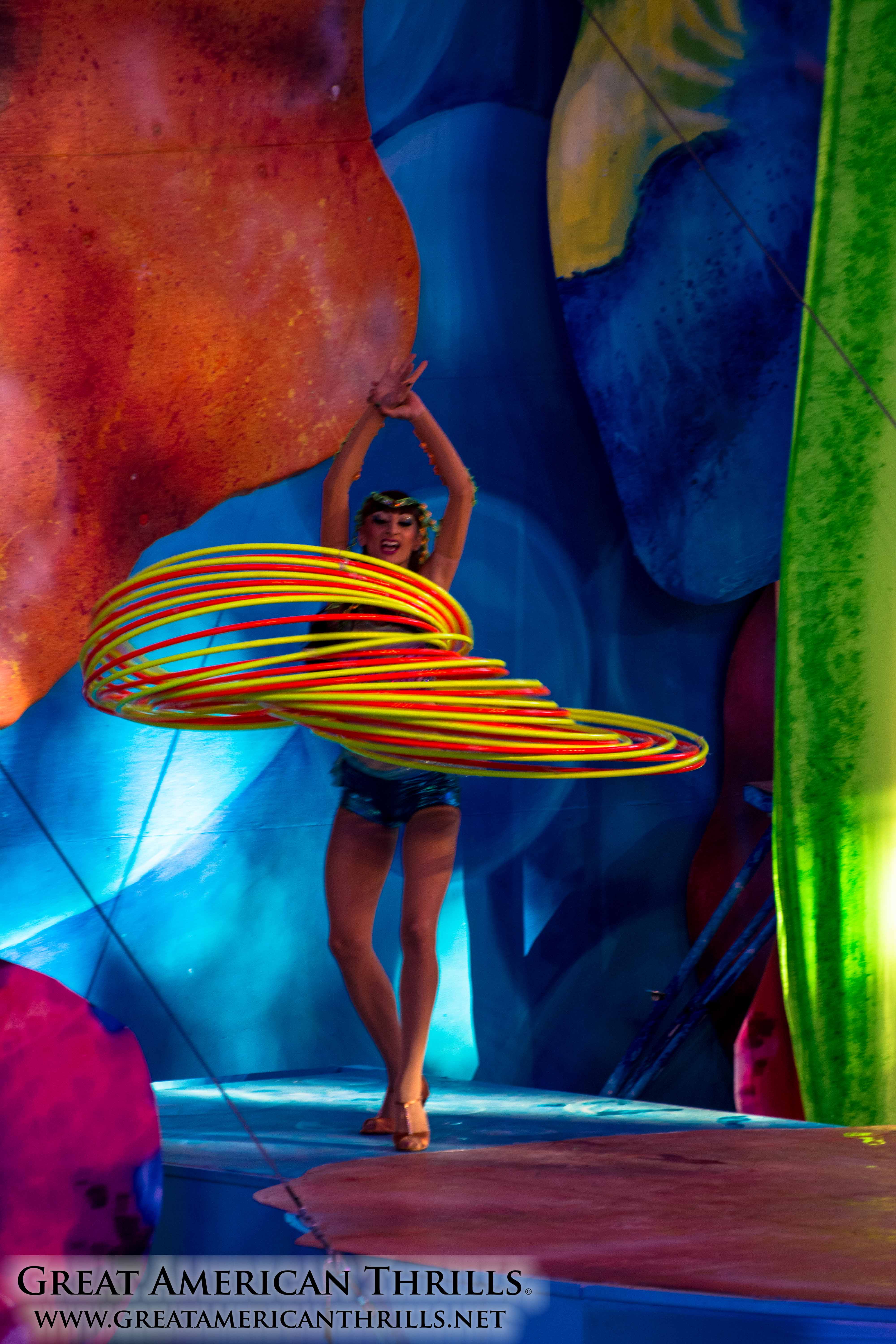
There are seven individual performances in all, this one featuring a hula loop artist.
If you’ve ever been to a “cirque” style show before, you’ll see many of those elements in the program (we can’t really call this a show – it’s much more than that). The program features a showcase of talents, that as the park says, “…combines the grace, power and agility of our bottlenose dolphins and the amazing spectacle of of true performance artists…”

If you don’t feel out of shape after looking at this, you must be one of these two performers!
As you would expect, the entire program is themed with an aquatic flair to it. Costumes mimic sea life, actors are adorned with prosthetics to give them a more “fishy” quality and the entire amphitheater (formerly Dolphin Harbor Stadium) is adorned with colorful graphics strewn about the facility.
There are seven parts to the show in all, each with their own featured characters and skills on display. During pre-production of the show, nearly 300 acts auditioned to be one of those seven featured performances.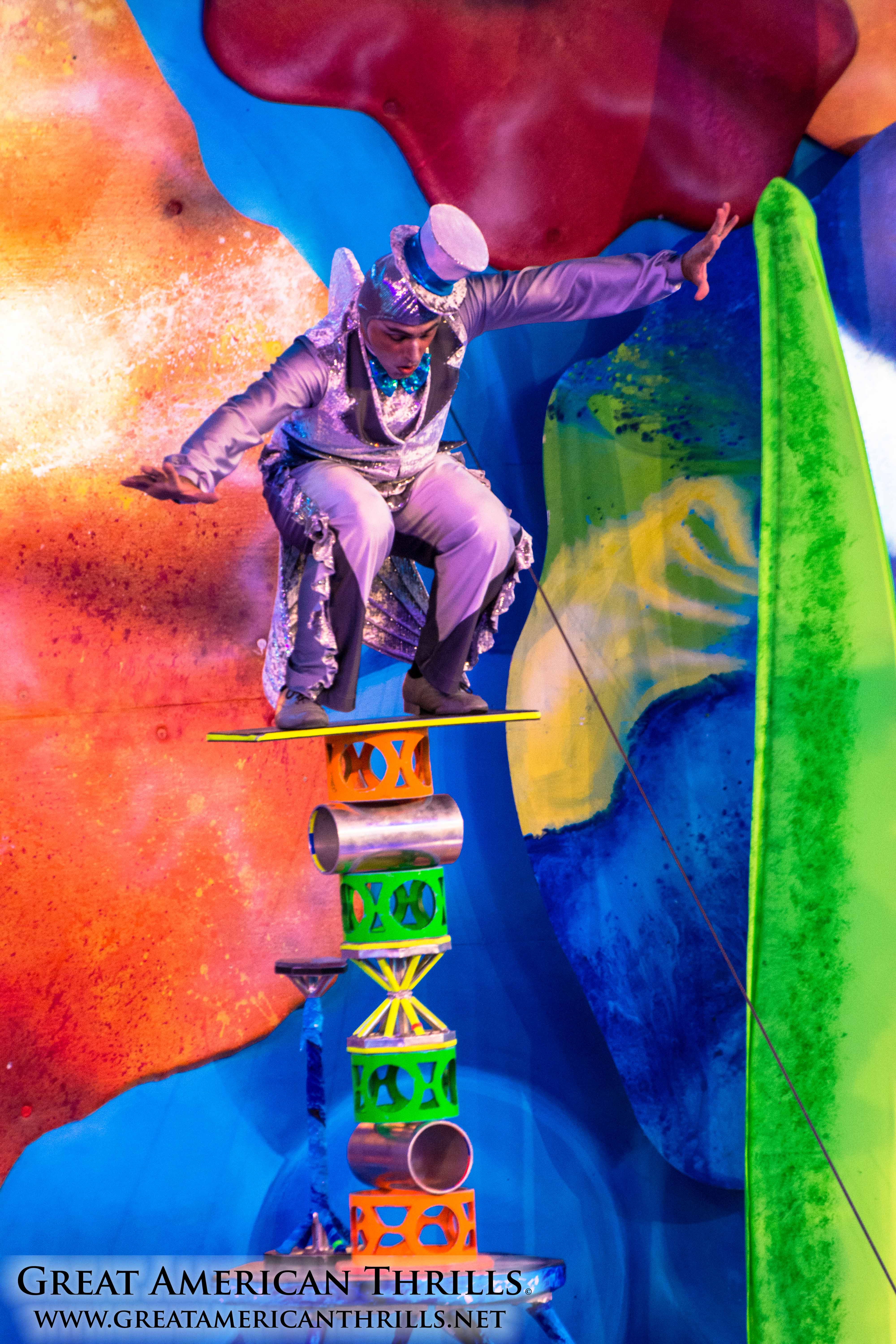
The pace is good and the program keeps moving for the most part with no real lag time. During the human performances, the dolphins show off their stuff as well, including a particularly entertaining dolphin hula hoop behavior that you’ll simply have to see for yourself.
The show was created, produced and directed by Neil Goldberg, an acclaimed Broadway director who also founded the Cirque Dreams troupe over 20 years ago. In other words, this guy knows what he’s doing.
“Our goal was to complement the personalities of the dolphins and performers through playfulness…and unparalleled showmanship,” said Goldberg. “It will be one of those unique, memorable entertainment attractions rarely experienced.”
I’ll be posting a full, exclusive interview with Goldberg later this week.
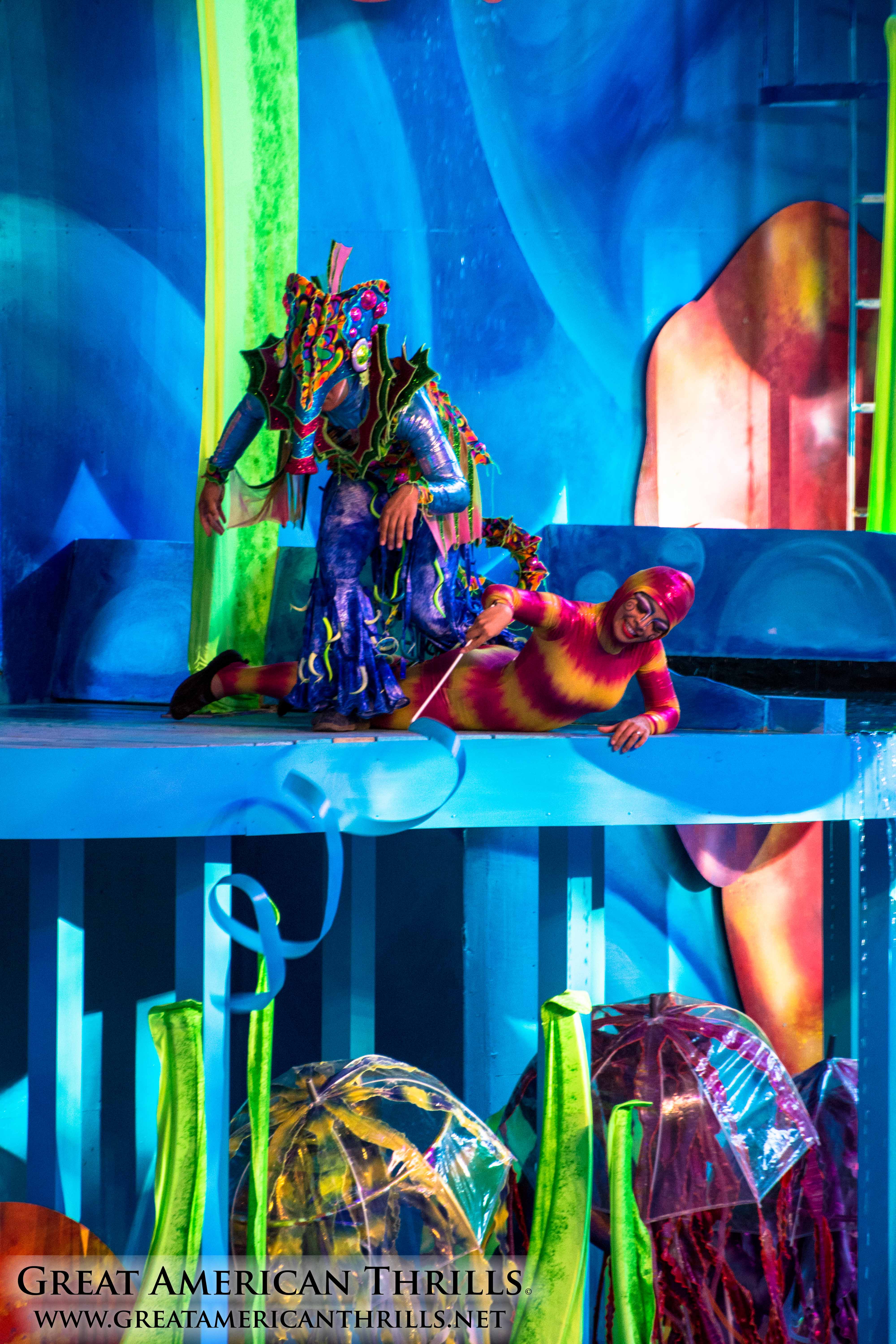
Colorful characters abound in this production – the first for a Northern California amusement park.
The only thing that I can find wrong with the show, is that it has a limited run – just from Memorial Day Weekend though August 11th. But in a way, that works – it makes it a limited engagement, so the performances are better and more special to those who witness them as spectators. It’s quality over quantity, and something that most parks would not think twice about.
I’ll be posting a full interview with the Creator and Director of Cirque Dreams Splashtastic, Neil Goldberg, later this week.

The dolphins are not always at center stage, unlike how most aquatic shows tend to be – rather, they work in tandem with the performers to create a sort of serendipity on stage.
For now – get your plans in now and get out to Six Flags Discovery Kingdom to experience this one of a kind piece of amusement park entertainment – it’s certainly worth the trip.
As always, Great American Thrills™ would like to thank those who made this post possible: Neil Goldberg, Nancy Chan, Lee Munro as well as the entire staff and crew of Six Flags Discovery Kingdom and Cirque Dreams – Splashtastic!

The entire cast takes a bow at the end of the program – to a standing ovation no less – during the first public performance.
Interested in purchasing / using some of my photos? Check out my 500px: http://500px.com/GreatAmericanThrills
View my videos on YouTube: http://www.youtube.com/user/GreatAmericanThrills
Follow me on Facebook: http://www.facebook.com/GreatAmericanThrills
Tweet me on Twitter: http://www.twitter.com/krowberry
+1 Me on Google+: https://plus.google.com/u/1/115502587437263155125/posts
Follow me on Instagram: http://instagram.com/krowberry
I rent all my camera gear through my friends at: BorrowLenses
Top Five Most Terrifying Amusement Park Mishaps of All Time
You see it all the time come the summer months, “Killer ride injures passengers,” “Man dies after roller coaster ride.” Heck, search, “roller coaster accident” on YouTube, and you’ll find no shortage of videos – mostly of rides undergoing a “safety cut out” where all trains simply stop where ever they are in the circuit.
While these “stories” are mostly media spin, incidents have and still do occur – however many are a direct result of disobeying park rules and regulations. With that being said, here now are the five most terrifying (actual) amusement park mishaps:
5. Happiest Place on Earth?

Monorail track is not an alternative to the front gate.
Disneyland has certainly seen it’s fair share of problems over the years. Nine people have been killed in the park (although officially they all died ‘on the way to the hospital,‘ as no one ever dies in Disneyland‘).
Seven of the nine deaths can be directly attributed to disobeying park rules or trespassing. Two have drowned in the Rivers of America. An employee who wasn’t aware of her surroundings was crushed in the “America Sings” Theater.
But the one we’ll focus on is the story of Thomas Guy Cleveland, who at 19 years old, had the brilliant idea of getting into the park via the monorail track.
Amazingly, he scaled the 15 foot track, avoided the 240V power line and began his trek to get into Disneyland immortality.
When security spotted him – naturally he began to run down the beam to avoid them. What he didn’t realize, was that they were trying to warn him that a monorail was approaching and that he should jump off the beam.
He didn’t jump off – and he didn’t get into the park for free, either.
This is certainly not the first time that someone has been killed jumping fences or at least trying to at an amusement park. This kid is lucky he still has life after diving into Jurassic Park: The Ride to retrieve his lost hat – while the ride was running. Not the brightest bulb in the set. Even if you’re not a fan of amusement parks – this video will make you cringe.
It just proves – you can’t stop stupid – no matter how many fences, gates and signs you put up.
4. Perilous Plunge – Knott’s Berry Farm, CA (2000-2012)

Perilous Plunge was plagued with delays, malfunctions and modifications in its’ 12 year run. (Photo by Knott’s Berry Farm.)
When it opened in 2000, Perilous Plunge was the tallest, fastest, steepest (and wettest) flume ride in the world.
It was also the most temperamental advanced water ride of its’ time, requiring complete computer control and even a magnetic braking system built into the base of the ride to stop it in the limited space available for a splashdown pool.
During a special event at the park, a woman somehow slipped out of the ride’s lap bar restraint system on the drop, killing her instantly. Investigators believed that because she was so overweight, her mass shifted violently in the steep drop, causing her to fall out.
The boats on the ride were later modified with 5-point racing harnesses as additional restraints – then converted to standard, over the shoulder “horse collar” restraints. The entire attraction was scrapped in late 2012 for future expansion.
3. Crystal Beach Cyclone – Ontario, CN (1927-1946)

Traver’s most successful of his “terrifying triplets.”
The most famous of Harry Traver’s designs, the Cyclone was and still is considered to be the most intense roller coaster ever built. With speeds approaching 55 mph and g forces in excess of +5, there aren’t many steel coasters today that can pull that off. (And the Cyclone was wood, with a steel lattice structure.)
Considering the ride ran for nearly 20 years with only a single fatality was mind boggling – how it happened is even more head turning (Literally).
Turns out in 1938 – on opening day of the season, no less – Amos Wiedrich allegedly stood up to take his coat off, after the ride had begun. Because he was out of his seat on the first drop, he simply fell out from the forces. To ad insult to injury, he was hit seconds later by the train he had been riding in when it came back around through the circuit.
Oh, did we mention this was the only roller coaster in history to have a Nurse’s Station at the exit? (Apparently it was all for show, but considering the damage this ride could have done, it may have been a worthy investment to keep the insurance down!)
2. Action Park “Cannonball Run” – Vernon, NJ (1985-sporadically into 1996)
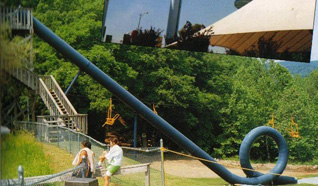
Someone apparently thought this was a good idea.
Yes, you heard me right, looping water slide. Long before parks were marketing 45 degree pitched slides as “looping” Action Park in New Jersey had them beat with a bona fide vertical looping water slide.
According to most reports, the ride was open for one month in the summer of 1985, then was opened sporadically through 1996, when it was eventually torn down.
By principle, it *should* have worked – but that wasn’t the case…ever.
Concussions, abrasions and the possibility of being stuck in the slide were all risks people were willing to take to get on this ride – well, that and allegedly $100 bills that park management bribed them with to try it.
You can read a first hand account of the ride from someone who actually experienced it here.
On a related side note – Action Park (and many of it’s “groundbreaking, people breaking” attractions) was closed in 1996, and re-opened as Mountain Creek Resort in 1997. All of the non-conforming (i.e. unsafe) rides, including the looping waterslide were destroyed – with newer, safer ones replacing them (Though, that’s up for debate).
1. Lightning – Revere Beach, MA (1927-1933)
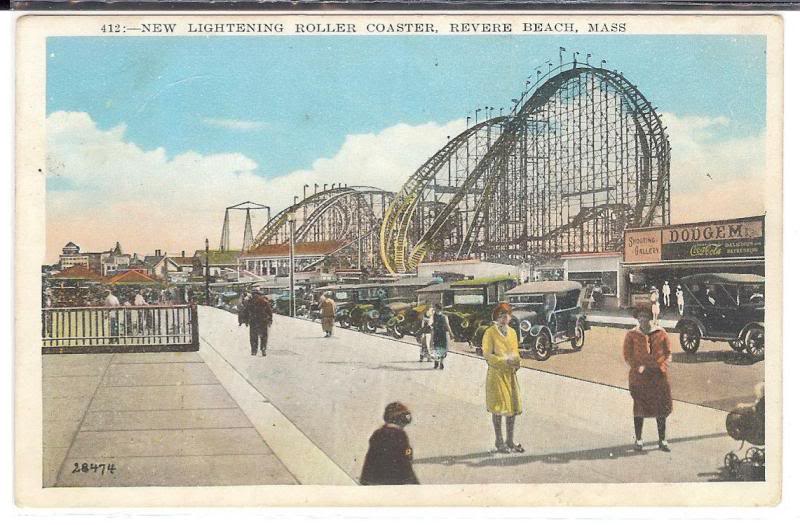
Revere Beach’s “Lightning”
The last of Harry Traver’s infamous “Terrifying Triplets” – Lightning was so twisted, most riders could not handle the brutal forces exerted on them.
On the second day of operation, a young girl was somehow ejected from the ride and died after hitting the track below. According to lore, the ride was shut down for 20 minutes, “…so they could remove the body.”
That’s right – the ride was back up and running after only 20 minutes. Odds are, the line increased quite a bit, too.
Back in the 1920’s it wasn’t unheard of for a ride to become more popular after it killed someone. Today, we have a bit higher standards and regards for our personal safety, thankfully.

Roar! at Six Flags Discovery Kingdom in Vallejo, CA
Sharp eyed coaster fans will notice that both the Lighting and Cyclone first drops have a modern counterpart. Both the “Roar” wooden coasters at Six Flags Discovery Kingdom and Six Flags America share the similar first drop with Traver’s triplets.
So, will we ever see another Crystal Beach Cyclone, or looping water slide? At the rate safety technology is going – I certainly wouldn’t put it out of the realm of possibility. Just look at how far we’ve come in just the past 90 years!
—
And there you have it – ten of the most terrifying amusement park mishaps of all time.
It should be noted, that while awful and scary as some of these incidents are, they are also an infinitely tiny minority of the total rides taken over the course of history.
Many of these instances occurred before the advent of safety regulations, government oversight, understanding of g-forces or restraint technology.
The odds of you being injured at a modern amusement park are actually lower than when you are driving to the park itself. So be smart – obey the park rules and you’ll have a fun and safe time!
Gold Striker *ACTUAL REVIEW* at California’s Great America

“Wow.”
That’s the word most people were saying after they got off Gold Striker this evening. While not open to the public yet, California’s Great America invited people, including yours truly, to come out and participate in a promo shoot for commercials and still advertising.

Gold Striker looms large over Carousel Plaza and the front entrance to the park.
Folks, this ride is the REAL DEAL and is setting up to be a real “sleeper hit” across the country. Most people know Great America as a park that seems to enjoy removing rides rather than building them. Gold Striker might just make you forgive them (maybe).
The fun starts before you get to the lift hill (that’s right, BEFORE you get to the lift hill!) Folks in the rear seats will appreciate the incredible whip of the turnaround out of the station, which could be the tightest I’ve ever seen taken at speed before on a woodie) and those in the front seat will appreciate the airtime (yes, I said AIRTIME) on the bunny hill before the lift.
After ascending the lift, riders enter the “initial descent tunnel” and that’s where all hell breaks loose. The ride is fast, noisy and the effect of blasting out fo the tunnel is impossible to describe.
From there the ride does a VERY close flyby of the station stairs, giving wonderful photo / video opportunities. A floater hill and a few head choppers later, the ride finds it’s speed…and keeps it until the brake run.
I don’t want to completely ruin the ride for you, but know that there are many “pops” of air on this ride, usually to set you up for another element. Call it a “tag team coaster” because they work perfectly together.
Coming into the final turn, you hit the magnetic (it’s Silicon Valley, gotta have some technology) and then back to the station. Pictorium fans will be saddened to learn that two of the entrances have been demolished, but the building itself still stands.
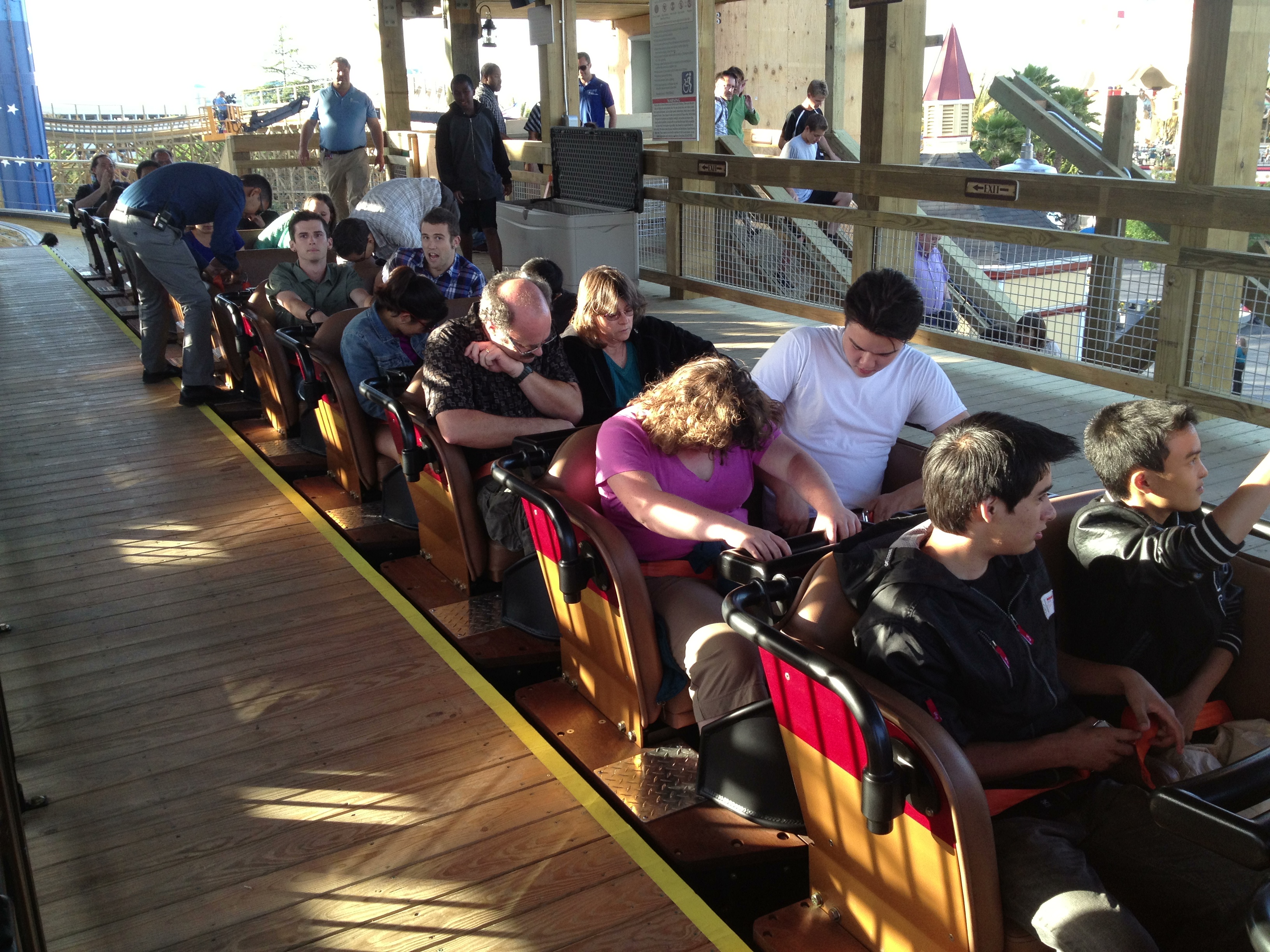
“Millennium Flyer” trains harken back to the “Golden Age” of coaster design. The trains are Gold / Red, Red Gold – in 49ers shades.
To quote my ride mate for this marathon session, “Airtime is back with GCI.”
We squeezed in nine (9) rides before the park shut down the line. Average wait times were 15 minutes, shrinking as more and more of the general public left. This ride is NOT EASY to marathon, but for all the RIGHT reasons. It is INTENSE, BREAKNECK PACED and to be quite honest, many of us in attendance were pinching ourselves, wondering how we got this ride to come here in the first place.
So, in conclusion…
This is a winner all-around for a park more recently known for REMOVING rides than ADDING them. Be prepared for sharp transitions, “set up” surprises and well-timed elements. The ride is smooth with little attitude. This is not an, “airtime machine” but it has well over 8-10 (I kept losing count) pop airtimes. There are moments when you’re riding only on up-stops.
Now, you can take your kids on Grizzly as a warm up and test their (and your) mettle on Gold Striker.
In my opinion, this coaster could EASILY take on El Toro in national polls and in many cases it should WIN.
The ONLY thing missing from this ride…is YOU!
To learn more about Gold Striker or to purchase tickets to the park, visit www.cagreatamerica.com

 Great American Thrills®