
New Amusement Park Rides Delayed Significantly This Summer
Remember when new rides and attractions opened with the start of the season at your local amusement or theme park? That’s certainly not the case this year.
A record number of attractions are still fighting to open up for the season, this as many parks pass the halfway point of their operational calendar.
And it’s not just one factor that’s throwing things off – it would appear the entire industry ran into a figurative “buzz saw” when it came to opening attractions on time this year. Here’s a list of attractions off the top of my head that have found themselves “behind the 8-ball” just this year:
Falcon’s Fury
Zumanjaro Drop of Doom
Diagon Alley
Verruckt
Break Point Plunge
Goliath
Big Thunder Mountain Railroad
New England SkyScreamer
Now, I say “behind the 8-ball” for this reason: parks advertise their newest product to get people excited to come back next year. But if you (or your group) came early in the season, you more than likely missed out on the new attraction completely (at least, this year).
Even professional park travelers like myself plan for and anticipate delays for new rides – but even we’ve been taken aback at rides opening beyond the Fourth of July – especially in seasonal parks closed in the winter.
So what’s behind all these rides having what I consider to be major delays in opening? Are they too extreme or complex? Or is it sometime much simpler? Let’s take a closer look:
Weather:
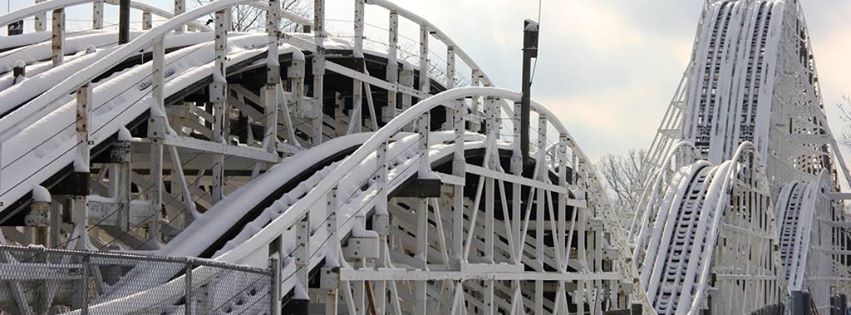
Photo courtesy of Kings Island Facebook page.
This was the worst winter on record east of the Rocky Mountains. In many cases – construction couldn’t even start until the snow was moved and the ground thawed. Sadly, that didn’t happen until April in some places. (It was still icy in the Great Lakes in JUNE).
Fabrication:
There are only so many pieces that can be built by these companies, some of which employ less than 50 employees. If a company waited to buy a product until late in the season, they’ll be at the end of the line, so to speak to receive their new products.
Bureaucracy:
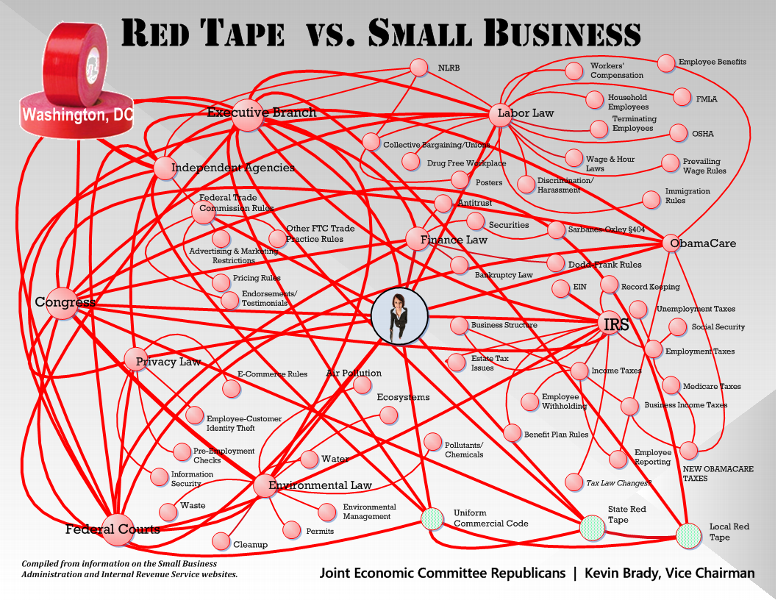
“Red tape” has done more to kill off parks than it has to make them safer!
If you’ve ever played the game “RollerCoaster Tycoon” you know it’s quite easy to build new attractions. But if the game were to be truly accurate, players would have to spend more time in the local permits office than managing their park. The litany of paperwork and regulations ended up killing a famous water park here in California.
While most point to the Golden State as the epicenter of red tape (See Gold Striker’s struggles to finally open) the East Coast is now getting into the act.
After a brutal winter prevented construction for most of the off-season at Six Flags Great Adventure, Zumanjaro – a world record free fall in New Jersey, was finally ready to open for season pass previews after months of delays…
…only to be told by the State that their ride inspector would not be able to get out to the park to officially sign off on its operating permit. Whoops.
Design Flaws / Challenges:

Verruckt required a complete re-design after tests showed it wasn’t performing as predicted.
Whether it’s too complex in terms of computer and electrical systems – or just a bad design to begin with – sometimes rides don’t transfer perfectly from the computer and drafting board to the real world. All parks (except the old Action Park) have guests’ safety as their number one priority – and if it means opening a ride late to ensure it does not hurt, maim or kill people – it’s a delay that’s always worth taking.
So will all of the rides and attractions open by the end of THIS season? Only time (and a host of other factors) will tell. One can only hope that parks can get “back on schedule” next year and start debuting rides when the season begins (or shortly thereafter).
What do you think? Are there any other factors I might have missed? LEave me a comment either below or on my social media channels – I’d love to hear what you think!
Insane Coaster Wars debuts new season, but still needs some off-season rehab
After filming all last summer, Indigo Films‘ “Insane Coaster Wars” debuted it’s third season last night – and I can’t help but comment on their latest “effort.”
The premise of the show, is a decent one – have people vote on specific aspects of certain rides, then rank them against other coasters around the world. Seems straightforward, right?
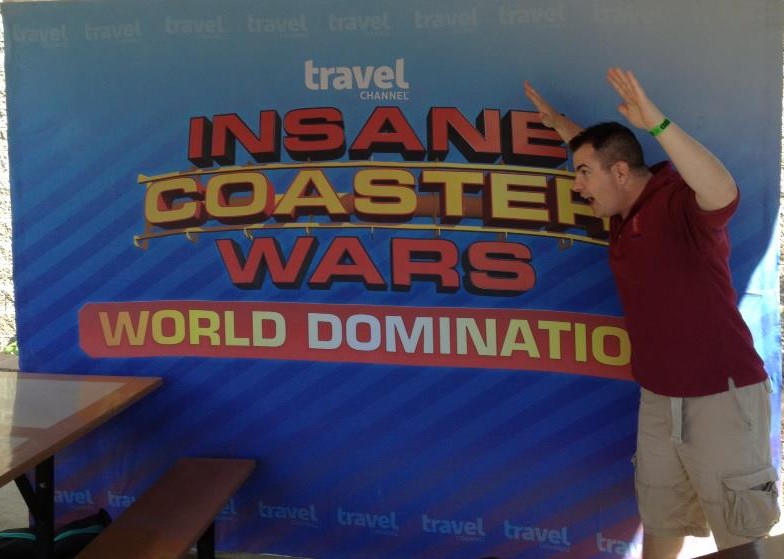
Experiencing a film date in St. Louis last summer.
At issue with most coaster and park enthusiasts (who make up a large number of the viewing audience) however, is the continued downgrade in quality of the traditional summer “coaster show” over the past few years. “Insane Coaster Wars” is just the latest in a string of low budget, low quality productions from powerhouses like the Travel Channel and Discovery. Just look at some of the reactions from last night’s debut:



So what can this show do to make itself better in the eyes of it’s core audience? Read on:
1.) Stop hiring actors and talk to real “coaster enthusiasts”
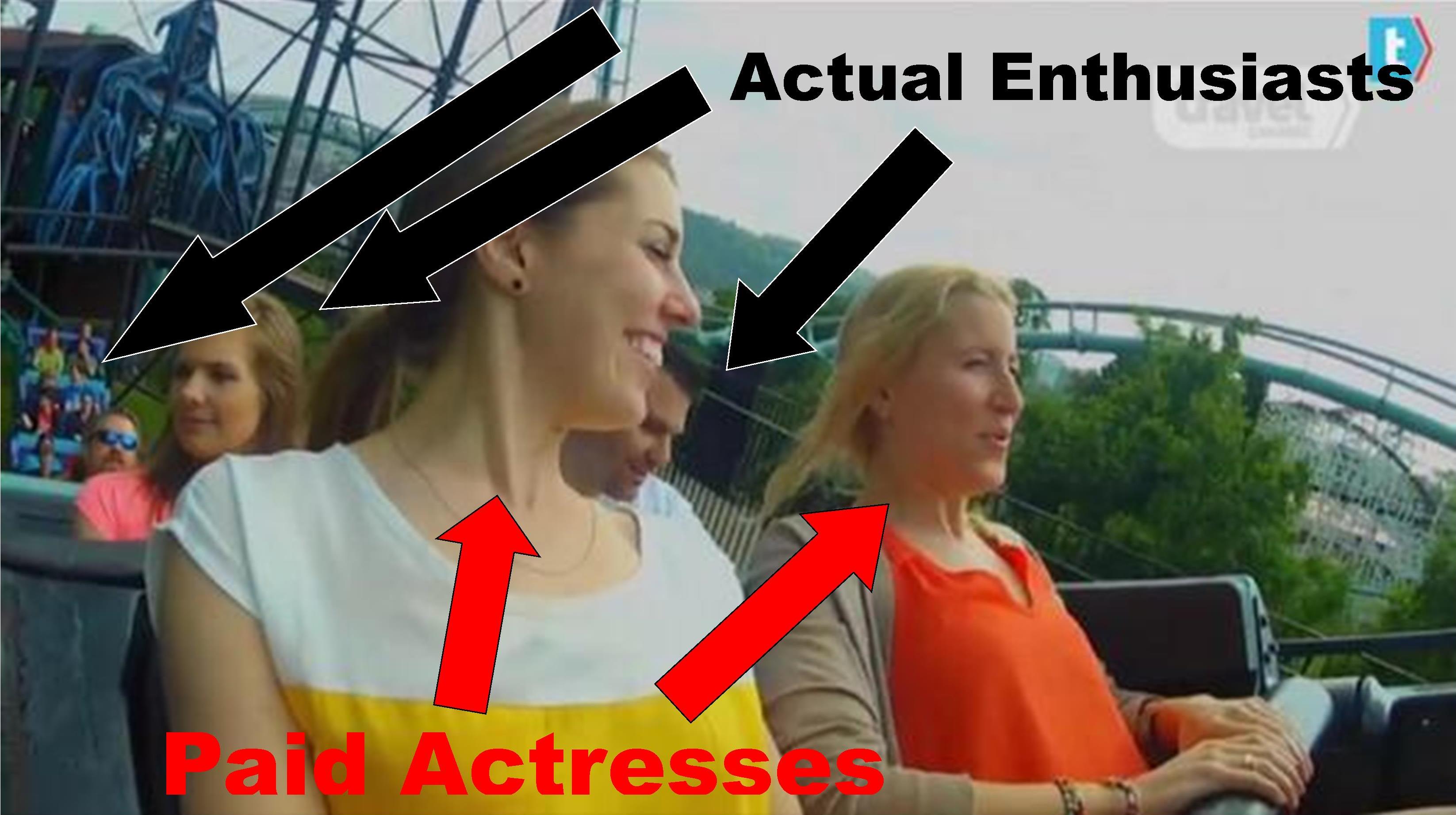
Original screengrab by Dan Hower (who’s also in the second row with Alyssa Schipani). Used with permission.
SPOILER ALERT: Television isn’t what it always appears. Multiple sources have confirmed to this website that the “coaster enthusiasts” featured in each segment are actually…wait for it…local actors found on Craigslist, hired for around $300 each.
Yup, Craigslist. Home to “Casual NSA Encounters” and apparently beautiful & young roller coaster junkies. Didn’t you wonder why those featured riders always seemed to speak really good english…in the middle of Taiwan and Costa Rica?
Those “friends from college” who “visit the park all the time” – it’s usually their first trip ever to these parks. Yet, the graphic in the lower third clearly says they’re “Coaster Enthusiasts.”
Last night’s episode featured two “coaster enthusiasts” who had never been to Kennywood – and in fact, had not been to a park, “in years.” True enthusiasts don’t take years off – they rarely take months off.
What’s even more ironic – if the production company wanted to save up to $1200 per segment (and it’s obvious they do) simply stop hiring actors – just call on the local region of the American Coaster Enthusiasts – not to just fill the seats, but to TALK on camera. Not only are many of our members familiar with being interviewed – we’ll do it for FREE!
Some of the phrases that are used by these actors must also drive park managers nuts. Things like, “I felt like it was about to fly off the track,” or “I can’t believe I survived,” really make PR Managers have GREAT days. Simple rule to follow: Never mention death or dismemberment on TV when referring to amusement parks. You don’t say “bomb” at airports and on planes…
2.) Compare rides “Apples to Apples”
Outlaw Run and La Avalancha? How are those two rides even remotely similar? (They do both loop, but they’re built completely different). The best way I can describe it – it’s like comparing apples to oranges. It’s as if the people in charge took suggestions from people who actually knew what they were talking about – then threw those papers up in the air, and randomly pulled out rides.
3.) Be wary of those who make money off parks
Robb Alvey – who was once the “host” of the program – has now been relegated to a “Creative Consultant” production credit off-screen (which is a major improvement in my humble opinion). That being said, his wife was featured on the premiere show as a coaster enthusiast, along with one of their friends. I’d call them non-actors, but both he and his wife have agents.
Now, doesn’t this scream nepotism to anyone else besides me? Then again, at least us true coaster enthusiasts know she actually is quite knowledgeable about the subject. Too bad the producers edited her in a way that ensured she sounded just like any other clueless park guest.
Don’t even get me started on how his presence on the production team could directly influence his view count (and income) on his commercialized videos on YouTube…
4.) Allow park experts or bloggers to vote, not the general public
Let’s face it – most of these Craigslist actors (and indeed other park guests) don’t even know about the other rides they’re comparing, so how exactly can you compare them if you’ve never been on them…oh wait, isn’t that how the Mitch Hawker Poll runs? : )
Conclusion:
While the show did make some minor improvements and tweaks, it’s still the same copy / paste generic “coaster show” that’s polluted the airwaves for far too long. Yes, the POV is good, but it’s everything around it that just brings the show down.
If you’re looking to support a quality roller coaster / amusement park program, consider sharing our “Great American Thrills” concept with your favorite cable channel or production company. We promise the enthusiasts we feature – will actually know what they’re talking about:
Great America Pavilion the pregame destination for San Francisco 49ers fans this season


If you’re a California’s Great America fan – it’s time to start cheering. Literally and emphatically.
Yesterday, the park announced that in addition to becoming “the official amusement park of the San Francisco 49ers,” (as if there was any doubt) they will soon be opening the “Great America Pavilion,” an 18,000 sq. ft. multi-purpose facility that will be home to the Red Zone Rally pregame event for all 49ers home games, as well as other Levi’s® Stadium events.
“We’re very excited to be partnering with the 49ers on the Red Zone Rally pregame events,” said California’s Great America Vice President & General Manager Raul Rehnborg. “For 49ers fans and attendees of other Levi’s® Stadium events, Great America Pavilion will be the perfect venue to enjoy the game-day atmosphere, dine on delicious food offerings and easily access Levi’s® Stadium, which is located adjacent to the new facility”
“The Red Zone Rally will be a tremendous pregame destination for 49ers fans,” said 49ers Chief Operating Officer Al Guido.
During 49ers home contests, the Red Zone Rally at Great America Pavilion opens three hours prior to kickoff, features flat screen televisions throughout, San Francisco 49ers Gold Rush cheerleaders and alumni, an array of live entertainment, interactive activities and incredible dining options.

And when the stadium isn’t in use – the park now has a completely upgraded meeting and dining facility, that can be divided into three distinct areas or combined into one incredibly large venue. Oh, and the first event has already been held in the nearly-finished facility…Coaster Con XXXVII.
So yes, it’s not a new hyper coaster or ride – but it’s more important than that – it signals (quite clearly) a fundamental shift in the relationship between the San Francisco 49ers and Cedar Fair. Specifically, this announcement has far-reaching implications for the long-term future of the park – all positive in nature. Gone are the days of Cedar Fair Corporate (Dick Kinzel in particular) berating and indeed SUING the 49ers over a litany of issues.
It’s quite obvious that new Cedar Fair CEO, Matt Ouimet, has seen the San Francisco 49ers not as the enemy, but rather as a lucrative and positive business partner – and that can only bode well for a park that many (myself included) wrote off only seven years ago. (Lord knows Dick Kinzel tried to literally write it off according to my sources). So on the outside it may appear to just be an expansion of a picnic pavilion – but this announcement means the world to a park that’s on one hell of a kickoff return.
For more information on the Red Zone Rally, visit: www.49ers.com/tickets
For more information on Group Sales at the park, visit: https://www.cagreatamerica.com/group-sales
The Death of the Wooden Coaster at Six Flags

This past month has not been a good one if you’re a wooden roller coaster residing at a Six Flags park. The chain announced the closure of not one, but two additional woodies: the Riverside Cyclone at Six Flags New England and the legendary Colossus at Six Flags Magic Mountain.
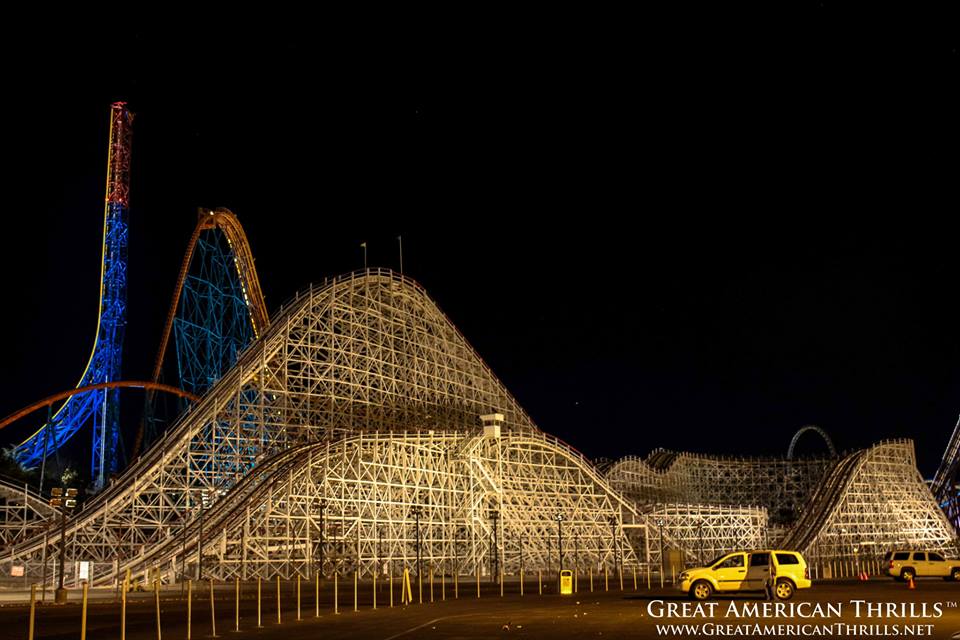
Colossus dominates the parking lot of Magic Mountain, but not for long.
1.) Park builds wooden coaster.
2.) Due to unknown reasons (some insiders claim it’s to save money) maintenance is deferred, making the ride rougher.
3.) As a result, the coaster must be modified from original form to save on wear and tear, either via brakes or “topper track.”
4a.) The coaster is EITHER removed altogether due to lack of ridership, complaints or sheer amount of work needed to repair and restore it…
OR
4b.) The coaster is modified to a steel track, provided by Rocky Mountain Construction, making it a steel coaster with wooden structure. (a la the “New Texas Giant,” “Iron Rattler”)

Iron Rattler at Six Flags Fiesta Texas
Hell, Colossus and it’s dual track hasn’t really raced for the past 20 years. Why? Usually only one track was open – you guessed it – to save on maintenance and wear. Anyone who’s ridden it this year will attest, the right side track hasn’t been used in months – and it shows.

The original drop of the Riverside Cyclone can be clearly seen below the modified drop.
So then, are we witnessing a generational shift in technology, much as our Great Grandparents saw the shift from side-friction coasters to safer (and more extreme) wooden upstop rides? Or are we witnessing a stopgap cost cutting measure? Tell me what you think in the comments section, below.
Personally, I’m torn – everyone loves the latest and greatest – but you have to remember and preserve the past, too. Wooden coasters are expensive to maintain, no doubt – but NOT maintaining them through their life ends up being more expensive in the long run.
My final thought – the Giant Dipper in Santa Cruz is 90 years old and yet it’s smoother than any wooden coaster at any Six Flags park. And yet, all of those woodies are at least 50 years YOUNGER.

New Lost Parks Episode on 1915 Pan Pacific Exposition in San Francisco!
It was our most challenging “Lost Parks” episode – ever. More locations that we’ve ever done before. More money spent than ever before – but it was all worth it.
Presenting the first episode of SEASON TWO of the “Lost Parks of Northern California” – the Pan Pacific Exposition (World’s Fair) of 1915:
Be sure to LIKE, COMMENT and SHARE the video with all your friends, family and favorite cable networks – who knows, we might someday take the show national – but we’ll need your help to do it!
Coaster Con XXXVII in the Bay Area this week
All this week, Great American Thrills will be bringing you insider coverage from Coaster Con XXXVII – the biggest event on the American Coaster Enthusiasts calendar – and the first time ever the event has been held exclusively in Northern California.
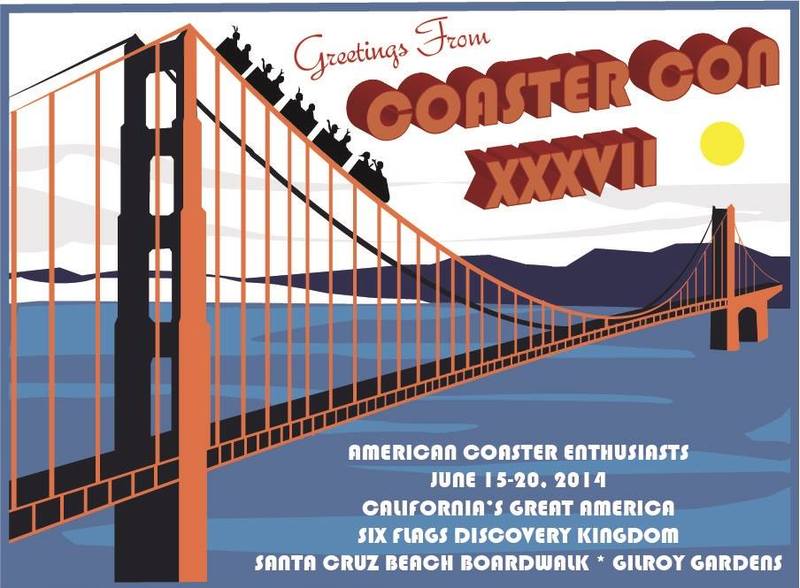
From behind the scenes tours, special VIP events and even a few surprises along the way…stay tuned to Great American Thrills as we update the site every evening.
You can also follow our social media accounts – as we’ll be updating LIVE as we can with these hashtags across all the platforms:
#CoasterCon
#GreatAmericanThrills
#LostParks
Aerial Ice Extreme Wows Guests at California’s Great America

Spotlights, trampolines, aerialists, giant hula hoops.
No, you haven’t gone to Las Vegas, you’re in California’s Great America, experiencing the brand new “Aerial Ice Extreme” show in the Great America Theatre.
After the resounding successes of both, “On Broadway” and the surprise sleeper hit, “Blades of Horror” the bar was set quite high for California’s Great America and its entertainment department to outdo itself this season. Spearheaded by Entertainment Director, Clayton Lawrence, guests over the past few seasons have seen a resurgence of quality, entertaining shows once again grace the park’s theatres.
So – would this one continue the upward trend? Read on…
Initially making a splash on “America’s Got Talent” this past summer, “Aerial Ice” combined the majesty of both ice skating (on a synthetic surface) as well as aerialists overhead. And it made an impression:
While the mishmash of ice skating, acrobatics and aerialists may seem a bit improbable – it all works out. The show is bound to draw comparisons to “Cirque Dreams: Splashtastic” that performed at Six Flags Discovery Kingdom this past season.
But, unlike “Cirque” which seemed to have way too much happening at the same time at many points – “Aerial Ice Extreme” keeps the action frenetic – but at the same time, easy to follow. You never feel as if you have “lost” yourself in the action of the show (and that’s a good thing.)
The show’s location at California’s Great America also throws in an additional wrinkle – several choreographed transitions between the synthetic (fake) ice and the real stuff. Speaking from experience – there’s a difference between the two – and to be able to make it look seamless is nothing short of impressive.
What’s more exciting, is that the ice rink – absent for decades in this theatre – has been fully utilized now for several seasons in a row. Not only is it a great place to cool off in the hot summer, but let’s face it – it’s just COOL to watch!
With the park now open for full-time operation, be sure to check out the show schedule ahead of time, as there may be days in which the theatre goes dark.
Trust me – you don’t want to miss this entertainment event the next time you visit the park.
Tsunami Soaker a Watery Blast of Fun

Each amusement or theme park is different. They each “need” attractions based on their audience and climate.
Many park fans (and even general public guests) have argued that one ride Six Flags Discovery Kingdom was desperately missing was another water ride. The park had two Intamin water rides (both debuted in 1999), a standard 20-person splashwater and rapids flume. But that was it. With temperatures easily pushing above 90 during the summer heat waves, the park needed something more – something new.
For many years, a rumored “log flume” was on the books, designed to interact with the animal exhibits already in the park. Consider it a “Water Safari,” but for whatever reason, the ride never materialized.
So, it was with great anticipation that I rolled up to the park last week to test drive the new Tsumani Soaker – a Mack built “Aqua Twist.”
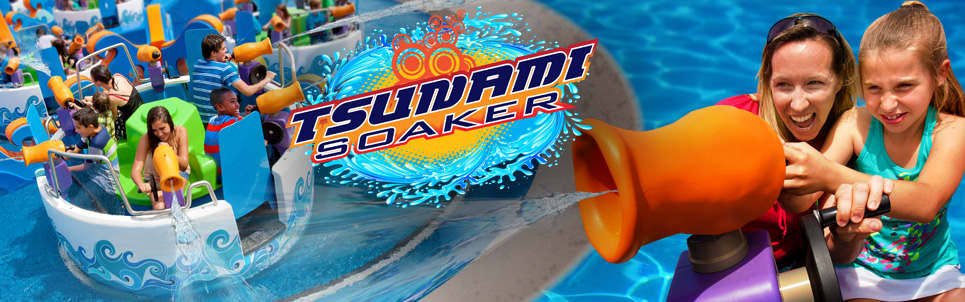
The ride is deceptively simple: Four turntables (one large, three small) sink down into water when the ride begins and slowly rotate. Riders are seated in “barrels” that actually float, as they “battle” other riders, those waiting in line and would be passerby’s with water guns attached to their barrels.
As soon as the ride cycle starts, the entire platform sinks, revealing the water though the grated platform. From there – the best I can describe it is this: ALL HELL BREAKS LOOSE. Water is flying literally everywhere – even the ride operator’s booth isn’t out of the firing line.
Part of the cool interactivity of the ride is the fact that you can still cool off – even if you never go on the ride. Five water guns are stationed outside of the ride’s fence, allowing non-riders to soak those on the ride. Just remember, you’re in range of the guns on the ride, too. You can even nail people waiting in line – which should be interesting to watch if people begin stampeding to try and stay dry.
And don’t let the small streams of water fool you – you will get soaked on this ride, there is no “wet.”
That being said, there are some minor flaws. All of the Great American Thrills team that day noticed a lack of a “long enough” queue line for the ride, which is bound to spill would-be riders into the midway.
I also imagine it’s a matter of time before the ride is modified, to include some form of seatbelt or restraint. Many riders on Media Day were seen standing up or switching seats to avoid the watery blasts. While riders were always safe and secure inside their barrels – most parks would rather you be COMPLETELY secured…in your seat.
The ride cycle is also quite long (this is a complaint?!?) but there’s a reason why this point ends up here. You see, all of the ride’s “guns” are built for right-handed people. We found that we had tired out from the one arm firing about halfway through the cycle (as did many of the other riders).
That being said, the long ride time also ensures no one will leave the ride dry. Scratch that – the ride’s cycle length ensures no one leaves the ride that isn’t drenched. Even with only one-fourth of the seats occupied, the entire Great American Thrills team was soaked to the bone. I can’t imagine how quickly you’ll be drenched when this ride is operating at full capacity.
Despite my qualms (and I’m a picky person), Tsunami Soaker is the perfect “family flat ride” that Discovery Kingdom desperately needed. It will be a welcome relief during the summer and if you bring an extra set of clothes. (You can always use the air dryer that’s now conveniently located at the ride exit too – though it’ll cost you $5.00 for three minutes).
WORD OF WARNING: Get a locker before going on this ride. Any electronic device is NOT safe from the inevitable drenching in your pocket, or in a backpack or other bay lying on the side of the ride.
Six Flags Wins Court Order To Ban “Animal-Rights” Protests From Property
If you’ve visited Six Flags Discovery Kingdom this year, odds are a group of animal-rights activists were there too, trying to pass out leaflets and dissuade you from entering the park.
Well, you won’t have to worry about them interrupting your day, at least for now.
According to the Times Herald, a Judge has ruled that the protests (if they occur) can only be done from the sidewalk of the park – not on park property, as they were being done prior to this injunction.
The activists are angry over what they claim is “mistreatment” of animals in captivity at the park. Activists have also claimed that this captivity has lead to premature deaths of animals, something the park strongly denies.
The protests were already a distraction outside the gates, when Deborah Classen and Janet Locke purchased season tickets to the park, for the sole purpose of handing out leaflets inside the park, hoping to disrupt park operations. The passes were officially revoked on April 13, according to court documents.
But, this is not the end of the saga – Six Flags’ corporate offices are still looking to get permanent injunctions against the activists, to prevent similar incidents in the future.
Now, in all fairness – I have yet to see the controversial film, “Blackfish,” which has been used as a rallying call for animal-rights activists over the past year. The film has certainly done a good job of polarizing people, however: it entrenches people who already had a strong opinion on either side of the argument. From my sources in the industry, serious questions have been raised about how it was produced, and the lack of the “other side” being presented.
I have also seen how many of the animals have been treated at this park, behind the scenes. I have never seen anything that these activists call “mistreatment.” In fact, I have only seen a caring, nurturing environment fostered by the park and it’s animal handlers. Many are deeply bonded with the animals under their care – and that relationship is clear from my interactions with them both in the past, and through the present.
No matter what your opinion or thoughts on the topic, the fact of the matter is this: You can’t do whatever you want on private property, that’s why it’s called PRIVATE property. I look forward to waving at the protesters as I happily drive into the parking lot of the park, soon.
Disneyland Ticket Prices Increase, Suspends Sales of Annual Pass

Following suit of it’s Florida parks, Disneyland today unveiled several changes to it’s pricing that has set the internet fandom ablaze with anger.
Single day, single park ticket prices were raised $4.00, to $96.00 per person over the age of 10. In addition, most park hopper tickets and annual passes were raised around 10% across the board.
Now, I’ve written before about the increases at Disney World – and how they’re actually a bargain when you consider the fact that Disney bundles their services, unlike other parks that charge separately for everything. (Think airline fares). But, Disney also dropped a bomb on SoCal residents, saying they won’t be selling any NEW Annual Passes to Southern California residents this year.
Why only Southern California? Because Disneyland has for years, offered discounted passes to residents of specific zip codes in the area. (Call it a “Sorry for interrupting your dinner with fireworks every night” discount). Effectively, the Resort needs to somehow mitigate the already large crowds in their parks. But, is this the best way to do it? Here’s my thoughts:
Firstly, there’s only have one person to blame for this problem of gluttony…Disney Marketing Executives.
Years ago, Disneyland was a destination resort – a place you went to once in a great while. My family always joked, “We’re due back for a trip to Disneyland, it’s been 10 years.
However, the culture has changed – and Disneyland tried to adapt with it. The park is now popular with two separate and very different clientele: the Annual Passholder and the Destination Tourist. Disney plays to these uber fans (and you have to be to pay $700 a year to go to the park) with merchandise, discounts and even conferences (D23). When you combine those two different types of people at a park, you get crowds. Lots and lots of crowds.
Gone are the days of “slower” operations – because the AP’s go on those days to avoid the tourists. When the kids are out of school, the AP’s stay away because the tourists are in the park en masse.
What a perfect “problem” to have!
Now, generally, Disneyland has some of the fastest, most efficient operations in the world when it comes to pumping people through rides. But there’s only so much you can do when the park is at capacity – during the middle of the week. At a certain point, you just can’t bring more people into the park.
So, what would be my solution? Eliminate the discount on Southern California passes. The difference in cost can be easily made up by those who will undoubtedly renew their pass, year after year, despite any price increases.
Or, go back to ticket books and limit the number of people allowed into the park on any given day. Basically, don’t guarantee admission until you’re in the park. The earlier people get there, the more they’re going to spend, anyway.
Folks, Disneyland is a fantastic place to have a few days of fun. The real secret to the magic – is that you have to pay up front, to not worry about anything else once you’re inside. So suck it up…the State of California isn’t making operating a park in the state any cheaper – so guess who gets to pay the difference…you guessed it – you and me.
Bolliger and Mabillard the Cadillac of Roller Coasters

There are many different coaster manufacturers, some build small rides, others build massive ones. But none have the mystique and prestige of Bolliger & Mabillard. Their factory in Ohio is shrouded in secrecy – it’s practically the “Willy Wonka Chocolate Factory” of the coaster world:

Even their logo is simple – just like how they design their rides, with simplicity in mind.
So, why are their rides always so much more expensive than others? And why all the prestige? Three words: quality, reliability and safety.
1.) Quality –
A B&M coaster is unmistakable, even from a distance. Their trademark “roar” grabs your attention – and their boxy track looks beefier than other manufacturers – because quite simply, it is!

By hugging the outside of the rails, B&M was able to tighten the tolerances of their wheels, making their rides incredibly smooth. Photo © Kris Rowberry
It is said that the tolerance, or distance between the rails and the wheels is never more than the thickness of a sheet of paper. Most other manufacturers have noticeable gaps in their wheels, or which spin after the ride stops. Not a B&M. That’s why they’re so much smoother than other steel coasters – they’re simply built better…now that’s Swiss precision!
2.) Reliability –
When a B&M coaster stops operating – never get out of line. 99% of the time, it’s a simple computer error that needs to be cleared. Even if it’s a minor mechanical issue – it doesn’t take long to fix. That’s because unlike other manufacturers who are overly reliant on electrical and hydraulic restraint systems – B&M continues to use the tried and true ratchet system – a system that is highly reliable and easy to repair. That’s why these stations are traditionally louder than others – it’s metal on metal contact.
3.) Safety –
B&M has always prided itself on efficiency – the four across seating model moved twice as many people as comparable coasters – but they did it with without sacrificing safety, in fact – they increased it.

Before B&M – no coaster had the ability to sit four people across a single row. This design innovation effectively doubled the capacity of other rides, while shortening the train. This decrease in forces allowed for tighter twists in the track. Photo © Kris Rowberry
This commitment to “getting it right the first time” has earned it’s most important asset: a flawless safety record.
You read right. B&M has never had a catastrophic failure or death on any of their coasters…EVER. (There have been three incidents involving people being hit by trains, but these were a result of guests trespassing on the infield, not a result of the ride or it’s manufacture.
B&M’s were one of the first to feature a redundant seat belt to backup their restraints – all without sacrificing the efficiency of the dispatches.
It is that sterling record that makes parks who choose B&M some of the safest in the world – and which commands such a higher price. Quite simply, you get what you pay for. This rings true not only in real life, but in the amusement world as well. A B&M coaster is like a new appliance – you can get the cheap-o model and save on the front end – or get the high-end model, and have it save you throughout it’s life.
A B&M is one of the best investments a park can make – so the next time track appears outside the factory in Ohio, cross your fingers it’s being delivered to your favorite park.
“Lost Parks” filming in San Francisco Friday
“Giddy” doesn’t begin to describe the thrill we get when we’re chasing down our local history. It’s more like “ecstatic.”
We’ve been given the rare opportunity to see a piece of San Francisco history – buried and forgotten for decades – so why exactly are we hunting down a 40 ton pipe organ? (And how do you bury something that big in a city that’s only 49 sq. miles?) After all, this isn’t “Lost Churches of Northern California,” right?
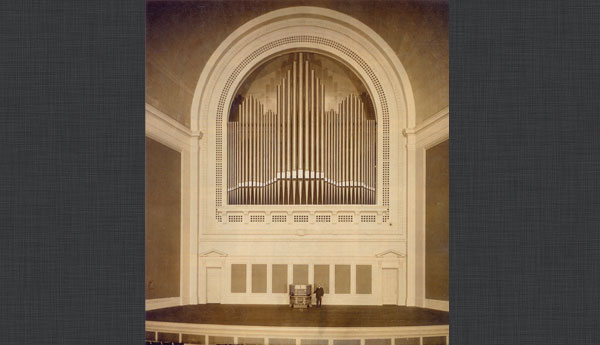
Behind the row of visible facade pipes, lies 39 tons of additional musical instrument!
Well, you’ll just have to follow us on social media for live updates throughout the day today and stay tuned for the debut of our second season, with the 1915 Pan Pacific episode debuting around Memorial Day!
Huell Howser would be proud – and jealous.
Giant Dipper Roller Coaster Turns 90 Years Old
When you think of Santa Cruz, odds are it’s image is one of the first you’ll conjure. And this weekend, the Grand Old Lady of Santa Cruz will celebrate a milestone birthday.
This Saturday, the Giant Dipper join only a small pantheon of rides in the world by turning 90 years old.
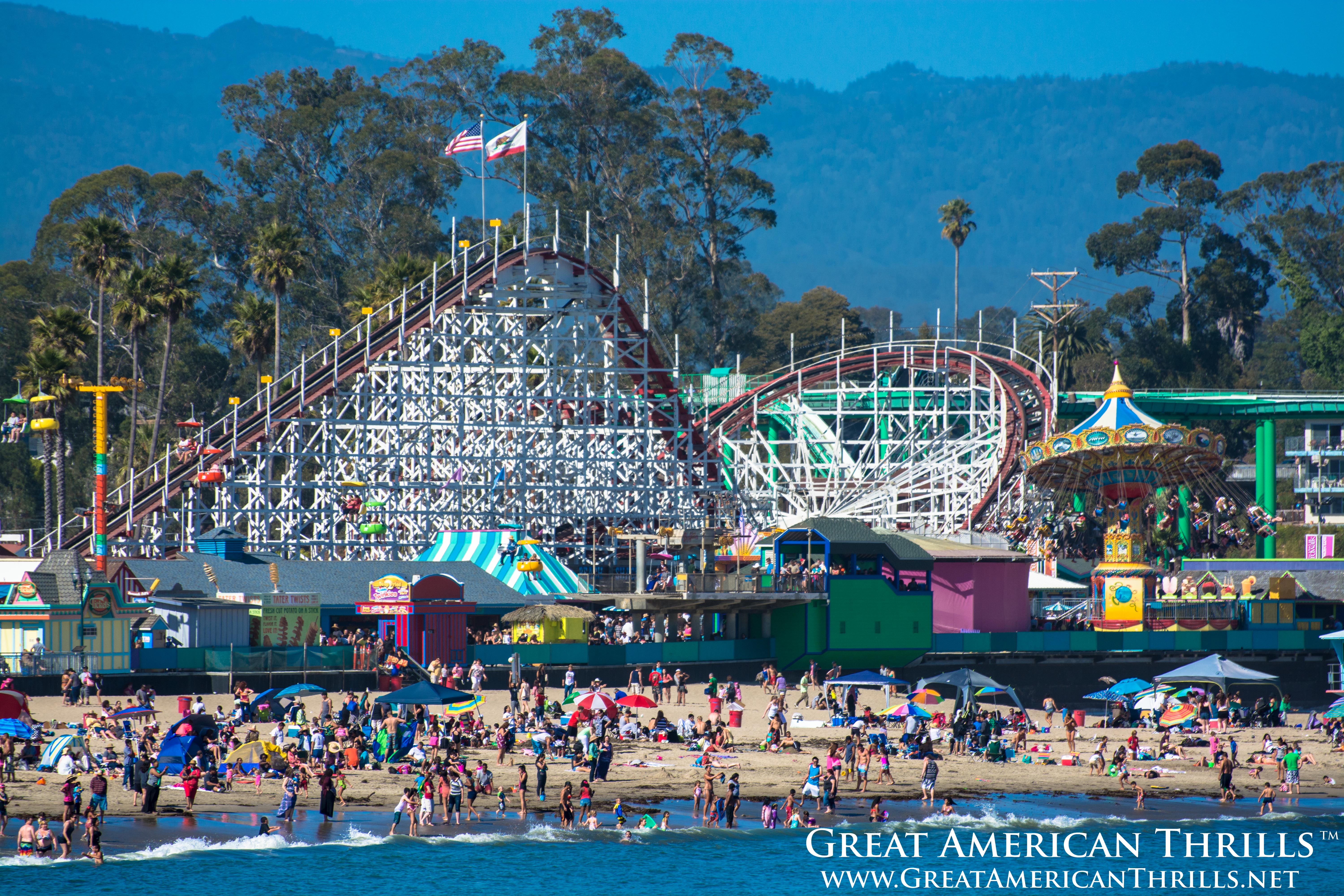
The idyllic location of the ride only amplifies it’s sensations. Photo © Kris Rowberry
An icon of coaster-dom, the Giant Dipper harks back to a different era – the so-called, “Golden Age” of wooden coasters and parks, where everyone had to build a bigger, faster, more intense ride than their neighbors. And to think it was built for only $50,000 back in 1924…
Now, most people will inevitably say, “Well, if its 90 years old – that wood is all 90, too!” But, that’s simply not the case. The reason wooden coasters seem to last forever, is because they’re constantly being replaced, piece by piece. Odds are, none of the wood on the ride is original to 1924 – but it certainly adds to the mystique.
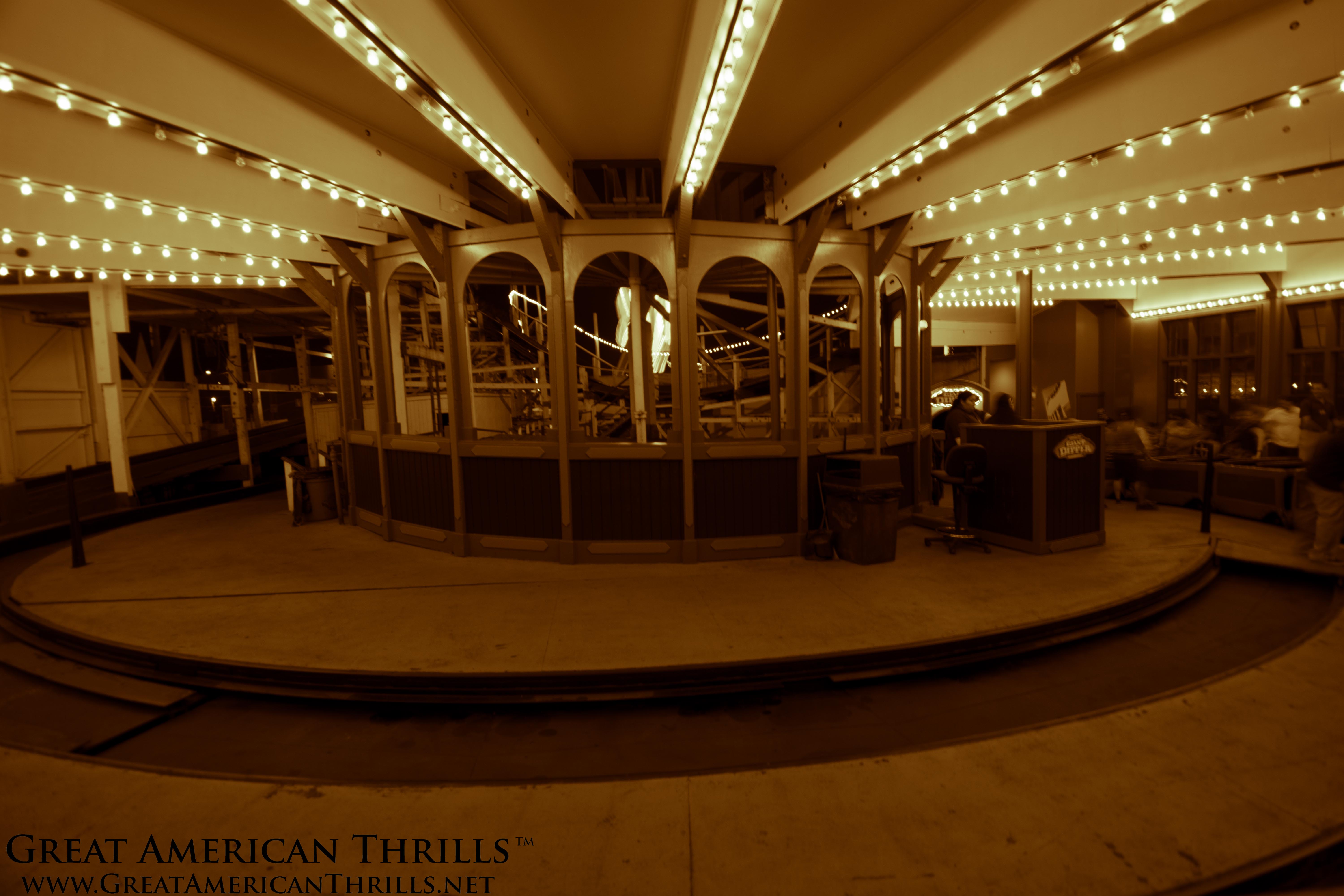
The unique, curved station was a necessity due to the layout of the ride – and is one of a handful of coasters that is manually braked (via a computer panel). Photo © Kris Rowberry
Around half a mile long, and only 70 feet high – the ride is dwarfed by others these days. In fact, a “lost park” in San Mateo bested the height of this coaster by ten feet, three years earlier. And yet – something about this ride makes it special. What is that “X” factor? Well, isn’t it obvious? Unlike the modern thrills of today (and nothing against them) but this ride has a soul…old in age, but perennially young at heart.
Countless celebrities have ridden the coaster, all with their own unique take on the thrill. Just walking up to the station provides riders with a glimpse back into what made this ride not only a local legend – but an international destination.

The station is a study in history – old articles and fun facts adorn it’s curved surfaces. Photo © Kris Rowberry
Featured in many films and countless advertisements, the Giant Dipper is one of only two roller coasters given the honor of National Historic Landmark (The other being the Coney Island Cyclone).
Those who have never ridden are always shocked by the kick thei old girl can dish out – and *SPOILER ALERT* that kick starts well before the lift hill! In turning 90, the ride is not only a survivor, it is also a legend. A defiant vestige of times gone by and never to return.
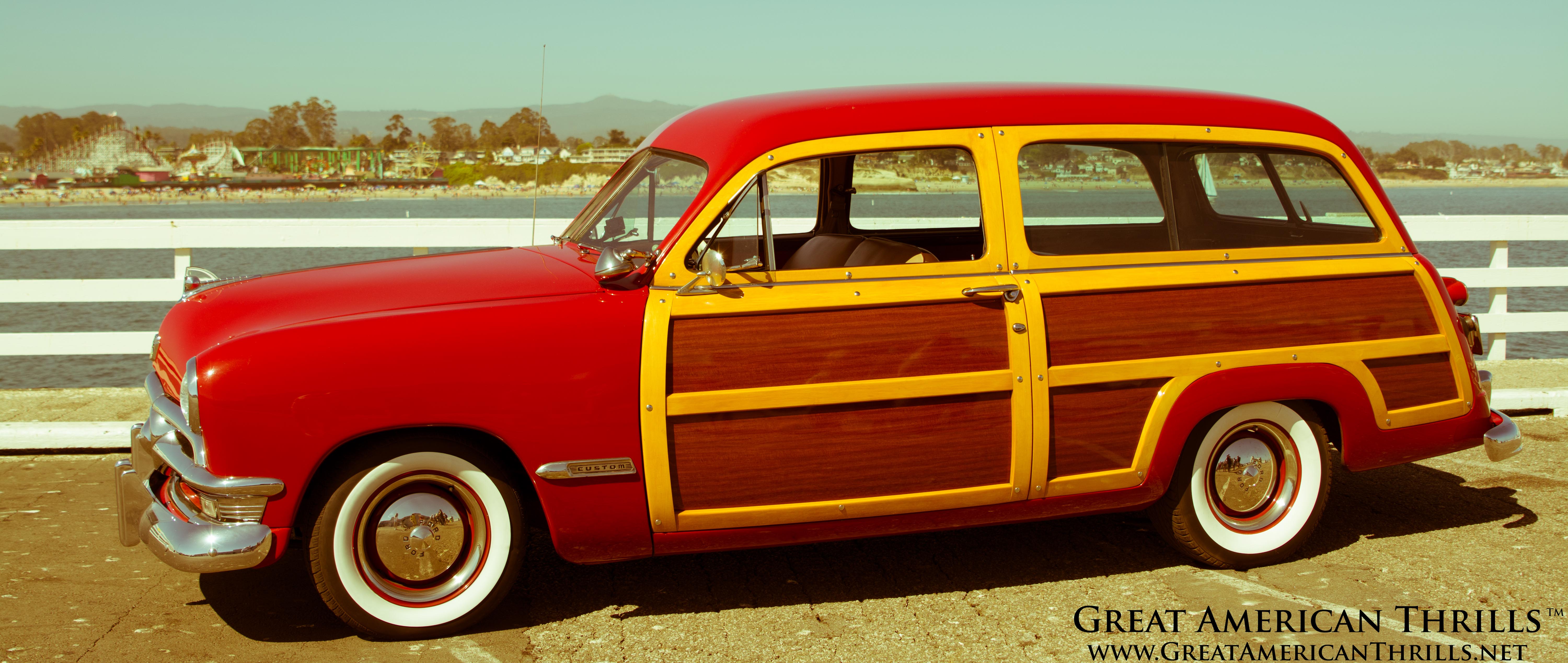
Timeless doesn’t even begin to describe this ride. By the way, this photo was taken in 2013. Photo © Kris Rowberry
So how did this ride survive the Great Depression, two World Wars and thousands of minor (and one major) earthquake? It’s the ownership – the Canfield Family, specifically. They’ve owed the Boardwalk since there was a Boardwalk – and nostalgia has been their best souvenir. I’m glad to be among the ranks that get to enjoy this ride each and every year.
There’s not many things that different generations have enjoyed together. Thankfully, the venerable Giant Dipper is one that will continue to thrill millions, for generations to come.
Cool Theme Park Video Contest
Do you enjoy making amusement / theme park videos? Want to win some awesome prizes? Then why not enter the Six Flags St. Louis “I Got Tsunami Soaked” video contest!
Just upload your video on how you’re preparing for the Tsunami Soaker, send the park a Tweet using hashtag: #IGotTsunamiSoaked and that’s it! Whoever receives the most RT’s wins! Deadline is May 20th, but get your entries in early for the best chance of going viral.
I visited the park last summer – and let me tell you, if you’ve never visited – it reminded me of Magic Mountain, if it were more beautiful and much more humid 🙂
North Korea’s Great America?
Imitation is the highest form of flattery, right? Well, sometimes it’s not flattering – it’s just blatantly ripping off. Case in point: Kaeson Youth park in North Korea. Now, I’m pretty familiar with both entrances to the two Great America’s here in the United States (they were built as twin parks after all, back in the mid 1970’s…) They both feature a unique, double-decker carousel, which is actually just one carousel with two individual decks.
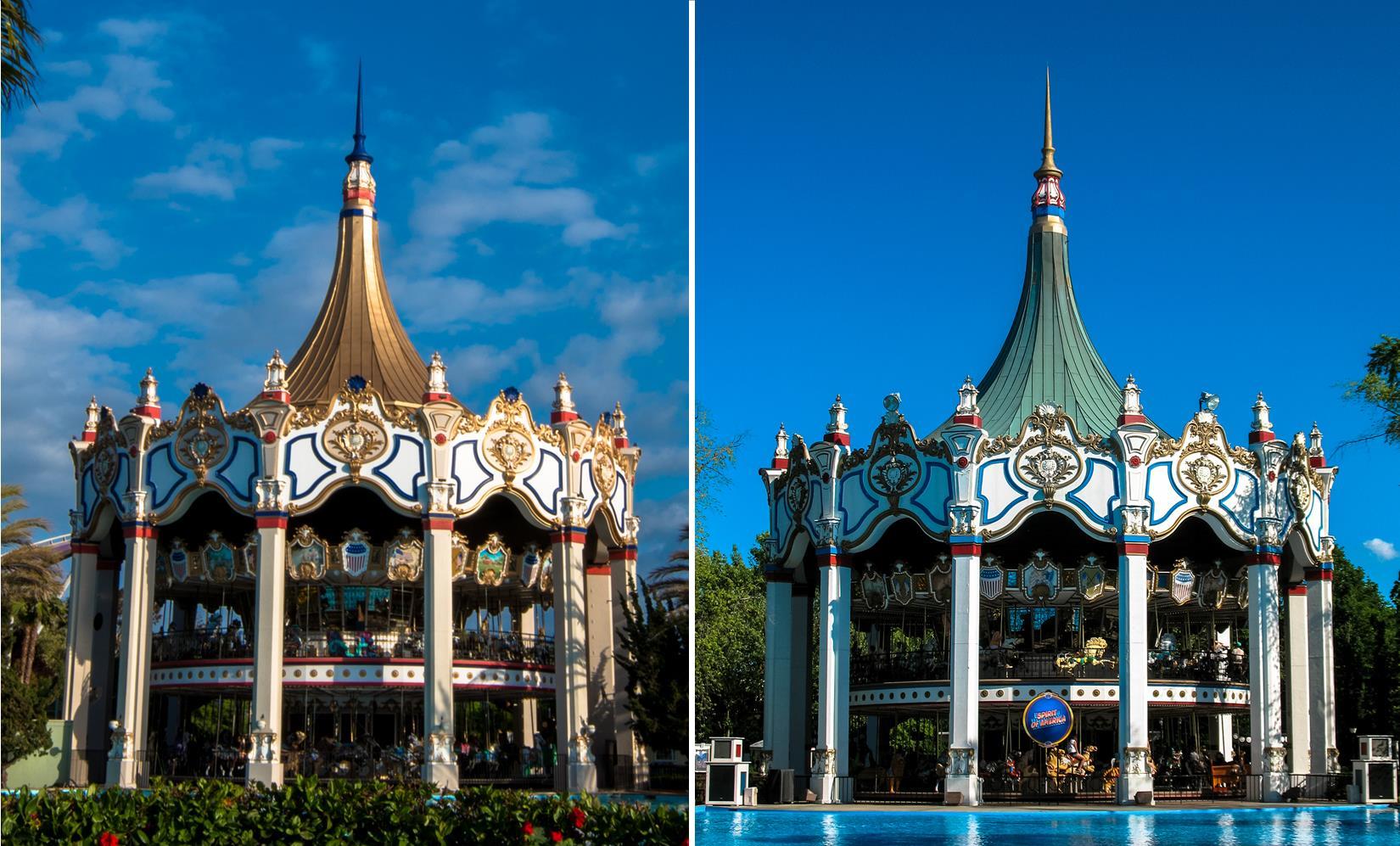
Santa Clara’s (left) and Gurnee’s (right) nearly twin carousels. Santa Clara’s is a foot higher, but the perspective is off due to non-matching focal lengths. Photos © 2008 & 2013, Kris Rowberry.
And apparently, someone who was allowed to make decisions in North Korea was familiar with the (almost) twin carousels, too. So much so, they decided to pluck it . The similarities are just uncanny – and with the worn-down look of the Korean park, it’s downright EERIE:

This is why knock-offs are never better than the original – no matter what the price!
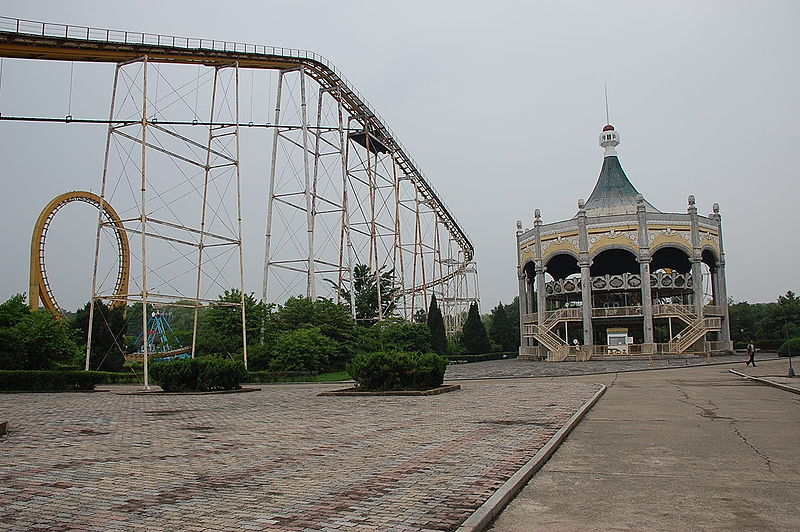
At least they got the staircases right – albeit, they put them in the front instead of the rear…wait – where IS the front?!?
This just goes to show the impact of Randall Duell’s design – a ride as iconic as Carousel Columbia was actually copied (albeit badly) thousands of miles away. Just don’t get me started on the abnormally long first drop of the coaster next to it – that’ll be for another post!
New Lost Parks Trailer for 1915 Pan Pacific Exposition

Yes, it’s been awhile since our last episode of “Lost Parks of Northern California” but I can assure you – the wait is worth it.
Presenting the first teaser trailer for our next episode, the 1915 San Francisco Pan Pacific Exposition (World’s Fair). We expect to wrap on the episode and debut it before #CoasterCon this summer.
If you’re a fan of amusement parks, roller coasters, history, organs and trains – you cannot afford to miss this episode!
Follow the journey by searching #LostParks on your favorite social media network!
RollerCoaster Tycoon Celebrates 15th Anniversary
Today marks the 15th anniversary of the first release of “RollerCoaster Tycoon” – arguably one of the most popular simulator games of all time. It also marks a milestone – millions of hours wasted playing the game by it’s combined players…

The original RollerCoaster Tycoon box.
Take yourself back a decade and a half…the only true simulator game that was commercially available was “SimCity” – but it’s time on the top was soon to be ended.
An unknown Scottish designer, named Chris Sawyer partnered with artist Simon Foster and composer Allister Brimble to create the game-changing simulator. Famed ride designer, John Wardley was even brought on as a special consultant.

Scottish developer, Chris Sawyer, developed and worked significantly on both RCT and RCT2.
Like many park fans, I was introduced to this program via a free, downloadable demo, that had a time limit and did not have the ability to save games.
The game allows players to either create an entire amusement park from scratch, or build up and maintain an existing park, within a set of pre-determined parameters.

The cartoon-like look hid the fact that real world physics were at play behind-the-scenes in the code.
It also featured an easy-to-understand user interface, which allowed even the most novice of players to step immediately into gameplay.
While initially a commercial flop – word spread quickly through the amusement fan community, who in turn told their friends about the quirky and addictive game, and it soon became a sleeper hit. There are three “versions” of the game, with expansion packs for each one.
Atari recently announced a fourth “sequel” to the original, dubbed “RollerCoaster Tycoon 4.” It will be released for iOS devices in summer, 2014.
The mark of a good game is the length of it’s shelf life. With many people still playing the original version, RollerCoaster Tycoon has stood the test of time – and is still going strong. Even with new rivals popping up, such as NoLimits and Theme Park Studio, RollerCoaster Tycoon continues to hold a significant audience, when many other games gave gone the way of the Dodo.
Heck, there was even a RollerCoaster Tycoon pinball machine – endorsed by the American Coaster Enthusiasts, no less! Not too many brands can brag about that:

Photo by http://www.CoasterImage.com
In addition, many variants of the “tycoon” style of game have popped up since the initial release of the original RollerCoaster Tycoon. Games such as Prison Tycoon, Railroad Tycoon are among just a few to enter the market. Even SimCity tried to get back into the fray, with the poorly received “Sim Theme Park.”
Special thanks to Lost Parks producer, Nicholas Laschkewitsch for suggesting this post! Got a good post idea? Feel free to send it in!
Universal Studios “Earthquake” Inspired by Bay Area Rapid Transit
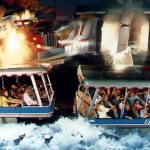
If you’ve been to Universal Studios in Hollywood, the odds are pretty good you’ve taken the famous “Studio Tour.” A mainstay of this attraction since 1988, “Earthquake: The Big One” allows unsuspecting tourists to experience a simulated magnitude 8.3 tremor.

Photo illustration by Universal Studios Hollywood
Speaking from experience – it’s more like a solid 5.0 to me – but I digress.
Anyone who’s lived in the Bay Area however, will take note that the show in Soundstage 50 show might seem a bit TOO familiar to them. That’s because the designers of this attraction took many pains to recreate a Bay Area Rapid Transit (BART) station.
Now, by today’s standards – the effects are okay, but dated. Maybe it was just me as a kid, but I seem to remember things happening a LOT faster back in the day. What I’ve always wanted to do, though – is experience the show like this video depicts, with full cinematic effects going and a cast. Oh, and at 24 frames per second, so it’s more dramatic. Cost prohibitive? Most definitely. Bad ass and awesome? You better believe it:
Notice how they got the train right, and the station’s “Brutalist” style architecture? Heck, they even got the BART horn just about right, too! Note all the similarities in this, the SFO station built in the 1990’s:
So the next time you’re at Universal Studios Hollywood – take a CLOSER look at Earthquake: The Big One. And the next time you’re in a BART station in the Bay Area – pray for no major quakes.
Protect Your B-Roll Videos
Before the advent of the internet (and subsequently, high speed internet speeds), amusement parks would send out “b-roll” or simply put, “generic footage” of either their park or a certain ride, so that news outlets could use it in stories, most notably, to promote a new attraction that is opening up.
Fast forward to today’s “connected world” and parks continue to send out these videos, only it’s now done mostly via social media, YouTube or their own webpages.
Subsequently, many people have taken these videos and spread them via their own accounts, which helps spread the word about the new attraction or offering. (It’s also known as a “Viral Effect.”) Exactly what the park wanted, right?
Well, not quite.
You see, there’s a new epidemic going around these days, called “MONETIZATION.” That’s where users take these readily available videos and cash in on them – and it’s costing your park some serious money.
How? Check it out:
1.) Your park hires a production company to come out and professionally film and edit a good promotional video for your park or, you pay an employee to do the same on your payroll.
2.) The video is uploaded to your social media accounts and YouTube channel.
3.) The video is liked, commented on and shared by users on social media via “SHARE” buttons, thereby promoting the product / service.
Now here’s where the ecosystem turns illegal:
4.) Some users will then download (also known as “rip”) your video off of YouTube, then re-uploaded onto their personal account. The video is then is “monetized,” which means ads are shown in order to make money for the user for every view it receives.
“But it’s not that bad – at least my message is getting out there, right?”
As harmless as it may seem, the investment you made to help promote the park is in fact, now directly making money for someone else, who didn’t contribute a dime to it’s production nor asked for permission to use it for their own account. Simply put…that’s copyright infringement, folks.
Would you feel the same if you set up a photo shoot, took a stunning photo, then had it sold repeatedly online thousands of time, without you ever being paid for it?
YouTube Terms of Service (TOS) requires that:
“Your video is not eligible for monetization if it contains content that you didn’t create or get permission from its creator to use. You need to be able to show written permission for the following video elements:
- Audio: copyrighted sound recordings, live performances, background music, etc.
- Visuals: images, logos, software, video game footage, etc.
- Any other content you don’t own worldwide commercial usage rights to.”
We’re pretty sure user “CoastersCoastersCoasters” didn’t create that beautiful Six Flags new ride announcement video on their own…let alone pay for it.
Here’s some more food for thought – YouTube has many “Super Users” who actually make a living off of monetized videos. Are you comfortable with providing direct income to them, without them working for you? I didn’t think so.
So, how can you prevent this?
Start by adding a watermark to your video. It’s actually relatively simple even with rudimentary editing software – and any professional and/or legitimate production company hired by you should be able to accommodate this request without any problems. This will ensure that people know YOU own this content, not others.
Secondly, you’ll need to do some legwork on YouTube, but it’s fairly easy. Just do a search for your video every now and then, and see what pops up. Considering any illegal copies of your video will be similarly named to yours for SEO – that’s easy enough to spot.
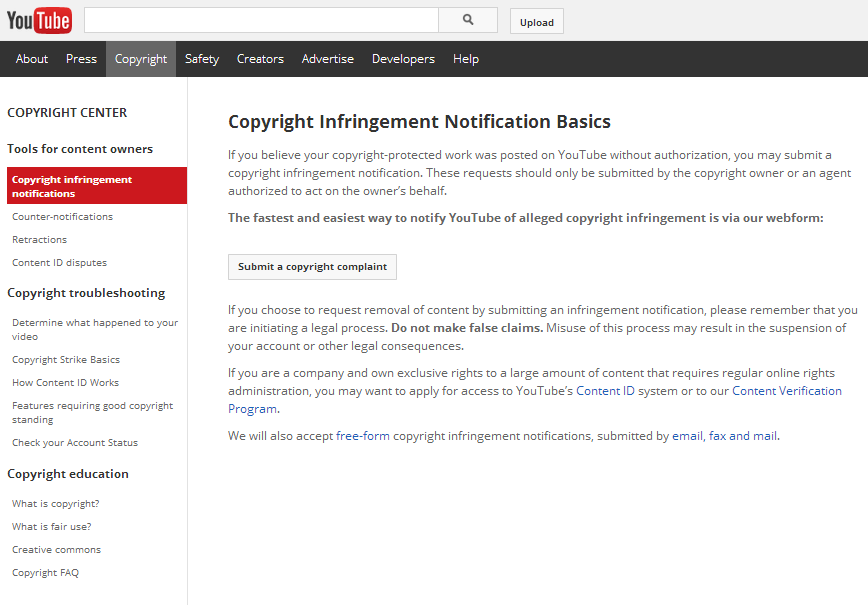
The reporting from for copyright infringement on YouTube is vastly streamlined compared to a DCMA takedown notice – and hits infringers in the wallet, where it hurts the most.
Thirdly, WHEN you find an offending video, report it. Ever since the Digital Millennium Copyright Act, or DMCA was passed, YouTube and other social content sources have been very good at taking down content owned by others, especially when a formal complaint is filed. You can begin that process here: https://www.youtube.com/yt/copyright/copyright-complaint.html
Then, go into your media list and purge it of any contacts you’ve found to be doing more harm than good. It makes no sense to keep inviting people to press events if all they’re doing is stealing from under your nose.
As a victim of copyright infringement in the past, I can tell you that prompt, succinct action is the best course of action. While trying to be nice and extending an olive branch is always a nice thought – it’s not always the best way to end the problem permanently. Repeat offenders do just that – repeat.
Together, we can stamp out copyright infringement and eradicate the epidemic of monetization…together!
Review my prior posts about “Social Media and the Amusement Park” here.
About the Author:
Kris Rowberry has been following the amusement industry for over 15 years. He is the creator and host of both “The Lost Parks of Northern California” and “Great American Thrills®“
Disney World admission price increases – but is it really that expensive?
This week, the amusement fan community and even the national media gravitated to the news that Walt Disney World was increasing their single day, admission prices to $99 at the Magic Kingdom. It was the second price hike in less than 12 months for the Florida resort.
Now, most people who read the story probably thought the same thing: HOLY CRAP – IT’S $100 DAMN DOLLARS TO GO TO DISNEY WORLD FOR A SINGLE DAY?!?
However, there are a few factors that most sources (and most viewers) probably didn’t take into consideration when the story broke. Let us then, consider the following:
A single day admission (purchased at the main entrance to the park):
Disney World: $99.00
Six Flags Over Texas: $64.99
Cedar Point: $54.99
So, “apples to apples,” Disney seems wildly overpriced, right? Well – first we have to ask if it’s really an “apples to apples” comparison. There’s one thing that most folks don’t take into account when price-comparing parks – it’s their line management programs (AKA “fast pass” systems).
Disney offers their “Fastpass” system free of charge, (built into the cost of admission, regardless of length of ticket) to all guests with a valid ticket on all of their operating “e-Ticket” attractions as well as many others. (The only constraint is how many you can hold at one time). Both Six Flags Over Texas and Cedar Point also offer their own version of a line management system (dubbed “The FLASH Pass” and “Fast Lane,” respectively). However, they are generally limited to set number of attractions or rides per ticket.
And unlike Disney, both chains charge additional fees for this service. Six Flags has three different tiers of pricing, ranging from $40 to $90 per guest, while Cedar Point offers two tiers of pricing, ranging from $75 to $90).
With that in mind, let’s now see how much each park is really costing you, “apples to apples”:
Disney World: $99.00
Six Flags Over Texas: $104.99 – $154.99
Cedar Point: $129.99 – $144.99
*It should be noted – that all costs in this comparison are calculated at the single person rate.
With the extra service of a “fast pass” system on some of their major rides, we can see that a trip to the Magic Kingdom is actually still quite competitive with other parks around the country – in fact – you’re getting MORE for your money on a single day admission.
Spread it out over several days, and the Disney price drops even further, whereas at Cedar Point and Six Flags, you’ll need to pay full price for their “fast pass” systems each and every time you go.
Now, this comparison does not take into account a season pass which – depending on the number of times visiting the park – can dramatically reduce these prices. But, considering most people visit Disney only once a year (or less in my case) then we’ve assumed folks will visit these regional parks the same amount of times per year.
What do you think? Was Disney out of order for raising prices twice in a single year? Do you use “fast pass” systems at parks OTHER than Disney? Why or why not? Leave me a comment below and tell me what YOU think!
Could Cedar Fair offer a “California Season Pass” instead of a Platinum Pass?
I travel fairly often to visit amusement and theme parks – that’s no secret. But I’m also a big fan of getting the most bang for my buck, especially in this economy. Case in point:
Cedar Fair, L.P. currently offers three different levels, or tiers of season passes:
Your standard SEASON pass, which gets you admission into a single park.
The GOLD Pass, which in NorCal gets you admission to: California’s Great America, Halloween Haunt, Gilroy Gardens and free parking at each park.
And finally, the PLATINUM Pass, which gets you admission and free parking to ALL the Cedar Fair owned parks.
Most of us in California, however – never get a chance to leave the Golden State, which makes upgrading to a PLATINUM pass very cost prohibitive, considering the next closest Cedar Fair park besides Knott’s – is World’s of Fun…in Missouri.

That’s a long road trip to use your Platinum Pass to it’s maximum potential.
That being said, I believe there’s room for Cedar Fair to debut a fourth tier of passes – the CALIFORNIA Pass.
It could be positioned between the GOLD and PLATINUM passes, in terms of perks and pricing. In addition to all the benefits of a GOLD pass, it would also get you admission and parking at Knott’s Berry Farm and Soak City Water Park.
Now for most people, this doesn’t seem like much to add for it’s own tier – but since the West Coast parks are so far separated from the rest of the chain in terms of distance and topography, most California park fans are content to stay IN the state and will never be able to get the full benefits out of a PLATINUM pass, unlike their counterparts in the Midwest and on the East Coast, where parks are only a drive’s day (or less) away.
As a result, they may not upgrade to the higher cost tier, and forgo even visiting the other parks in California, where they could be spending money. Of course, on the flip side, if a CALIFORNIA pass was added, I know that I’d be much more willing to upgrade to it and happily drive more often to SoCal to get my Xcelerator and Monte fixes MUCH more often.

Xcelerator at Knott’s Berry Farm. Photo by Kris Rowberry. All rights reserved.
What do you think – would YOU purchase a CALIFORNIA pass if it was offered? Leave your thoughts in the comment section below, or reach out to us on our SOCIAL MEDIA pages, too!
Beverly Hills Cop 3 Filmed at Great America 20 Years Ago

The mid-nineties were awesome. Nickelodeon was just hitting its stride. The Soviet Union was no more. And a movie studio had just purchased the entire Kings Entertainment amusement park empire – with the intention of turning them into THEME parks.
With Paramount at the helm, the former Kings parks became valuable assets in terms of new shooting locations for films. Considering the advertising slogan at the time, “Where the magic of the movies meets the thrills of a lifetime” – it would only make sense that a feature film would eventually be made inside one of Paramount’s parks.
And in 1994, that’s exactly what happened at Great America. Coincidentally, a film was being pitched to the major L.A. studios at the same time. Essentially, it was “Die Hard,” but at an amusement park. Paramount looked to their stable of franchises to see if the concept would work, and they found their answer with, “Beverly Hills Cop 3.”
The film is all but forgettable when it comes to plot – and its effect on the cinema landscape is minimal at best. In fact, it only has a 10% “fresh” rating on Rotten Tomatoes. It was also a flop at the box office, losing $8 million domestically. It eventually made money after being released worldwide – but was still the least successful of the three “Beverly Hills Cop” films.
However, if you’re a fan of California’s Great America…it’s a literal time capsule into the Santa Clara park at the beginning of the Paramount-era. The scenic railway is still there, Vortex is still green! But arguably, the most memorable scene in the film features one of the most beloved attractions to ever grace the Great American skyline.
In it, Axel attempts to escape pursuing Wonder World security guards by jumping onto “the Spider” a large, three-armed Ferris Wheel that us locals know better as the “Triple Wheel.” (Gurnee fans know it as the “Sky Whirl”) However, one of the ride cabins begins to come loose, with two young children trapped inside.
Axel somehow exits his locked cabin, (through the magic of Hollywood) and slides down to the hub of the ride. From there, he ascends up the other arm, rescues the children and rappels down to the ground, just moments before the cabin smashes down.
Sharp eyed viewers will spot famous film director, George Lucas in this scene as well.
As for the Triple Wheel, the constant starts and stops required to get these exciting scenes may have contributed to the ride’s early demise. The attraction was designed to run continuously throughout the day – and the necessary re-takes and repositions were hard on both the hydraulics and motors. The Triple Wheel was dismantled after the 1997 season, to make way for Invertigo, which itself was removed after the 2011 season.
Currently, the site of the ride remains empty, however it is used for “Friday Night Flicks” during the summer.

Photo by: California’s Great America
While the rumor mill is always churning out stories about new attractions coming to this area – long-time fans of both Great Americas always hold out hope that someday, they’ll round Hometown Square and hear that unmistakable whine in the park once again:
Inaugural #CoasterChat TONIGHT on Twitter!
Join the creator and host of Great American Thrills®, along with the creator of CoasterAddict.com, for the first ever #CoasterChat tweetup!
Many of us love roller coasters and the amusement parks that build them. Similarly, many of us also tweet…all of the time. Now, we hope to merge the two together on a weekly basis, discussing the latest news and topics surrounding the amusement park industry. We look forward to hearing all of your great ideas and enthusiastic candor!
So, how can YOU participate? It’s easy! Just log into Twitter around 6:00pm TONIGHT, and search for / follow the #CoasterChat hashtag – it’s that easy to join in on the fun – see you there, coaster fans!

Logo by: CoasterAddict.com
Six Flags scores viral hits on social media this off-season
Kudos to Six Flags for turning one of the worst winters EVER into one of the most entertaining – and keeping their followers on social media engaged during the long off-season:
First up, is Six Flags St. Louis…
After a bitter cold spell gripped the midwest, the marketing folks at the former Mid-America park decided to trudge through the snow to make a statement…and a brilliant one at that:
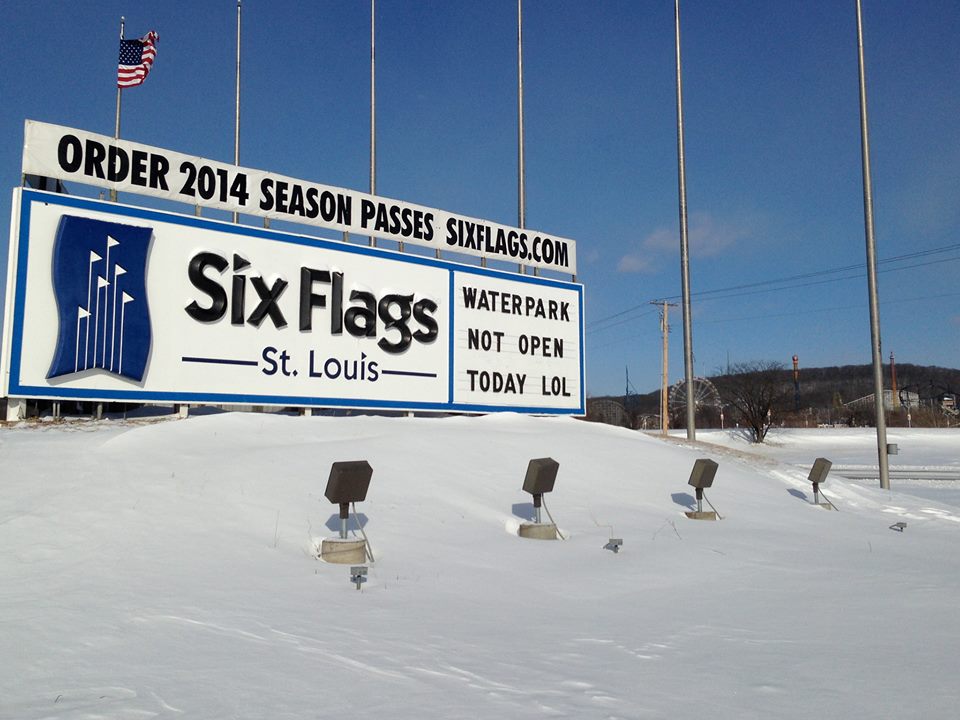
The folks in the marketing department deserve a raise just for changing the sign in those conditions!
Now, would it have been even funnier if they said the water park WAS open? Of course, but you have to imagine the marketing and ops folks would have had fits of people showing up, ready to take “bobsled runs” down those frozen, fiberglass slides.
Not to be outdone, this week, Six Flags Great America decided to have some fun with their own freeway advertising signage – this time invoking one of the greatest comedies (and certainly best park-related movies) of all time:
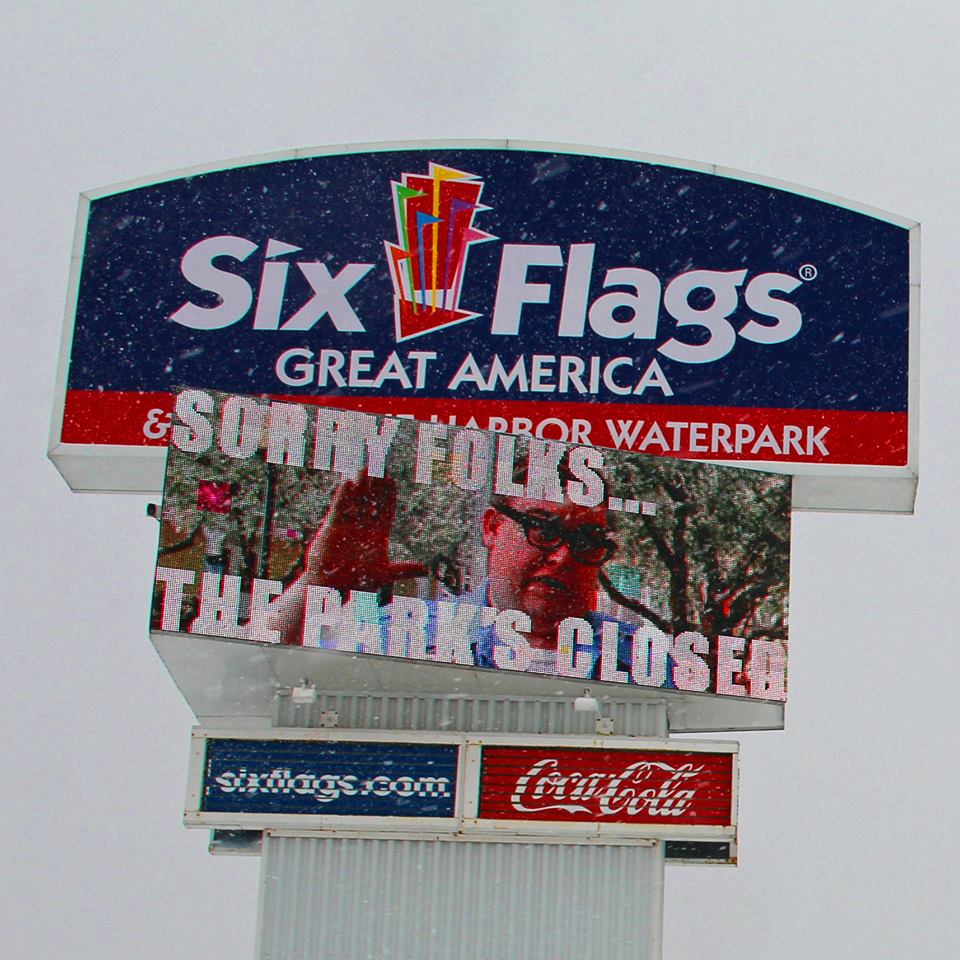
“The moose out front should have told you – that it’s colder here than in Alaska right now!”
Folks – this is what social media is all about – in each of these instances, fans and news outlets picked up on the post – and shared it across a wide swath of the internet. Even if you weren’t a fan of these parks…chances are you would have seen or HEARD about these posts if you lived near or around these parks.
And to think – this is all FREE PUBLICITY (and positive, too) is when the parks are CLOSED. Thousands of people are now talking about these parks – and you can bet some folks decided to go in on a season pass online, probably hoping for warmer weather to show up! 🙂
Again, that’s the name of the game on social media when you’re at an amusement park – don’t just throw out updates for the sake of throwing out updates (I.E. throwing crap on the wall and seeing what sticks) – curate excellent content, and it will inevitably lead to better engagement…which will lead to more butts passing through those turnstiles.
Review my prior posts about “Social Media and the Amusement Park” here.
About the Author:
Kris Rowberry has been following the amusement industry for over 15 years. He is the creator and host of both “The Lost Parks of Northern California” and “Great American Thrills®“
 Great American Thrills®